Rapid global spread, emerging variants, overwhelmed healthcare systems – these are just some of the devastating consequences an infectious disease can have. As a specialist in this field, you’ll help shape the global health landscape, investigating and managing infectious diseases.
Over one year (full-time) or two years (part-time / split-study), you’ll develop specialist skills and bridge the fields of epidemiology, laboratory sciences and public health. If you want to influence research, policy and control, this truly multi-disciplinary programme is the perfect match for you.
After core training in fundamental concepts of infectious diseases agents and their control, you will be able to tailor your studies through a range of modules to match your future career aspirations. The module choice encompasses disease agents such as Malaria, influenza, HIV, TB, neglected tropical diseases and many others along with approaches to their control.
What you will learn
- Grow critical knowledge in global health and infectious diseases, including investigating the transmission of endemic and epidemic infections
- Understand how to select appropriate methods of control, as well as designing, implementing and evaluating co-ordinated control programmes
- Discover the best ways to assess the constraints of local public health delivery systems
- Develop the skills to manage available resources in the context of the control of infectious diseases
- Explore the impact on particular geographical regions or specific diseases.
Each module is taught by experienced academic researchers of international standing often with global networks of collaborators that will benefit your studies. You’ll also hear from guest speakers covering topical issues, from climate change and health policy to case studies and emerging technologies applied to a variety of diseases.
To take your learning from taught theory to research, you’ll have the opportunity to develop your own research project from a wide range of topics related to infectious diseases. You’ll be able to tailor the topic to suit your professional interests guided by academics or overseas collaborators.
Many past students’ research projects are exceptional and have contributed directly to published research outputs and included exciting collaborations with public health, research organisations, or NGOs.
Who is it for?
Biological science graduates and scientists. Medical graduates and intercalating medical students, veterinarians, retraining NGO employees. However, we also accept some students who aspire to a new career in controlling infectious diseases.
The programme attracts applications from all over the world. Whatever your background, you’ll show a keen interest in infectious diseases and a desire to have influence in the field. You will study alongside a broad range of professionals from across the globe.
By the end of the course, you’ll be equipped with new specialist skills, and be prepared for a career in the control of infectious diseases. Past students are working across the world for a range of organisations, often in influential positions.
Our graduates work in education, health ministries, international disease control agencies and aid organisations. Malaria Consortium, Cancer Research UK or Public Health England are just a few of the employers who need graduates in this area. Perhaps you are keen to pursue an academic career through studying a PhD programme.
Duration
One year full-time or part-time/ split-study over two years. Ways to study explained.
Intercalating study
Find out about intercalating this programme.
Control of Infectious Diseases
Watch Programme Director Matthew Yeo talk about the programme.


Winston Lam
Control of Infectious Diseases

The below structure outlines the proposed modules for this programme. Programme and module specifications provide full details about the aims and objectives of each module, what you will study and how the module is assessed.
- Structure of the year
Term 1 (September - December) consists of ten teaching weeks for AB1 slot modules, plus one Reading Week* in the middle of the term. Followed by the Winter break.
Term 2 (January - March) consists of a further ten weeks of teaching for C and D slot modules, plus a Reading Week in the middle of the term. C modules are taught in five half-week blocks before Reading Week. D modules are taught in five half-week blocks after Reading Week. Followed by the Spring break.
Term 3 (April - September) consists of five weeks of teaching for E slot modules, taught in half-week blocks, and the project report.
*Reading Week is a week during term where no formal teaching takes place. It is a time for private study, preparing for assessments or attending study/computer skills workshops. There are two Reading Weeks at LSHTM: one in November and the other in February.
- Term 1
Students take two compulsory AB1 modules:
- Introduction to Disease Agents & Their Control
- Basic Statistics for Public Health & Policy
In addition, students take one of the following AB1 module combinations:
- Basic Epidemiology and Introduction to Health Economics and Health Policy, Process & Power (3 modules)
- Extended Epidemiology and Introduction to Health Economics or Health Policy, Process & Power (2 modules)
- Terms 2 and 3
Students take a total of five study modules, one from each timetable slot (C1, C2, D1, D2, E). The list below shows recommended modules. There are other optional modules which may be taken only after consultation with the Programme Director.
C1 slot
- Designing Disease Control Programmes
- Health Care Evaluation
- Malaria: From Science to Policy and Practice
C2 slot
- Conflict & Health
- Design & Analysis of Epidemiological Studies
- Diagnostic Bacteriology
- Population, Poverty and Environment
- Statistical Methods in Epidemiology
D1 slot
- Applied Communicable Disease Control
- Control of Sexually Transmitted Infections
- Current Issues in Maternal & Perinatal Health
- Economic Analysis for Health Policy
- Medical Anthropology and Public Health
- Spatial Epidemiology in Public Health
- Vector Sampling, Identification & Incrimination
- Water, Sanitation and Hygiene, and Health
D2 slot
- Epidemiology of Infectious Diseases
E slot
- Applying Public Health Principles
- HIV
- Integrated Vector Management
- Neglected Tropical Diseases
- Project report
During the summer months (July - August), students complete a research project studying aspects of an intervention programme, for submission by early September. If appropriate, this may take the form of an optional period in a relevant overseas location. Most students on this course undertake projects overseas. Students undertaking projects overseas will require additional funding of up to £1,500 to cover costs involved.
Please note: Should it be the case that you are unable to travel overseas or access laboratories in order to complete your project, you will be able to complete an alternative desk-based project allowing you to obtain your qualification within the original time frame. Alternatively, you will be able to defer your project to the following year.
Changes to the programme
LSHTM will seek to deliver this programme in accordance with the description set out on this programme page. However, there may be situations in which it is desirable or necessary for LSHTM to make changes in course provision, either before or after registration. For further information, please see our page on changes to courses.

| Fees 2026/27 | ||
|---|---|---|
| Home | Full-time | £14,250 |
| Part-time | £7,125 | |
| EU/Overseas | Full-time | £31,450 |
| Part-time | £15,725 |
*Mobile users, scroll right to view fees
Sources of funding:
In order to be admitted to an LSHTM master's degree programme, an applicant must:
- hold either a first degree at Second Class Honours (2:2) standard in a relevant discipline, or a degree in medicine recognised by the UK General Medical Council (GMC) for the purposes of practising medicine in the UK, or another degree of equivalent standard awarded by an overseas institution recognised by UK ENIC or the GMC.
or
- hold a professional qualification appropriate to the programme of study to be followed obtained by written examinations and judged by LSHTM to be equivalent to a Second Class Honours (2:2) degree or above.
or
- have relevant professional experience or training which is judged by LSHTM to be equivalent to a Second Class Honours (2:2) degree or above.
If you have not previously studied in the UK, you can check our guide to international equivalent qualifications for our master's degrees.
Additionally for the MSc Control of Infectious Diseases, some prior public health/overseas experience is advantageous and will be considered but is not necessarily a prerequisite for this course.
Applicants who do not meet the minimum entry requirement, but who have relevant professional experience may still be eligible for admission. Qualifications and experience will be assessed from the application.
English language requirements
If English is not your first language, you will need to meet these requirements: Band B.
Some applicants may be exempt if they have previously studied in English or meet other specified criteria. Please see our English language requirements for details.
It is possible to apply without English language test results however the results of a test may be listed as a condition of an offer of admission.
Intercalating students
This option is available for in-person MSc programmes. You will need the equivalent of a bachelor's degree to undertake a master's degree. This will usually require you to have a BSc degree or have completed the first three years of your medical degree. More information on intercalating a Master's at LSHTM.
Access and widening participation
At LSHTM we are committed to ensuring that excellent students feel encouraged to apply for a course of study with us. We have introduced an innovative contextual admissions system that is designed to support those students who have faced the greatest barriers to their learning. More information on widening participation at LSHTM.
Applications for this programme are currently closed. Register your interest to be notified when applications open for 2026/27 (early November).
Applications should be made online and will only be considered once you have provided all required information and supporting documentation.
Please also read LSHTM's Admissions policies (pdf) prior to submitting your application.
You can apply for up to two master's programmes. Make sure to list them by order of preference as consideration will be given to your top choice first.
Please ensure you pay careful attention to the content of your personal statement, as we do not invite applicants to interview for this programme, so the clarity and relevance of the information you can provide is of considerable importance to us. We would like to know your experiences in the relevant field(s), your reasons for applying to our programme, what you hope to gain from the training we offer, and how you intend to use the knowledge and skills you acquired to further your career and contribute to improving health.
Application fee
A standard non-refundable application fee of £50 applies to all Master’s degree programmes and is payable upon application submission. The application fee also applies to PG Diplomas and PG Certificates where appropriate. Income generated from the application fee is shared between scholarships and the student hardship funds.
Application deadline
All applicants are encouraged to apply as early as possible to ensure availability of a place and a timely decision on their application. This is particularly important for applicants with sponsorship deadlines.
Closing dates for all taught face-to-face MSc, PG Diploma and PG Certificate applications for entry in the 2027/28 academic year is:
- Sunday 25 July 2027 at 23:59 UK time for all students requiring a Student visa
- Tuesday 31 August 2027 at 23:59 UK time for all UK, Irish and non-Student visa students.
Applicants will be required to meet the conditions of their offer and provide all necessary documents by the date of their Offer of Admission.
Tuition fee deposit
All applicants must respond to their offer of admission within 28 days or their place will be released and the offer automatically declined. The deposit is deductible from tuition fees upon full registration with LSHTM. Applicants in receipt of a full scholarship will not be required to pay the deposit.
- Home students: £500 non-refundable deposit, payable within 28 days of the offer date
- Overseas students: £2,000 non-refundable deposit
- Offers made before 31 January 2027: deposit due by 1 March 2027
- Offers made from 1 February 2027 onwards: deposit due within 28 days of the offer date.
Do you need a visa?
Please visit our Visa & Immigration pages for advice and guidance.
Important notice for nationals/citizens of Afghanistan, Cameroon, Myanmar or Sudan: If you require a UK student visa, the government has introduced a “visa brake”. As a result, LSHTM is currently unable to sponsor student visas for applicants from these countries.
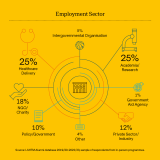
Graduates from this programme enter a diverse range of positions in public health, research, NGOs, health programmes, health services, government, policy and planning.
Employability
On average, 90% of our master's graduates from the 2019/20-2022/23 cohorts were in employment or undertaking further studies 15 months after graduation (Graduate Outcomes Surveys, 2020-2023).
Hear Lanre's thoughts on the MSc Control of Infectious Diseases
Lanre tells us about studying the MSc Control of Infectious Diseases programme at LSHTM, the skills he has learned and his plans for his future career.
Graduates from this programme enter a diverse range of positions and organisations across the fields of epidemiology, laboratory sciences and public health.
Below you will find just a few of the positions and organisations that our graduates from this course have entered after graduating:
- Example job titles:
-
Assistant Professor
Doctor
Editorial Assistant
Epidemiologist
Immunisation Consultant
Infection Control Nurse
Malaria Data Analyst
Operational Researcher
Pharmacist
Programme Manager
Public Health Officer
Public Relations Executive - Example organisations:
-
Malaria Consortium
Apotex
Basel University Hospital
Cancer Research UK
Chesterfield Royal Hospital (NHS)
RAPP
Civil Service
IBM
Public Health England
Gavi, the Vaccine Alliance
London School of Hygiene & Tropical Medicine
Terrence Higgins Trust
The European Centre for Disease Control
The Global Fund to Fight AIDS, Tuberculosis and Malaria
LSHTM Alumni
LSHTM’s alumni community includes over 35,000 graduates across more than 190 countries. It offers a lifelong connection to LSHTM and to each other.
We are proud of our global alumni network, which includes many notable members, such as:
- Tedros Adhanom, the Director-General of the World Health Organization (WHO), who completed his MSc in Immunology of Infectious Diseases
- Karina Rando, the Minister of Public Health in Uruguay, studied MSc Public Health – Health Economics stream
- Christopher Whitty, Chief Medical Officer for England and Chief Medical Adviser to UK Government, studied MSc Epidemiology.
- Vanessa Bradford Kerry, founder of the non-profit Seed Global Health, director of the Program in Global Public Policy and Social Change at Harvard Medical School, and Special Envoy for Climate Change and Health for the World Health Organization (WHO), studied the MSc in Health Policy, Planning and Financing

- Career support - the LSHTM Careers Service provide a range of services from 1-1 appointments to events and workshops.
- Alumni blogs - did you know LSHTM has over 35,500 alumni in more than 190 countries.
- International alumni chapters - find an LSHTM network of alumni near you from our over 30 chapters.