
What is the Planet-Friendly School Meals Initiative?
The Planet-Friendly School Meals Initiative is a collaborative research programme run by the Research Consortium for School Health and Nutrition which aims to support countries and Governments to design and implement school meals programmes that are good for people and the planet.
Amid global challenges like malnutrition, economic instability, and environmental destruction, the initiative aims to empower countries with data-driven strategies to transform their national school meals programmes into a force for change—nourishing children, strengthening local economies, and safeguarding the planet, one meal at a time.
What problem are we trying to solve?
The world currently faces an extreme malnutrition crisis. Today, approximately 733 million people – that’s 9% of the global population – are classified as hungry. At the same time, around 1 in 8 people worldwide are living with obesity, with rates projected to rise to more than 50% by 2030.
A key driver in this crisis is climate change. Unpredictable extreme weather events are wreaking havoc on our global food systems, destroying crops and creating a highly unpredictable market—in turn driving food insecurity and making it increasingly difficult to afford a healthy diet.
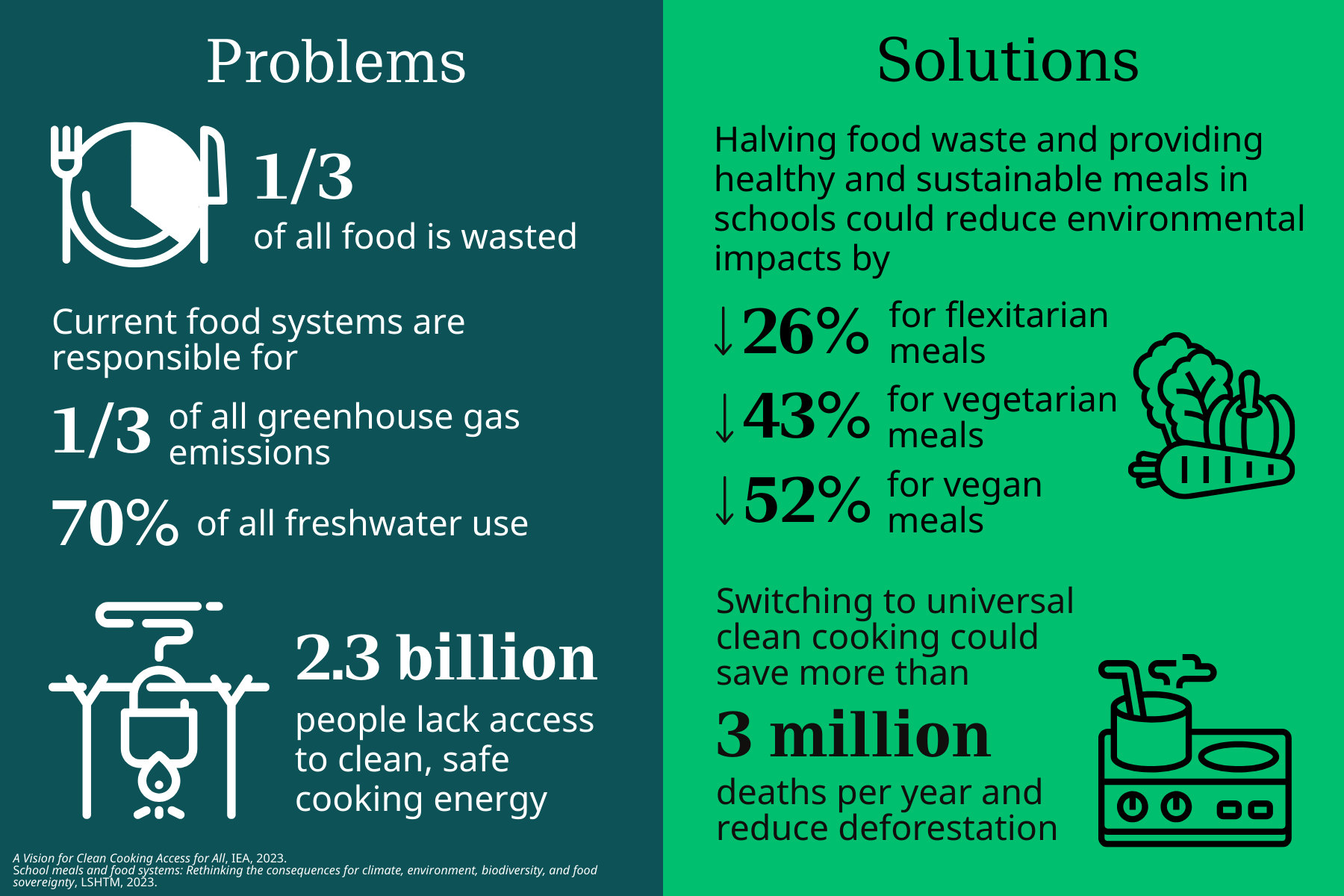
At the same time, food systems themselves are a huge part of the problem. Unsustainable food production and consumption practices are responsible for one third of all human-induced greenhouse gas emissions, simultaneously contributing to the depletion of natural resources, habitat and biodiversity loss, deforestation, ocean acidification, and climate change.
That is to say: our food systems are failing us. They are leaving us poorly nourished while pushing the planet towards environmental catastrophe.
School meals: A unique opportunity
So where do school meals come in?
School meals programmes make up the largest proportion of the global public food system, feeding 418 million children every day, and are overwhelmingly funded and managed by governments worldwide.
This presents a unique opportunity for countries to make significant change at scale—and relatively quickly too, since the policy levers lie directly in the hands of governments.
Our research: Unlocking the power of school meals
In 2023, the Planet Friendly School Meals Initiative published a white paper titled “School Meals and Food Systems: Rethinking the consequences for climate, environment, biodiversity and food sovereignty”, in collaboration with 164 authors from 85 organisations worldwide.
Drawing on scientific and policy evidence, cutting-edge mathematical modelling from the researchers behind the EAT-Lancet Commission on Food, Planet, Health, and more than 50 real-world case studies, the paper explored actionable strategies for governments to create healthier, more sustainable school meal programmes that benefit both people and the planet.
What we found: Four ways to make a change
Our evidence-based report has identified the key policy changes that would have the most significant influence on planet health. The areas include:
- Menu
The type and quantity of foods consumed by children in school make up the largest impact on environmental outcomes. A key step in shifting to planet-friendly school meals is to plan and select diverse nutrient-dense resilient school meals with low environmental impact, high climate and soil adaptation potential and sourced in sustainably and equitable ways. Reducing meat, especially ruminant, where this is overconsumed, with the goal of shifting to predominantly plant-based diets would have the largest impact. Our modelling analyses revealed that relatively modest changes to standard school menus can reduce environmental impacts by 26-43%.
- Waste
Around a third of all food is lost or wasted. Food loss and waste account for 8-10% of global GHGs. In some high income schools, food waste has been estimated to be 20-29% of prepared foods. Packaging waste accounts for 40% of global plastic waste generation most of which relates to food and drink. School meals are likely an important contributor to plastic waste, through reliance on packaged food items and single-use service ware. Reducing food loss and waste at all school levels and reducing or eliminating plastic waste would have significant impact on resources used and the associated environmental impact.
- Energy
Traditional cooking systems, using high emissions fuels such as firewood, charcoal and kerosene, burned inefficiently on open fires or simple stoves cause massive health and environmental damage, including deforestation, greenhouse gases emissions and respiratory health outcomes. Traditional cooking is utilized in more than 85% of schools in low income countries. Switching to clean cooking to prepare school meals preferably modern energy cooking solutions from renewable energy would have a significant impact on climate change, land usage and health outcomes.
- Education
Consistent and action-oriented food education can empower future generations by fostering healthier and more sustainable food habits at a critical age when life-long dietary preferences and social attitudes are formed and carried into adulthood. Schools need a transformative approach to meaningfully learn about the interconnectedness between food systems, health, wellbeing and the environment and to develop the capacity to act upon this learning.
- Procurement
Planet-friendly school meals can create demands for systemic changes to food systems, including more ecological, agrobiodiverse and equitable food production, regenerating land and protecting biodiversity.
Supporting countries to take forward planet-friendly policies
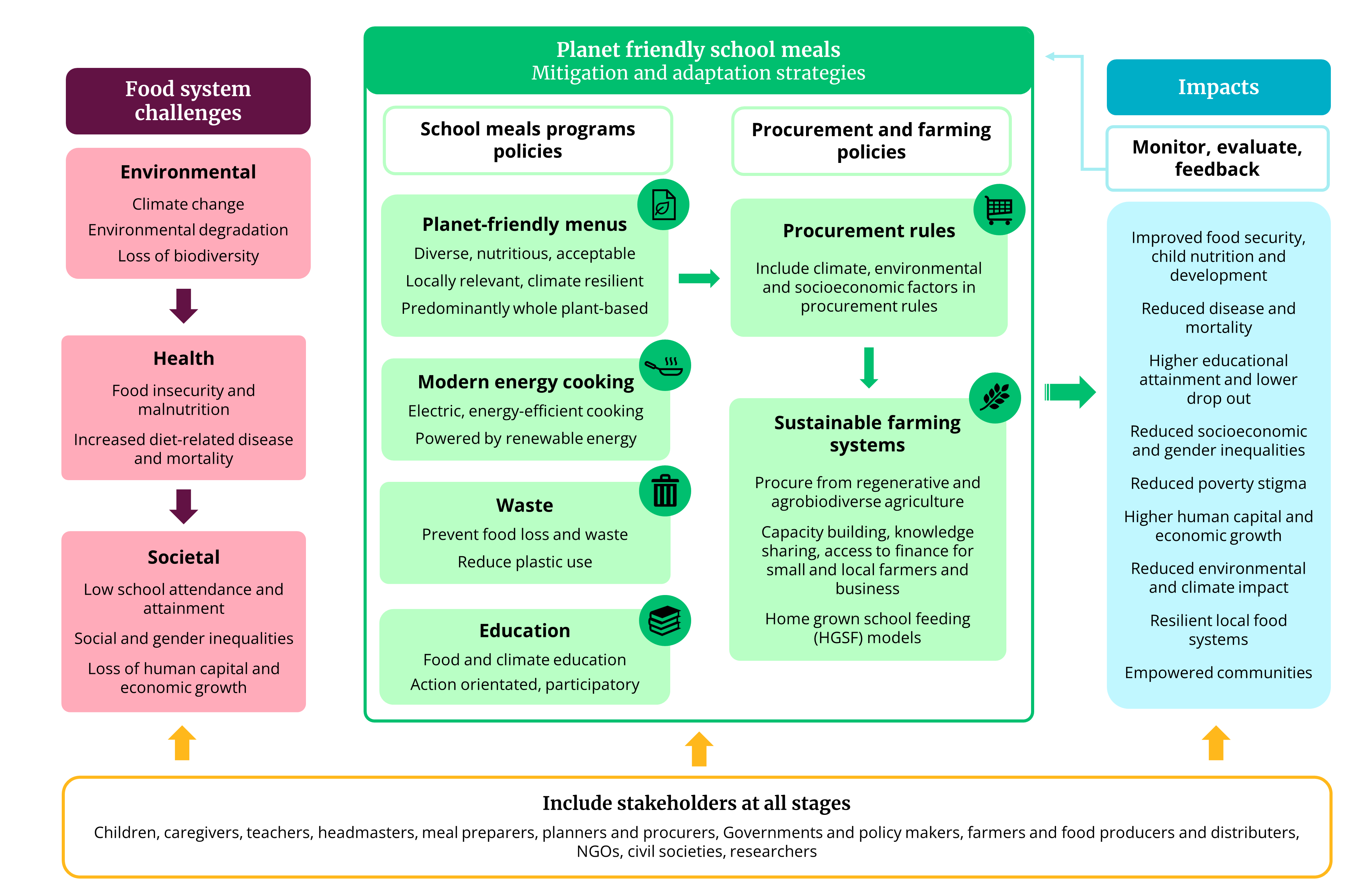
Our initiative aims to support all countries – including national and local Governments - in making school meals nutritious, equitable and planet friendly by co-creating tools to model and track the cost and the health, environmental, educational and economic outcomes of implementing healthy, planet-friendly school meal policies in different settings.
The set of tools we are co-creating will be focused on the following key priority areas as identified in the White Paper:
Menu: selecting diverse nutrient-dense resilient school meals with low environmental impact, high climate and soil adaptation potential and sourced in sustainably and equitable ways
Waste: Reducing food loss and waste at all levels and reducing or eliminating plastic waste at school level
Energy: Switching to clean cooking to prepare school meals preferably modern energy cooking solutions from renewable energy
Education: Action-oriented education on sustainable healthy diets and the link between food systems and the environment to empower the future generation to make more sustainable choices.
Procurement: linking school meals programmes with sustainably and ecologically produced foods that nourish people and planet
We aim to engage with policymakers, researchers and stakeholders at all levels to co-create inclusive and locally relevant tools that enable better-informed policy and funding decisions on school meals.
We engage a global varied network of researchers, policy makers and grass-root organisations and implementers to create better predictions and solutions. We will enable knowledge exchange by holding regular online workshops so that best solutions can be shared across countries with similar challenges and environmental and political landscapes.
Get in touch
Collaboration is at the heart of the Planet-Friendly School Meals Initiative. If you would like to be involved, we would be delighted to have a conversation with you.
Silvia Pastorino, Programme Lead: [email protected]
Resources
Read the Research Consortium's evidence-based white paper on "School Meals and Food Systems: Rethinking the consequences for climate, environment, biodiversity, and food sovereignty". Produced in collaboration with 164 contributors from 84 organizations worldwide.