World Breastfeeding Week, 1-7 August, is an opportunity to reflect on one of the most important issues in maternal and child health: how families are supported to make informed infant feeding decisions.
Breastfeeding saves lives and improves health for both babies and mothers, providing all the nutrients required for optimal infant growth and development. Yet, as highlighted by the Lancet 2023 Series on Breastfeeding, fewer than half of infants and young children globally are breastfed in line with World Health Organization recommendations, which includes exclusive breastfeeding for the first six months and continued breastfeeding alongside solid foods for two years.
While formula feeding is an essential and appropriate option for many families, and some parents chose to use formula due to various factors such as lack of support or barriers to breastfeeding, the broader feeding environment in which these decisions are made is increasingly shaped by commercial influences that deserve much closer attention.
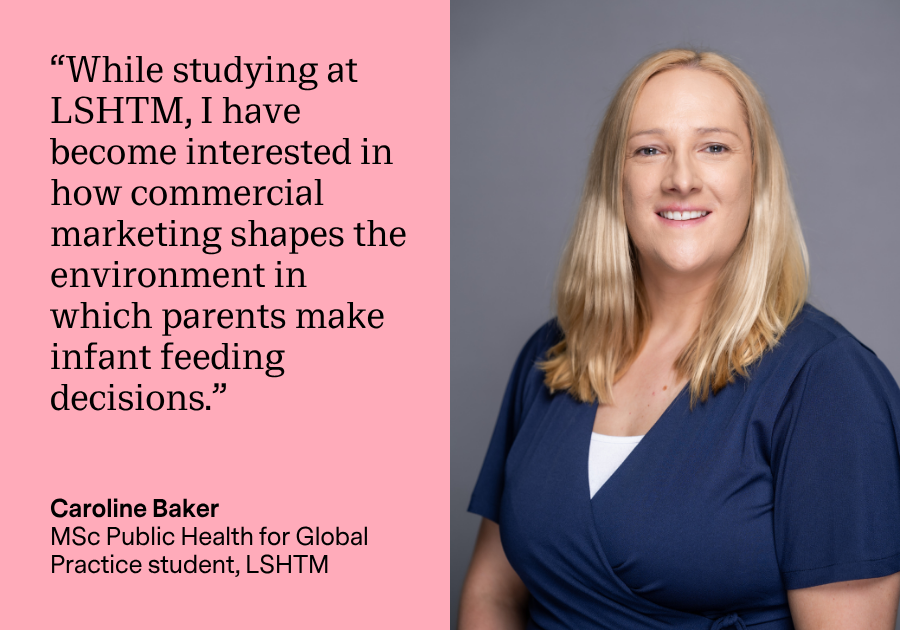
During my studies at the London School of Hygiene & Tropical Medicine (LSHTM), I have become interested in how commercial marketing shapes the environment in which parents make infant feeding decisions. Research from LSHTM’s MARCH Centre (including Advertising of Human Milk Substitutes in UK; and Maternal Experiences in Thailand) highlights that, despite decades of international action, commercial marketing of breastmilk substitutes continues to influence feeding decisions in ways that can undermine breastfeeding.
An ongoing global problem
Public concern about formula marketing is not new. The Nestlé boycott of the late 1970s brought global attention to the marketing of infant formula and led to the International Code of Marketing of Breast-Milk Substitutes in 1981, which sets out how breast milk substitutes should be marketed. Yet more than 40 years later, implementation and enforcement remain incomplete in many countries.
One study led by researchers from the MARCH Centre at LSHTM explored how commercial milk formula (CMF) is promoted within publications aimed at healthcare professionals in the UK.
The researchers found CMF advertisements in almost half of the publications they reviewed, none of which complied with the International Code. These findings were particularly striking as they highlighted how commercial influence extended beyond parents themselves and helped shape the information environment in which healthcare professionals provide advice and support for infant feeding.
How the industry has evolved
The CMF industry has changed significantly over recent decades, diversifying product ranges and promoting specialised formulas that claim to alleviate colic, improve sleep or enhance cognitive development. While infant formula is tightly regulated to ensure its safety and nutritional adequacy, many of the health claims used to market specialised products, and justify higher prices, are not supported by strong independent evidence. Because formula is regulated as a food rather than a medicine, these claims are not required to meet the same evidential standards as pharmaceutical companies.
More recently, CMF marketing has moved into increasingly subtle and pervasive spaces. Parents may encounter formula marketing on social media platforms with personalised advertisements, free gifts in exchange for app sign-ups, and relatable influencer content that normalises formula use. While manufacturers often present formula marketing as a way of informing parents about available products, critics argue that information about infant feeding is most appropriately provided by independent health professionals and trusted public health sources, rather than by companies with a commercial interest in increasing sales. Parents are experienced consumers who make informed and considered decisions about infant feeding, however the scale and sophistication of targeted digital marketing can create an uneven playing field, making commercial messages difficult to avoid or recognise. These tactics are also more difficult to monitor and regulate, raising important questions about whether existing policies are keeping up with evolving challenges in the digital domain.
What needs to happen next
Supporting breastfeeding is not just a personal issue – it is a public health priority. As World Breastfeeding Week reminds us, creating environments where families can make informed feeding decisions requires action far beyond individual parents.
By bringing together expertise in maternal health, nutrition, health systems and policy, MARCH Centre researchers are generating evidence on how commercial marketing affects infant feeding decisions in different settings, from healthcare systems to social media. They are also evaluating whether policies such as the International Code are being effectively implemented, and identifying where governments and health services can better support breastfeeding families. This evidence helps policymakers design interventions that protect breastfeeding while ensuring families who need formula receive accurate, independent information.
Creating environments that support informed infant feeding decisions will require continued collaboration between researchers, healthcare professionals, policymakers and communities. It also requires recognising that, while many women wish to breastfeed, some face significant barriers and need timely, compassionate support to achieve their feeding goals or, where breastfeeding is not possible, to make informed decisions without undue commercial influence.
As marketing practices continue to evolve, understanding how commercial influences shape feeding decisions will remain an important area of research. Through its interdisciplinary research, the MARCH Centre is helping to generate evidence, strengthen health systems and inform policies and interventions that support families to give every child the best possible start in life.
If you enjoyed this article and would like to build a career in global health, we offer a range of MSc programmes covering health and data, infectious and tropical diseases, population health, and public health and policy.
Available on campus or online, including flexible study that works around your work and home life, be part of a global community at the UK's no.1 public health university.