

These are the strategies and approaches used by the private sector to manufacture and sell products that are detrimental to health have been termed the “commercial determinants of health”.
The field of the commercial determinants of health is still emerging, but represents an effort to systematize efforts to observe, understand, and ultimately confront the drivers, strategies, tactics and societal impacts of commercially driven disease. The Commercial Determinants Research Group, based in the Faculty of Public Health and Policy at LSHTM, conducts research in this areas. Its projects include research on a range of industries – including the tobacco, alcohol and food industries, and the fossil fuel and gun industries among others, as well as research on the use of similar tactics by parts of the healthcare industry. It also researches the cross-industry playbooks used by harmful commodity industries.
- Corporate/commercial tactics to influence on policy/practice/science, including the use of misinformation
- Analysis/evaluation of the effects of commercial activities, campaigns and products (on health but also on other outcomes - e.g. policymaking, guidelines)
- Conflicts of interest
- Application of methodological approaches e.g. discourse analysis; and
- Systems thinking in research on commercial determinants
We are a multidisciplinary group of public health researchers within the faculty of Public Health and Policy at LSHTM. This website provides a focus for our research, which has a strong focus on corporate influence on health and health inequalities. We have a particular misinformation strategies - the industry ‘playbook.’
Our work covers many industries – recent studies have examined the tactics of the alcohol and tobacco industries, the food industry, the firearms industry, the fossil fuel industry, and others. Other research is focussed on alcohol advertising, and conflicts of interest.
- Defining the Commercial Determinants of Health
- The need for a conceptual understanding of the macro and meso commercial determinants of health inequalities.
Maani N, Collin J, Friel S, Gilmore AB, McCambridge J, Robertson L, Petticrew M.
Eur J Public Health. 2021 Oct 11;31(4):674-675. doi: 10.1093/eurpub/ckab048 - Bringing the commercial determinants of health out of the shadows: a review of how the commercial determinants are represented in conceptual frameworks.
Maani N, Collin J, Friel S, Gilmore AB, McCambridge J, Robertson L, Petticrew MP.
Eur J Public Health. 2020 Aug 1;30(4):660-664. doi: 10.1093/eurpub/ckz197 - Defining and conceptualising the commercial determinants of health.
Gilmore AB, Fabbri A, Baum F, Bertscher A, Bondy K, Chang HJ, Demaio S, Erzse A, Freudenberg N, Friel S, Hofman KJ, Johns P, Abdool Karim S, Lacy-Nichols J, de Carvalho CMP, Marten R, McKee M, Petticrew M, Robertson L, Tangcharoensathien V, Thow AM.
Lancet. 2023 Apr 8;401(10383):1194-1213. doi: 10.1016/S0140-6736(23)00013-2
- The need for a conceptual understanding of the macro and meso commercial determinants of health inequalities.
- Researching the Commercial Determinants
- The Commercial Determinants of Health and Evidence Synthesis (CODES): methodological guidance for systematic reviews and other evidence syntheses.
Petticrew M, Glover RE, Volmink J, Blanchard L, Cott É, Knai C, Maani N, Thomas J, Tompson A, van Schalkwyk MCI, Welch V.
Syst Rev. 2023 Sep 14;12(1):165. doi: 10.1186/s13643-023-02323-0 - Learning from the CO-CREATE project: A protocol for systems thinking across research (STAR).
Knai C, Savona N, Finegood D, Aguiar A, Blanchard L, Conway-Moore K, Helleve A, Klepp KI, Lien N, Luszczynska A, Vlad I, Rønnestad AM, Rutter H.
Obes Rev. 2023 Sep;24 Suppl 2:e13624. doi: 10.1111/obr.13624.PMID: 37753598 - The case for developing a cohesive systems approach to research across unhealthy commodity industries.
Knai C, Petticrew M, Capewell S, Cassidy R, Collin J, Cummins S, Eastmure E, Fafard P, Fitzgerald N, Gilmore AB, Hawkins B, Jensen JD, Katikireddi SV, Maani N, Mays N, Mwatsama M, Nakkash R, Orford JF, Rutter H, Savona N, van Schalkwyk MCI, Weishaar H.
BMJ Glob Health. 2021 Feb;6(2):e003543. doi: 10.1136/bmjgh-2020-003543 - Corporate practices and the health of populations: a research and translational agenda.
Maani N, McKee M, Petticrew M, Galea S.
Lancet Public Health. 2020 Feb;5(2):e80-e81. doi: 10.1016/S2468-2667(19)30270-1 - The SPECTRUM Consortium: a new UK Prevention Research Partnership consortium focussed on the commercial determinants of health, the prevention of non-communicable diseases, and the reduction of health inequalities.
Horton M, Perman-Howe PR, Angus C, Bishop J, Bogdanovica I, Brennan A, Britton J, Brose LS, Brown J, Collin J, Dockrell M, Fitzgerald N, Friel S, Gillespie D, Gilmore AB, Hill SE, Knai C, Langley T, Martin S, McNeill A, Moore G, Munafò MR, Murray RL, Opazo Breton M, Pearce J, Petticrew M, Reid G, Robson D, Rutter H, Shahab L, Shortt N, Smith K, Syrett K, Bauld L.
Wellcome Open Res. 2021 Jan 14;6:6. doi: 10.12688/wellcomeopenres.16318.1
- The Commercial Determinants of Health and Evidence Synthesis (CODES): methodological guidance for systematic reviews and other evidence syntheses.
- Mechanisms and responses (multiple industries)
- How Do Industry-Funded Alcohol and Gambling Conferences Frame the Issues? An Analysis of Conference Agendas.
Dun-Campbell K, van Schalkwyk MCI, Petticrew M, Maani N, McGill E.
J Stud Alcohol Drugs. 2023 Mar;84(2):309-317. doi: 10.15288/jsad.22-00045 - Brexit, trade and the governance of non-communicable diseases: a research agenda.
Hawkins B, Barlow P, van Schalkwyk MC, Holden C.
Global Health. 2023 Aug 23;19(1):61. doi: 10.1186/s12992-023-00956-3. - The pollution of health discourse and the need for effective counter-framing.
Maani N, van Schalkwyk MC, Petticrew M, Buse K.
BMJ. 2022 May 4;377:o1128. doi: 10.1136/bmj.o1128 - The commercial determinants of health: The mini-budget is a consequence of foundational forces medicine must bear witness to
Maani N, McKee M.
BMJ. 2022 Sep 27;378:o2327. doi: 10.1136/bmj.o2327. - Schools for healthy lives, not for corporate interests.
van Schalkwyk MCI, Knai C, Jackson N, Maani N, Petticrew M.
Lancet Child Adolesc Health. 2021 May;5(5):e14. doi: 10.1016/S2352-4642(21)00097-3 - Manufacturing doubt: Assessing the effects of independent vs industry-sponsored messaging about the harms of fossil fuels, smoking, alcohol, and sugar sweetened beverages.
Maani N, van Schalkwyk MCI, Filippidis FT, Knai C, Petticrew M.
SSM Popul Health. 2021 Dec 23;17:101009. doi: 10.1016/j.ssmph.2021.101009. - The new WHO Foundation - global health deserves better.
Maani N, Van Schalkwyk MC, Petticrew M, Ralston R, Collin J.
BMJ Glob Health. 2021 Feb;6(2):e004950. doi: 10.1136/bmjgh-2021-004950 - Attitudes and practices of public health academics towards research funding from for-profit organizations: cross-sectional survey.
Nakkash R, Ali A, Alaouie H, Asmar K, Hirschhorn N, Mugharbil S, Nuwayhid I, London L, Saban A, Rashid SF, Ahmed MK, Knai C, Bigland C, Afifi RA.Int
J Public Health. 2020 Sep;65(7):1133-1145. doi: 10.1007/s00038-020-01416-0. - The perils of preprints.
van Schalkwyk MCI, Hird TR, Maani N, Petticrew M, Gilmore AB.
BMJ. 2020 Aug 17;370:m3111. doi: 10.1136/bmj.m3111 - Editor and peer reviewer financial conflict of interest policies in public health journals.
Ralph A, Petticrew M, Hutchings A.
Eur J Public Health. 2020 Dec 11;30(6):1230-1232. doi: 10.1093/eurpub/ckaa183 - Mechanisms for addressing and managing the influence of corporations on public health policy, research and practice: a scoping review.
Mialon M, Vandevijvere S, Carriedo-Lutzenkirchen A, Bero L, Gomes F, Petticrew M, McKee M, Stuckler D, Sacks G.
BMJ Open. 2020 Jul 19;10(7):e034082. doi: 10.1136/bmjopen-2019-034082 - Characterizing restrictions on commercial advertising and sponsorship of harmful commodities in local government policies: a nationwide study in England.
McKevitt S, White M, Petticrew M, Summerbell C, Vasiljevic M, Boyland E, Cummins S, Laverty AA, Millett C, de Vocht F, Junghans C, Vamos EP.
J Public Health (Oxf). 2023 Aug 22:fdad155. doi: 10.1093/pubmed/fdad155 - Typology of how 'harmful commodity industries' interact with local governments in England: a critical interpretive synthesis.
McKevitt S, White M, Petticrew M, Summerbell C, Vasiljevic M, Boyland E, Cummins S, Laverty AA, Junghans C, Millett C, De Vocht F, Hrobonova E, Vamos EP.
BMJ Glob Health. 2023 Jan;8(1):e010216. doi: 10.1136/bmjgh-2022-010216
- How Do Industry-Funded Alcohol and Gambling Conferences Frame the Issues? An Analysis of Conference Agendas.
- Commercial Determinants of Mental Health
- Conceptualising the commercial determinants of suicide: broadening the lens on suicide and self-harm prevention.
van Schalkwyk MCI, Collin J, Eddleston M, Petticrew M, Pearson M, Schölin L, Maani N, Konradsen F, Gunnell D, Knipe D.
Lancet Psychiatry. 2023 May;10(5):363-370. doi: 10.1016/S2215-0366(23)00043-3 - Commercial determinants of mental health.
Tompson AC, Mulrenan C, Hartwell G, Petticrew M, van Schalkwyk MCI, Maani N.
BMJ. 2022 Aug 22;378:o2034. doi: 10.1136/bmj.o2034
- Conceptualising the commercial determinants of suicide: broadening the lens on suicide and self-harm prevention.
- The Commercial Determinants of Health and COVID-19
- Back to our roots or sowing new seeds: thinking anew on the paradigms of health, harm and disease.
van Schalkwyk MCI, Zenone M, Maani N, Petticrew M, McKee M.
J Public Health (Oxf). 2022 Nov 21;44(Suppl 1):i28-i33. doi: 10.1093/pubmed/fdac093 - Public health emergency or opportunity to profit? The two faces of the COVID-19 pandemic.
van Schalkwyk MC, Maani N, McKee M.
Lancet Diabetes Endocrinol. 2021 Feb;9(2):61-63. doi: 10.1016/S2213-8587(21)00001-2 - Our Postpandemic World: What Will It Take to Build a Better Future for People and Planet?
van Schalkwyk MC, Maani N, Cohen J, McKee M, Petticrew M.
Milbank Q. 2021 Jun;99(2):467-502. doi: 10.1111/1468-0009.12508 - The Commercial Determinants of Three Contemporary National Crises: How Corporate Practices Intersect With the COVID-19 Pandemic, Economic Downturn, and Racial Inequity.
Maani N, VAN Schalkwyk MC, Petticrew M, Galea S.
Milbank Q. 2021 Jun;99(2):503-518. doi: 10.1111/1468-0009.12510
- Back to our roots or sowing new seeds: thinking anew on the paradigms of health, harm and disease.
- The Alcohol Industry
- Under the influence: system-level effects of alcohol industry-funded health information organizations.
Maani N, Ci van Schalkwyk M, Petticrew M.
Health Promot Int. 2023 Dec 1;38(6):daad167. doi: 10.1093/heapro/daad167. - Trends in alcohol-specific deaths in the UK and industry responses.
Maani N, van Schalkwyk MC, Petticrew M.
Lancet Gastroenterol Hepatol. 2023 May;8(5):398-400. doi: 10.1016/S2468-1253(23)00002-X - Drinking on an empty stomach: a scoping review of the evidence on how consuming food with alcohol affects short-term outcomes.
Ramsbottom A, Petticrew M, Huber A, van Schalkwyk MCI.
J Public Health (Oxf). 2023 Aug 28;45(3):612-620. doi: 10.1093/pubmed/fdac117 - Denormalising alcohol industry activities in schools.
van Schalkwyk MC, Petticrew M, Maani N, Hawkins B.
Lancet Public Health. 2023 Feb;8(2):e90-e91. doi: 10.1016/S2468-2667(22)00341-3 - Commentary on McCambridge et al.: When the emperor has no clothes (but pretends to be a fashion expert).
Petticrew M.
Addiction. 2023 Mar;118(3):567-568. doi: 10.1111/add.16120 - Distilling the curriculum: An analysis of alcohol industry-funded school-based youth education programmes.
van Schalkwyk MCI, Petticrew M, Maani N, Hawkins B, Bonell C, Katikireddi SV, Knai C.
PLoS One. 2022 Jan 12;17(1):e0259560. doi: 10.1371/journal.pone.0259560 - Educ' Alcool's misinformation: more mixed messages about alcohol harms.
Petticrew MP, van Schalkwyk MCI, Maani NJ, Peake LK.
Eur J Public Health. 2022 Feb 1;32(1):6-7. doi: 10.1093/eurpub/ckab198 - Responsible Drinking, Conflicts of Interest, and the Elephant in the Room: A Commentary on A Scoping Review of "Responsible Drinking" Interventions by Gray, Williams & Shaffer (2020).
Petticrew M, Fitzgerald N, Maani N, McCambridge J, Pettigrew S, van Schalkwyk M.
Health Commun. 2021 Feb;36(2):257-259. doi: 10.1080/10410236.2020.1827541 - Corporate ventriloquism undermines action on alcohol harms.
van Schalkwyk MCI, Maani N, Pettigrew S, Petticrew M.
BMJ. 2021 Aug 3;374:n1879. doi: 10.1136/bmj.n1879. - Dark Nudges and Sludge in Big Alcohol: Behavioral Economics, Cognitive Biases, and Alcohol Industry Corporate Social Responsibility.
Petticrew M, Maani N, Pettigrew L, Rutter H, VAN Schalkwyk MC.
Milbank Q. 2020 Dec;98(4):1290-1328. doi: 10.1111/1468-0009.12475 - Alcohol Industry Corporate Social Responsibility, Strategic Ambiguity, and the Limits of Fact-Checking: Response to Drinkaware UK and International Alliance for Responsible Drinking Regarding Our Study of Misinformation on Alcohol Consumption and Pregnancy.
Petticrew MP, Lim AWY, van Schalkwyk MCI, Maani Hessari N.
J Stud Alcohol Drugs. 2020 May;81(3):392-394. - Éduc'alcool and the Web of Misinformation About Alcohol and Health.
Petticrew MP, Lim AWY, van Schalkwyk MCI, Maani Hessari N.
J Stud Alcohol Drugs. 2020 May;81(3):386-387. - Food as harm reduction during a drinking session: reducing the harm or normalising harmful use of alcohol? A qualitative comparative analysis of alcohol industry and non-alcohol industry-funded guidance.
Ramsbottom A, van Schalkwyk MCI, Carters-White L, Benylles Y, Petticrew M.
Harm Reduct J. 2022 Jun 25;19(1):66. doi: 10.1186/s12954-022-00648-y - Analysis of How Lobbying by the Alcohol Industry Has Eroded the French Évin Law Since 1991.
Millot A, Maani N, Knai C, Petticrew M, Guillou-Landréat M, Gallopel-Morvan K
J Stud Alcohol Drugs. 2022 Jan;83(1):37-44. - A Framing Analysis of Consultation Submissions on the WHO Global Strategy to Reduce the Harmful Use of Alcohol: Values and Interests.
Rinaldi C, van Schalkwyk MC, Egan M, Petticrew M.
Int J Health Policy Manag. 2022 Aug 1;11(8):1550-1561. doi: 10.34172/ijhpm.2021.68 - How public health teams navigate their different roles in alcohol premises licensing: ExILEnS multistakeholder interview findings.
O’Donnell R, Mohan A, Purves R, Maani N, Egan M, Fitzgerald N.
Southampton (UK): National Institute for Health and Care Research; 2022 Aug. - Addressing alcohol-related harms in the local night-time economy: a qualitative process evaluation from a complex systems perspective.
McGill E, Marks D, Petticrew M, Egan M.
BMJ Open. 2022 Aug 25;12(8):e050913. doi: 10.1136/bmjopen-2021-050913 - Applying a complex systems perspective to alcohol consumption and the prevention of alcohol-related harms in the 21st century: a scoping review.
McGill E, Petticrew M, Marks D, McGrath M, Rinaldi C, Egan M.
Addiction. 2021 Sep;116(9):2260-2288. doi: 10.1111/add.15341 - Analysis of the accuracy and completeness of cardiovascular health information on alcohol industry-funded websites.
Peake L, van Schalkwyk MCI, Maani N, Petticrew M.
Eur J Public Health. 2021 Dec 1;31(6):1197-1204. doi: 10.1093/eurpub/ckab135 - What on-line searches tell us about public interest and potential impact on behaviour in response to minimum unit pricing of alcohol in Scotland.
Leon DA, Yom-Tov E, Johnson AM, Petticrew M, Williamson E, Lampos V, Cox I.
Addiction. 2021 Aug;116(8):2008-2015. doi: 10.1111/add.15388 - Call to restore funding to monitor youth exposure to alcohol advertising.
Ross CS, Babor TF, Bartholow BD, DeJong W, Fitzgerald N, Jackson KM, Jernigan DH, Naimi TS, Noel JK, Petticrew M, Severi K, Siegel MB, Stockwell T, Tori M, Xuan Z.
Addiction. 2021 Oct;116(10):2922-2923. doi: 10.1111/add.15590
- Under the influence: system-level effects of alcohol industry-funded health information organizations.
- The Firearm Industry
- The Firearm Industry as a Commercial Determinant of Health.
Maani N, Abdalla SM, Galea S.
Am J Public Health. 2020 Aug;110(8):1182-1183. doi: 10.2105/AJPH.2020.305788. - A qualitative framing analysis of how firearm manufacturers and related bodies communicate to the public on gun-related harms and solutions.
Hussain Z, van Schalkwyk MCI, Galea S, Petticrew M, Maani N.
Prev Med. 2023 Jan;166:107346. doi: 10.1016/j.ypmed.2022.107346
- The Firearm Industry as a Commercial Determinant of Health.
- The Gambling Industry
- Statutory levy on gambling may do more harm than good.
van Schalkwyk MCI, Thomas S, McKee M, Fell G, Daube M.
BMJ. 2023 Apr 6;381:e075035. doi: 10.1136/bmj-2023-075035 - Harm built in-why the gambling industry needs a Silent Spring moment.
van Schalkwyk MC, Cassidy R, Petticrew M, McKee M.
BMJ. 2023 Jan 26;380:203. doi: 10.1136/bmj.p203 - Gambling disorder.
van Schalkwyk MCI, McKee M, Cassidy R, Petticrew M, Blythe J.
Lancet Psychiatry. 2022 Jun;9(6):429. doi: 10.1016/S2215-0366(22)00068-2 - Gambling Act review.
van Schalkwyk MCI, Blythe J, McKee M, Petticrew M.
BMJ. 2022 Feb 1;376:o248. doi: 10.1136/bmj.o248 - The politics and fantasy of the gambling education discourse: An analysis of gambling industry-funded youth education programmes in the United Kingdom.
van Schalkwyk MCI, Hawkins B, Petticrew M.
SSM Popul Health. 2022 May 12;18:101122. doi: 10.1016/j.ssmph.2022.101122 - "When the Fun Stops, Stop": An analysis of the provenance, framing and evidence of a 'responsible gambling' campaign.
van Schalkwyk MC, Maani N, McKee M, Thomas S, Knai C, Petticrew M.
PLoS One. 2021 Aug 26;16(8):e0255145. doi: 10.1371/journal.pone.0255145 - A public health approach to gambling regulation: countering powerful influences.
van Schalkwyk MCI, Petticrew M, Cassidy R, Adams P, McKee M, Reynolds J, Orford J.
Lancet Public Health. 2021 Aug;6(8):e614-e619. doi: 10.1016/S2468-2667(21)00098-0 - Global public health action is needed to counter the commercial gambling industry.
Thomas S, Cowlishaw S, Francis J, van Schalkwyk MCI, Daube M, Pitt H, McCarthy S, McGee D, Petticrew M, Rwafa-Ponela T, Minja A, Fell G.
Health Promot Int. 2023 Oct 1;38(5):daad110. doi: 10.1093/heapro/daad110 - Protecting children and young people from contemporary marketing for gambling.
Thomas S, van Schalkwyk MCI, Daube M, Pitt H, McGee D, McKee M.
Health Promot Int. 2023 Apr 1;38(2):daac194. doi: 10.1093/heapro/daac194
- Statutory levy on gambling may do more harm than good.
- The Tobacco Industry
- Sunak's smoke-free generation: spare a thought for the tobacco industry.
Hartwell G, Gilmore AB, van Schalkwyk MCI, McKee M.BMJ. 2023 Dec 12;383:2922. doi: 10.1136/bmj.p2922. - Use of e-Cigarettes and Attendance at Stop Smoking Services: A Population Survey in England.
Hartwell G, Egan M, Brown J, Pliakas T, Petticrew M.
Toxics. 2022 Oct 7;10(10):593. doi: 10.3390/toxics10100593.
- Sunak's smoke-free generation: spare a thought for the tobacco industry.
- Private Healthcare
- Understanding the US Health Care Industry as a Commercial Determinant of Health.
Galea S, van Schalkwyk MCI.
JAMA Health Forum. 2023 Jul 7;4(7):e232795. doi: 10.1001/jamahealthforum.2023.2795.
- Understanding the US Health Care Industry as a Commercial Determinant of Health.
- The Social Media Industry
- Advertising Alternative Cancer Treatments and Approaches on Meta Social Media Platforms: Content Analysis.
Zenone M, Snyder J, Bélisle-Pipon JC, Caulfield T, van Schalkwyk M, Maani N.
JMIR Infodemiology. 2023 May 31;3:e43548. doi: 10.2196/43548 - The Social Media Industry as a Commercial Determinant of Health.
Zenone M, Kenworthy N, Maani N.
Int J Health Policy Manag. 2023;12:6840. doi: 10.34172/ijhpm.2022.6840 - Associations between social media, adolescent mental health, and diet: A systematic review.
Blanchard L, Conway-Moore K, Aguiar A, Önal F, Rutter H, Helleve A, Nwosu E, Falcone J, Savona N, Boyland E, Knai C. Obes Rev. 2023 Sep;24 Suppl 2:e13631. doi: 10.1111/obr.13631
- Advertising Alternative Cancer Treatments and Approaches on Meta Social Media Platforms: Content Analysis.
- Obesity
- Understanding the dynamics emerging from the interplay among poor mental wellbeing, energy balance-related behaviors, and obesity prevalence in adolescents: A simulation-based study.
Aguiar A, Önal F, Hendricks G, Blanchard L, Romanenko E, Fismen AS, Nwosu E, Herstad S, Savona N, Harbron J, Knai C, Samdal O, Rutter H, Lien N, Jalali MS, Kopainsky B. Obes Rev. 2023 Sep;24 Suppl 2:e13628. doi: 10.1111/obr.13628. - What policies are there and what policies are missing? A Photovoice study of adolescents' perspectives on obesity-prevention policies in their local environment.
Banik A, Knai C, Klepp KI, Rutter H, Rito A, Lien N, Baillergeau E, Szczuka Z, Boberska M, Kulis E, Luszczynska A.Obes Rev. 2023 Sep;24 Suppl 2:e13617. doi: 10.1111/obr.13617. - System mapping with adolescents: Using group model building to map the complexity of obesity.
Savona N, Brown A, Macauley T, Aguiar A, Hayward J, Ayuandini S, Habron J, Grewal NK, Luszczynska A, Mendes S, Klepp KI, Rutter H, Allender S, Knai C. Obes Rev. 2023 Feb;24 Suppl 1:e13506. doi: 10.1111/obr.13506 - Identifying the views of adolescents in five European countries on the drivers of obesity using group model building.
Savona N, Macauley T, Aguiar A, Banik A, Boberska M, Brock J, Brown A, Hayward J, Holbæk H, Rito AI, Mendes S, Vaaheim F, van Houten M, Veltkamp G, Allender S, Rutter H,Knai C. Eur J Public Health. 2021 Apr 24;31(2):391-396. doi: 10.1093/eurpub/ckaa251 - How involved are parents in their child's early years setting's food decisions and practices?
Williams L, Warren E, Knai C. SSM Qual Res Health. 2022 Dec;2:100142. doi: 10.1016/j.ssmqr.2022.100142. - The "Cinderella sector": The challenges of promoting food and nutrition for young children in early years' settings in England.
Warren E, Williams L, Knai C. Ecol Food Nutr. 2022 Sep-Oct;61(5):576-594. doi: 10.1080/03670244.2022.2073353. - Overweight and obesity prevention for and with adolescents: The "Confronting obesity: Co-creating policy with youth" (CO-CREATE) project.
Klepp KI, Helleve A, Brinsden H, Bröer C, Budin-Ljøsne I, Harbron J, Knai C, Lien N, Luszczynska A, Nesrallah S, Oldridge-Turner K, Rito A, Samdal O, Savona N, Stensdal MK, Allender S, Hoelscher DM, Rutter H. Obes Rev. 2023 Feb;24 Suppl 1:e13540. doi: 10.1111/obr.13540. - Adolescents' capacity to take action on obesity: A concurrent controlled before-and-after study of the European CO-CREATE project.
Herstad SH, Grewal NK, Banik A, Klepp KI, Knai C, Luszczynska A, Mendes S, Rito A, Rutter H, Lien N. Obes Rev. 2023 Sep;24 Suppl 2:e13622. doi: 10.1111/obr.13622. - Adolescents' Perspectives on the Drivers of Obesity Using a Group Model Building Approach: A South African Perspective.
Hendricks G, Savona N, Aguiar A, Alaba O, Booley S, Malczyk S, Nwosu E, Knai C, Rutter H, Klepp KI, Harbron J. Int J Environ Res Public Health. 2022 Feb 14;19(4):2160. doi: 10.3390/ijerph19042160. - Co-creating obesity prevention policies with youth: Policy ideas generated through the CO-CREATE project.
Conway-Moore K, Knai C, Finegood D, Johnston L, Brinsden H, Aguiar A, Kopainsky B, Önal F, Helleve A, Klepp KI, Lien N, Luszczynska A, Rito AI, Rønnestad AM, Ulstein M, Blanchard L, Savona N, Rutter H . Obes Rev. 2023 Sep;24 Suppl 2:e13623. doi: 10.1111/obr.13623.PMID: 37753599
- Understanding the dynamics emerging from the interplay among poor mental wellbeing, energy balance-related behaviors, and obesity prevalence in adolescents: A simulation-based study.
- Other
- Quality and Utility of Information Captured by Surveillance Systems Relevant to Antimicrobial Resistance (AMR): A Systematic Review.
Al-Haboubi M, Glover RE, Eastmure E, Petticrew M, Black N, Mays N.
Antibiotics (Basel). 2021 Apr 13;10(4):431. doi: 10.3390/antibiotics10040431. - Improving Social Justice in COVID-19 Health Research: Interim Guidelines for Reporting Health Equity in Observational Studies.
Antequera A, Lawson DO, Noorduyn SG, Dewidar O, Avey M, Bhutta ZA, Chamberlain C, Ellingwood H, Francis D, Funnell S, Ghogomu E, Greer-Smith R, Horsley T, Juando-Prats C, Jull J, Kristjansson E, Little J, Nicholls SG, Nkangu M, Petticrew M, Rada G, Rizvi A, Shamseer L, Sharp MK, Tufte J, Tugwell P, Verdugo-Paiva F, Wang H, Wang X, Mbuagbaw L, Welch V.
Int J Environ Res Public Health. 2021 Sep 4;18(17):9357. doi: 10.3390/ijerph18179357. - 'It's Easily the Lowest I've Ever, Ever Got to': A Qualitative Study of Young Adults' Social Isolation during the COVID-19 Lockdowns in the UK.
Dedryver CC, Knai C. Int J Environ Res Public Health. 2021 Nov 10;18(22):11777. doi: 10.3390/ijerph182211777 - Improving social justice in observational studies: protocol for the development of a global and Indigenous STROBE-equity reporting guideline.
Funnell S, Jull J, Mbuagbaw L, Welch V, Dewidar O, Wang X, Lesperance M, Ghogomu E, Rizvi A, Akl EA, Avey MT, Antequera A, Bhutta ZA, Chamberlain C, Craig P, Cuervo LG, Dicko A, Ellingwood H, Feng C, Francis D, Greer-Smith R, Hardy BJ, Harwood M, Hatcher-Roberts J, Horsley T, Juando-Prats C, Kasonde M, Kennedy M, Kredo T, Krentel A, Kristjansson E, Langer L, Little J, Loder E, Magwood O, Mahande MJ, Melendez-Torres GJ, Moore A, Niba LL, Nicholls SG, Nkangu MN, Lawson DO, Obuku E, Okwen P, Pantoja T, Petkovic J, Petticrew M, Pottie K, Rader T, Ramke J, Riddle A, Shamseer L, Sharp M, Shea B, Tanuseputro P, Tugwell P, Tufte J, Von Elm E, Waddington HS, Wang H, Weeks L, Wells G, White H, Wiysonge CS, Wolfenden L, Young T.
Int J Equity Health. 2023 Mar 30;22(1):55. doi: 10.1186/s12939-023-01854-1. - Explaining differential socioeconomic effects in population health interventions: development and application of a new tool to classify intervention agentic demand.
Garrott K, Ogilvie D, Panter J, Sowden A, Petticrew M, Penn-Jones C, Foubister C, Lawlor E, Ikeda E, Patterson R, Van Tulleken D, Armstrong-Moore R, Vethanayakam G, Bo L, White M, Adams J.
Lancet. 2023 Nov;402 Suppl 1:S3. doi: 10.1016/S0140-6736(23)02056-1 - Sankey diagrams can clarify 'evidence attrition': A systematic review and meta-analysis of the effectiveness of rapid diagnostic tests for antimicrobial resistance.
Glover RE, Al-Haboubi M, Petticrew MP, Eastmure E, Peacock SJ, Mays N.
J Clin Epidemiol. 2022 Apr;144:173-184. doi: 10.1016/j.jclinepi.2021.11.032. - Case study research and causal inference.
Green J, Hanckel B, Petticrew M, Paparini S, Shaw S.
BMC Med Res Methodol. 2022 Dec 1;22(1):307. doi: 10.1186/s12874-022-01790-8. - The use of Qualitative Comparative Analysis (QCA) to address causality in complex systems: a systematic review of research on public health interventions.
Hanckel B, Petticrew M, Thomas J, Green J.
BMC Public Health. 2021 May 7;21(1):877. doi: 10.1186/s12889-021-10926-2. - Understanding decisions to use e-cigarettes or behavioural support to quit tobacco: a qualitative study of current and ex-smokers and stop smoking service staff.
Hartwell G, Egan M, Petticrew M.
Addiction. 2020 Mar;115(3):518-526. doi: 10.1111/add.14844. - PROTOCOL: When and how to replicate systematic reviews.
Karunananthan S, Maxwell LJ, Welch V, Petkovic J, Pardo JP, Rader T, Avey MT, Baptiste-Ngobi J, Batista R, Curran JA, Ghogomu ET, Graham ID, Grimshaw JM, Ioannidis JP, Jordan Z, Jull J, Lyddiatt A, Moher D, Petticrew M, Pottie K, Rada G, Shamseer L, Shea B, Siontis KC, Tschirhart N, Vachon B, Wells GA, White H, Tugwell P.
Campbell Syst Rev. 2020 May 28;16(2):e1087. doi: 10.1002/cl2.1087. - Effectiveness of arts interventions to reduce mental-health-related stigma among youth: a systematic review and meta-analysis.
Gaiha SM, Salisbury TT, Usmani S, Koschorke M, Raman U, Petticrew M.
BMC Psychiatry. 2021 Jul 22;21(1):364. doi: 10.1186/s12888-021-03350-8. - Stigma associated with mental health problems among young people in India: a systematic review of magnitude, manifestations and recommendations.
Gaiha SM, Taylor Salisbury T, Koschorke M, Raman U, Petticrew M.
BMC Psychiatry. 2020 Nov 16;20(1):538. doi: 10.1186/s12888-020-02937-x. - A framework for identifying and mitigating the equity harms of COVID-19 policy interventions.
Glover RE, van Schalkwyk MCI, Akl EA, Kristjannson E, Lotfi T, Petkovic J, Petticrew MP, Pottie K, Tugwell P, Welch V.
J Clin Epidemiol. 2020 Dec;128:35-48. doi: 10.1016/j.jclinepi.2020.06.004. Epub 2020 Jun 9. - Qualitative process evaluation from a complex systems perspective: A systematic review and framework for public health evaluators.
McGill E, Marks D, Er V, Penney T, Petticrew M, Egan M.
PLoS Med. 2020 Nov 2;17(11):e1003368. doi: 10.1371/journal.pmed.1003368. eCollection 2020 Nov. - Evaluation of public health interventions from a complex systems perspective: A research methods review.
McGill E, Er V, Penney T, Egan M, White M, Meier P, Whitehead M, Lock K, Anderson de Cuevas R, Smith R, Savona N, Rutter H, Marks D, de Vocht F, Cummins S, Popay J, Petticrew M.
Soc Sci Med. 2021 Mar;272:113697. doi: 10.1016/j.socscimed.2021.113697 - Case study research for better evaluations of complex interventions: rationale and challenges.
Paparini S, Green J, Papoutsi C, Murdoch J, Petticrew M, Greenhalgh T, Hanckel B, Shaw S.
BMC Med. 2020 Nov 10;18(1):301. doi: 10.1186/s12916-020-01777-6. - Evaluating complex interventions in context: systematic, meta-narrative review of case study approaches.
Paparini S, Papoutsi C, Murdoch J, Green J, Petticrew M, Greenhalgh T, Shaw SE.
BMC Med Res Methodol. 2021 Oct 25;21(1):225. doi: 10.1186/s12874-021-01418-3. - Reporting of health equity considerations in cluster and individually randomized trials.
Petkovic J, Jull J, Yoganathan M, Dewidar O, Baird S, Grimshaw JM, Johansson KA, Kristjansson E, McGowan J, Moher D, Petticrew M, Robberstad B, Shea B, Tugwell P, Volmink J, Wells GA, Whitehead M, Cuervo LG, White H, Taljaard M, Welch V.
Trials. 2020 Apr 3;21(1):308. doi: 10.1186/s13063-020-4223-5. - Emerging challenges in evidence-based public health and how to address them.
Petticrew M.
J Health Monit. 2020 Jun 4;5(Suppl 3):7-8. doi: 10.25646/6500. - Social distancing measures: barriers to their implementation and how they can be overcome - a systematic review.
Sadjadi M, Mörschel KS, Petticrew M.
Eur J Public Health. 2021 Dec 1;31(6):1249-1258. doi: 10.1093/eurpub/ckab103. - Encouraging greater empowerment for adolescents in consent procedures in social science research and policy projects.
Samdal O, Budin-Ljøsne I, Haug E, Helland T, Kjostarova-Unkovska L, Bouillon C, Bröer C, Corell M, Cosma A, Currie D, Eriksson C, Felder-Puig R, Gaspar T, Hagquist C, Harbron J, Jåstad A, Kelly C, Knai C, Kleszczewska D, Kysnes BB, Lien N, Luszczynska A, Moerman G, Moreno-Maldonado C, NicGabhainn S, Pudule I, Rakic JG, Rito A, Rønnestad AM, Ulstein M, Rutter H, Klepp KI.
Obes Rev. 2023 Sep;24 Suppl 2:e13636. doi: 10.1111/obr.13636. PMID: 37753605 - A new framework for developing and evaluating complex interventions: update of Medical Research Council guidance.
Skivington K, Matthews L, Simpson SA, Craig P, Baird J, Blazeby JM, Boyd KA, Craig N, French DP, McIntosh E, Petticrew M, Rycroft-Malone J, White M, Moore L.
BMJ. 2021 Sep 30;374:n2061. doi: 10.1136/bmj.n2061. - Framework for the development and evaluation of complex interventions: gap analysis, workshop and consultation-informed update.
Skivington K, Matthews L, Simpson SA, Craig P, Baird J, Blazeby JM, Boyd KA, Craig N, French DP, McIntosh E, Petticrew M, Rycroft-Malone J, White M, Moore L.
Health Technol Assess. 2021 Sep;25(57):1-132. doi: 10.3310/hta25570. - TRIPLE C reporting principles for case study evaluations of the role of context in complex interventions.
Shaw SE, Paparini S, Murdoch J, Green J, Greenhalgh T, Hanckel B, James HM, Petticrew M, Wood GW, Papoutsi C.
BMC Med Res Methodol. 2023 May 13;23(1):115. doi: 10.1186/s12874-023-01888-7. - When to replicate systematic reviews of interventions: consensus checklist.
Tugwell P, Welch VA, Karunananthan S, Maxwell LJ, Akl EA, Avey MT, Bhutta ZA, Brouwers MC, Clark JP, Cook S, Cuervo LG, Curran JA, Ghogomu ET, Graham IG, Grimshaw JM, Hutton B, Ioannidis JPA, Jordan Z, Jull JE, Kristjansson E, Langlois EV, Little J, Lyddiatt A, Martin JE, Marušić A, Mbuagbaw L, Moher D, Morton RL, Nasser M, Page MJ, Pardo Pardo J, Petkovic J, Petticrew M, Pigott T, Pottie K, Rada G, Rader T, Riddle AY, Rothstein H, Schüneman HJ, Shamseer L, Shea BJ, Simeon R, Siontis KC, Smith M, Soares-Weiser K, Thavorn K, Tovey D, Vachon B, Valentine J, Villemaire R, Walker P, Weeks L, Wells G, Wilson DB, White H.
BMJ. 2020 Sep 15;370:m2864. doi: 10.1136/bmj.m2864. - How effects on health equity are assessed in systematic reviews of interventions.
Welch V, Dewidar O, Tanjong Ghogomu E, Abdisalam S, Al Ameer A, Barbeau VI, Brand K, Kebedom K, Benkhalti M, Kristjansson E, Madani MT, Antequera Martín AM, Mathew CM, McGowan J, McLeod W, Park HA, Petkovic J, Riddle A, Tugwell P, Petticrew M, Trawin J, Wells GA.
Cochrane Database Syst Rev. 2022 Jan 18;1(1):MR000028. doi: 10.1002/14651858.MR000028.pub3.
- Quality and Utility of Information Captured by Surveillance Systems Relevant to Antimicrobial Resistance (AMR): A Systematic Review.
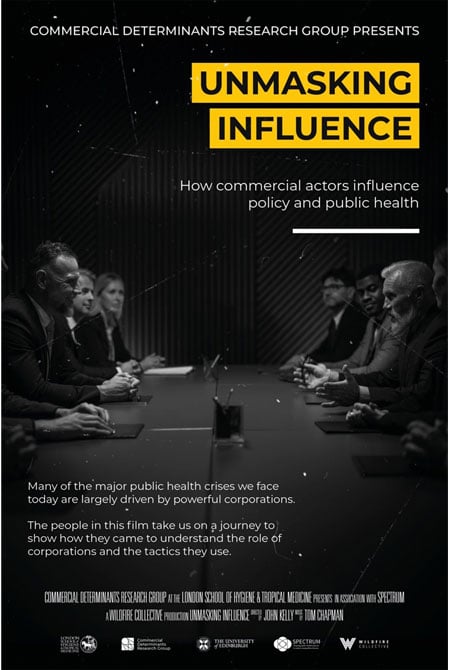
What is Unmasking Influence about?
Unmasking Influence is a film about how corporations influence policy and public health. It was produced by two members of the Commercial Determinants Research Group, Dr May van Schalkwyk and Professor Mark Petticrew and was funded through the SPECTRUM Consortium*.
Powerful commercial actors and the actions they take, affect us all, every day of our lives – many are undermining our health, our choices as individuals and as communities, and the sustainability of the planet. They shape what we see, eat, and do, and the science and laws that govern our societies. Yet we hardly talk about them or challenge the way they have become so powerful.
Unmasking Influence brings the commercial influences that are shaping our world out of the shadows through the expertise and experiences of people who work to expose and counter these forces. It aims to show, using examples from the tobacco, food, alcohol, pesticides, and other industries, why addressing these harmful commercial determinants of health is the major public health issue of our time and why policymakers must act.
* The SPECTRUM Consortium was funded (2019-2025) through the UK Prevention Research Partnership (grant reference MR/S037519/1), an initiative funded by UK Research and Innovation Councils, the Department of Health and Social Care (England) and the UK devolved administrations, and leading health research charities.
- Why make a film about corporate influence on policy and public health?
There is overwhelming evidence showing how some industries have systematically undermined science, policy, and public health, driving harm and widening inequities. We need to make sure this evidence can help catalyse change and is used to prevent this harm from continuing to happen. That requires making the issues visible and relatable to diverse audiences. Film is a uniquely powerful medium for this task, translating data and research into stories that reveal the mechanisms of influence and the consequences of conflicts of interest.
Films have the ability to inspire, motivate, and challenge entrenched thinking. They connect with audiences emotionally and intellectually, enabling policymakers, researchers, and the public to see the realities of corporate power and imagine different possibilities.
Corporate actors have long understood this power. Industries such as fossil fuels, tobacco, automotive, and chemicals have invested heavily in film to shape public opinion and protect their interests. Counter-narratives, grounded in evidence, are vital to expose these strategies and to challenge their influence.
There is a strong tradition of impactful films that have done this successfully. These works demonstrate that film can both reveal hidden harms and mobilise action for change.
Addressing the commercial determinants of health without film is like practising medicine without imaging – the problem remains invisible to many, and solutions are harder to define. Future filmmaking should not only diagnose the problem but also document progress towards dismantling conflicts of interest and freeing policy and science from corporate influence.
- Watch Unmasking Influence
Unmasking Influence is available to watch via the LSHTM Vimeo channel: https://vimeo.com/1131660477.
- Promoting Unmasking Influence
Promote Unmasking Influence using the official trailer https://vimeo.com/1123819285.
- Umasking Influence's journey so far
The journey started in Dublin where, thanks to Paula Leonard and Orla Fagan, Unmasking Influence was first screened at the Irish Film Institute. This was followed by a thought-provoking discussion, including reflections on the role of the academic community in protecting research and education from harmful commercial influence. It was at this first screening that the i-Mark for academics and researchers – an important initiative established by Paula building on the original i-Mark– was launched. The i-Mark and Unmasking Influence share a common call for independence from harmful industry influence. Unmasking influence then made its way to London School of Hygiene and Tropical Medicine (LSHTM). This screening brought together many of the film’s brilliant interviewees and director, John Kelly, to discuss topics covered in the film, including commonalities across harmful industry strategies and the importance of stories in bringing about positive change.
Unmasking Influence then travelled to Ghana, where it was shared with staff and students at Kwame Nkrumah University of Science and Technology in Kumasi thanks to Arti Singh and her wonderful team. The screening stimulated an insightful discussion.
Next, Unmasking Influence went online to contribute to FASD awareness month. This screening was following by a panel discussion chaired by Paula where Maggie May, Sarah Brennan, and Patti Rundall generously shared their wealth of expertise and experiences, and spoke powerfully about the unjust blaming of mothers and families for commercially driven harms and the need to work collaboratively to counter the influence of harmful industries.
Unmasking Influence then made its way to Belfast for a screening co-hosted by Queens University Belfast, the Centre for Sustainability, Equality and Climate Action (QUB), and Alcohol Forum Ireland. The screening took place at Queens Film Theatre followed by a plenary discussion hosted by BBC NI journalist Declan Harvey. The panel included Paula Leonard Siobhan Cullen Gillian Shorter annie campbell and the films co-executive producers May van Schalkwyk and Mark Petticrew.
It was then off to Copenhagen, where Unmasking Influence was screened twice at UN City. The first screening took place as part of the “Communicating for Impact” event, a joint event of WHO Regional Office for Europe, JA PreventNCD and JACARDI, bringing together communicators from ministries of health and partners. The second screening formed part of the high-level launch of the IARC Handbook on Alcohol and Cancer.
Unmasking Influence than made its way to Edinburgh, for a screening co-hosted by the Global Health Policy Unit and the Centre for Pesticide Suicide Prevention, the University of Edinburgh. This was followed by Q&A with panellists Heshani Sothiraj Eddleston, May van Schalkwyk, Keith Tyrell Lindsay Jaacks, Kathrin Lauber, PhD, Linda Bauld, Nason Maani.
Before its public release on the 3rd of November 2025, a final screening was held for students at LSHTM as part of the Issues in Public Health module.
We will continue to update this journey as Unmasking Influences travels across the world and reaches different audiences.
- Share how you are using Unmasking Influence
Please do let us know how you have used Unmasking influence. Please use the below link to tell us if you have held screenings of Unmasking Influence and used it for education or advocacy purposes. We would love to hear from you and about your experiences, and how the film was received!
- Research that inspired Unmasking Influence
- Lancet Series on the Commercial Determinants of Health: https://www.thelancet.com/series-do/commercial-determinants-health
- Lancet Breastfeeding series: https://www.thelancet.com/series-do/breastfeeding-2023
- Hawkins, Ben; Holden, Chris (2013). ‘Water dripping on stone’? Industry lobbying and UK alcohol policy. Policy and politics, 42 (1). pp. 55-70. ISSN 0305-5736 DOI: https://doi.org/10.1332/030557312x655468
- Hawkins, Benjamin; Holden, Chris (2013). Framing the alcohol policy debate: industry actors and the regulation of the UK beverage alcohol market. Critical Policy Studies, 7 (1). pp. 53-71. ISSN 1946-0171 DOI: https://doi.org/10.1080/19460171.2013.766023
- van Beemen, Olivier. Heineken in Africa: A Multinational Unleashed. Trans. by Bram Posthumus. London: Hurst & Company, 2019.
- van Tulleken C. Overdiagnosis and industry influence: how cow’s milk protein allergy is extending the reach of infant formula manufacturers BMJ 2018; 363 :k5056 doi:10.1136/bmj.k5056
- van Schalkwyk MCI, Petticrew M, Maani N, Hawkins B, Bonell C, Katikireddi SV, Knai C. Distilling the curriculum: An analysis of alcohol industry-funded school-based youth education programmes. PLoS One. 2022 Jan 12;17(1):e0259560. doi: 10.1371/journal.pone.0259560
- Maani N, van Schalkwyk MCI, Fillipis FT, Knai C, Petticrew M. Manufacturing doubt: Assessing the effects of independent vs industry-sponsored messaging about the harms of fossil fuels, smoking, alcohol, and sugar sweetened beverages . SSM Popul Health 2021 Dec 23:17:101009 https://pubmed.ncbi.nlm.nih.gov/35036514/
- Knai C et al. Systems Thinking as a Framework for Analyzing Commercial Determinants of Health. Milbank Q 2018 Sep;96(3):472-498 https://pubmed.ncbi.nlm.nih.gov/30277610/
- Hastings G. Hyperconsumption: Corporate Marketing vs. the Planet. Routledge 2022
- Zenone M, Kenworthy N, Maani N. The social media industry as a commercial determinant of health. International Journal of Health Policy and Management. 2022 Apr 27;12:6840. https://pmc.ncbi.nlm.nih.gov/articles/PMC10125226/
- Spin the bottle: How the UK alcohol industry twists the facts on harm and responsibility. Institute Studies, June 2025: https://www.ias.org.uk/publications/
- Palmer G. The Politics of Breastfeeding: When Breasts are Bad for Business. Pinter & Martin Ltd 2009
Meta (then Facebook) Internal documents:
- All news stories from the internal documents: https://facebookpapers.com/
- Access to documents themselves: https://fbarchive.org/collection
Meta legal threats/lawsuits/intimidation:
- https://brightdata.com/blog/general/meta-dismisses-claim-against-bright-data
- https://www.npr.org/2021/08/04/1024791053/facebook-boots-nyu-disinformation-researchers-off-its-platform-and-critics-cry-f
- https://www.eff.org/deeplinks/2021/08/facebooks-attack-research-everyones-problem?utm_source=chatgpt.com
- https://www.theverge.com/2020/10/23/21531232/facebook-nyu-ads-politics-data-election
- Education packs for use alongside Unmasking Influence
Coming soon: Stay tuned for downloadable education packs to use alongside Unmasking Influence
- Meet some of the people involved in making Unmasking Influence
Mark Petticrew (Co-executive producer)

Mark Petticrew is Professor of Public Health at the London School of Hygiene and Tropical Medicine (LSHTM). His main research interests are in evidence-based policymaking, and health inequalities. His research has a particular focus on the commercial determinants of health – in particular, the influence of unhealthy commodity industries on health (e.g. through the promotion of tobacco, alcohol, and unhealthy foods, and gambling products). Recent research includes analyses of misinformation disseminated by industry corporate social responsibility (CSR) bodies, and the common “playbook” which is used across these and other industries, including pharma, tech and digital media industries.
May van Schalkwyk (Co-executive producer)

May is a public health doctor and research fellow in commercial determinant in the Global Health Policy Unit and Centre for Pesticide Suicide Prevention at the University of Edinburgh. Her research aims to explain how commercial actors influence ideas, knowledge, science and policymaking. She publishes research on the tobacco, alcohol, gambling, fossil fuels, opioid, pesticide and firearm industries. She has a special interest in the role of film in public health policymaking, practice and advocacy.
Before transitioning into the field of public health research, May completed her post-graduate medical degree at the University of Sydney and has worked in the fields of malaria and cell-based immunotherapy research, HIV medicine, lung oncology and translational medicine. She entered specialty training in August 2016 as a Public Health Specialty Registrar and an Academic Clinical Fellow. In 2023, May completed her PhD on UK gambling policy and the gambling industry as a NIHR Doctoral Fellow at the London School of Hygiene & Tropical Medicine.
May now works at the University of Edinburgh in the commercial determinants of health in the Global Health Policy Unit and the Centre for Pesticide Suicide Prevention. She is also an honorary research fellow with the Commercial Determinants of Research Group (CDRG) at the London School of Hygiene & Tropical Medicine and holds an honorary consultant position in Public Health Scotland.
John Kelly (Director and editor)

John Kelly is the director and editor of Unmasking Influence. He is an award-winning creative director and digital specialist with a passion for using film to drive positive social change. With a background that spans over a decade, he has a proven track record of creating powerful digital campaigns and films for national and international charities, including the Red Cross and Save the Children. As Digital Director at Wildfire Collective, he specialises in end-to-end film production, from content direction and scriptwriting to animation and sound design. Wildfire is a cause-led agency that partners with charities and businesses to provide integrated design, web, communications, and film services, driven by shared values to make creativity count and achieve lasting impact.
John's versatile skills, demonstrated through collaborations with major organisations, showcase his ability to distill complex topics into clear, engaging content that connects with global audiences.
Katherine Severi (interviewee)

Dr. Katherine Severi is the Chief Executive of the Institute of Alcohol Studies (IAS), an independent charity dedicated to advancing evidence-based policy to reduce alcohol harm. Before joining IAS, Katherine gained valuable experience in the UK Civil Service and the charity sector.
She holds a Doctorate in Public Health from the London School of Hygiene & Tropical Medicine and a Master’s in Global Health and Public Policy from the University of Edinburgh. Her primary research focuses on the influence of corporations and managing conflicts of interest in public health policy.
Katherine serves in several advisory roles across key networks and committees, including the OHID Alcohol Advisory Group, the WHO Forum on Alcohol, Drugs, and Addictive Behaviours, the Alcohol Health Alliance, and Alcohol and Families Alliance. She is also an Honorary Lecturer at the University of Edinburgh’s School of Social and Political Sciences.
Marco Zenone (interviewee)

Marco Zenone (he/him) is an assistant professor of health science communication at the Faculty of Health Sciences, University of Ottawa. He completed his PhD in Public Health & Policy at the London School of Hygiene and Tropical Medicine, University of London. He then completed his postdoctoral training as a banting postdoctoral fellow at the School of Public Policy and Global Affairs, University of British Columbia. Dr. Zenone’s research program examines the health disinformation economy. As well, he leads active research into understanding how public health topics are portrayed in online and public spaces. His research is guided by the commercial determinants of health.
Research lab website: www.zenonelab.ca
Bluesky: @marcozenone.bsky.social
X: @marco_zenone
Gerard Hastings (Interviewee)

Gerard Hastings is Professor Emeritus at Stirling University in Scotland. For the last four decades he has studied the damaging impacts that commercial marketing has on our health and wellbeing and the planet as whole, publishing his findings widely in academic and non-academic outlets. His new book is available in English Hyperconsumption: Corporate Marketing vs. the Planet and French L'Hyperconsommation nuit gravement à la planète.
Ben Hawkins (Interviewee)

Ben’s work focusses on the regulation and political strategies of health harming industries at the nationally and globally. His previous work examined the implications of international trade and investment agreements for the ability of national governments to enact effective health policies. In addition, he has examined the implications of European single market laws for the enactment of health policies within EU member states, focusing on a case study of minimum unit pricing for alcohol in Scotland. His work employs qualitative methods such as semi-structured interviews and documentary analysis and draws on framing and discourse theory.
Patti Rundell (Interviewee)

Patti Rundall, OBE, is Policy Director of Baby Milk Action and Global Advocacy spokesperson for IBFAN – the global coalition of over 300 civil society organisations working in 114 countries to protect child health from commercial misinformation. Patti started her career as an artist and teacher, but changed course in 1980 to help IBFAN’s advocacy for the International Code of Marketing of Breastmilk Substitutes. This Code – the world’s first consumer protection Code – was adopted at the World Health Assembly in 1981 and has since been strengthened and clarified by 21 subsequent WHA resolutions that have kept this issue on the UN agenda. Patti has helped governments rebuff corporate pressure to trust the efficacy of voluntary codes and opt instead for legally binding regulations based on these UN resolutions.
When strong and well monitored, these laws have increased breastfeeding rates and saved millions of lives. Transparency and the need to safeguard policy setting, research and health systems from commercial influence, continue to be core themes and Patti has played a key role in the strengthening of EU baby food legislation, Codex global trading standards, the transparency and structure of the EU’s scientific advisory bodies and the adoption of new WHA Resolutions that keep pace with marketing developments. WHA49.15 in 1996 was the first WHA Resolution to call for COI safeguards in health care systems and led to the launch of the Conflicts of Interest Coalition and the strengthening of the Political Declaration on NCDs, first adopted at the UN General Assembly in 2011. As a keen advocate of networking , she founded the Baby Feeding Law Group, was a Trustee of Sustain and a leader of the International Nestlé Boycott. She also represented IBFAN on the EU’s Platform for Action on Diet and Physical Activity from 2007 to 2019. She was a founder of the interagency Infant Feeding in Emergencies Core Group that since 1999 has helped ensure that emergency responses are coordinated, not influenced by commercial agendas or exploited to create new markets for risky products.
Watch other films by CDRG
Short films based on research produced by members of the CDRG are available via our YouTube and Vimeo channels: https://www.youtube.com/@cdohshortfilms6094 and https://vimeo.com/user247685406.
How to get in touch with Wildfire Collective
Contact Wildfire Collective.