
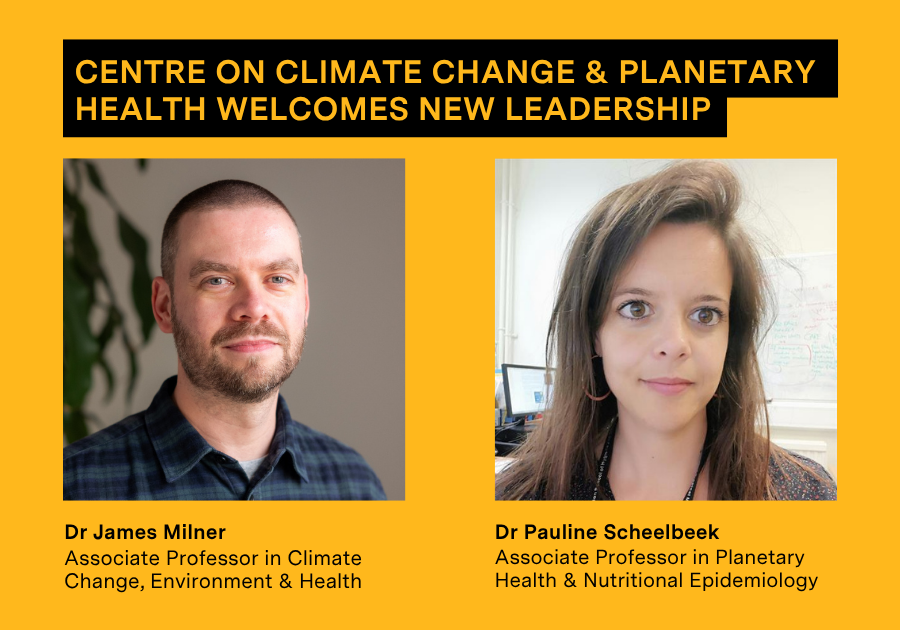
The Centre on Climate Change and Planetary Health (CCCPH) has appointed Associate Professors Dr Pauline Scheelbeek and Dr James Milner as its new Co-Directors, succeeding Professor Rosie Green and Professor Kris Murray. Pauline brings expertise in planetary health, sustainable and healthy food systems, and environmental change and health, while James's research focuses on the health impacts of climate change and the potential health benefits of climate mitigation. We spoke to them about their ambitions for the Centre, the opportunities ahead for climate and planetary health research, and how they hope to build on the Centre's work to turn evidence into action.
What does taking on the role of Co-Director mean to you, and what do you each bring to the role?
Pauline: Having been involved with the Centre since its inception as a member of the Management Group, I have seen it evolve from a small but ambitious initiative into a globally recognised centre for climate change and planetary health research. Being able to step into the role of Co-Director now feels, therefore, extremely exciting.
It is also a fascinating time for the field. As we near 2030 and the conclusion of the Sustainable Development Goals agenda, there is increasing attention on what comes next. The choices made in the coming years will shape the future of global health, sustainability, and equity for decades to come, and I am excited to help the Centre contribute to that conversation.
James: I’m new to the Centre and hope I’ll be able to bring a few new ideas and perspectives. I’m particularly looking forward to learning more about the wide range of fantastic planetary health research at the School. It’s such an exciting field to work in and is also a field that is still forming, which gives the Centre an opportunity to lead the way.
One of the strengths of our co-directorship is that we bring different but highly complementary perspectives. Pauline's work on food systems, nutrition and planetary health intersects naturally with my work on climate mitigation, environmental change and health impacts. Together, we can help ensure the Centre continues to connect expertise across disciplines while maintaining a strong focus on generating evidence that informs action.
What makes the CCCPH unique?
Pauline: What I find most exciting about the Centre is that it brings together people who might not otherwise work together. Some of the most interesting ideas emerge when researchers are exposed to different ways of thinking, different methods, and different perspectives.
This is particularly important in planetary health because we still do not fully understand all the potential co-benefits and trade-offs of climate action. Working across disciplines helps us identify synergies, anticipate unintended consequences, and avoid adaptation or mitigation strategies that may solve one problem while creating another.
Each discipline also brings its own networks of policymakers, practitioners, and partners. By connecting these communities, we are able to broaden the reach and impact of our work and ensure that research informs decisions across a wide range of sectors.
James: The environmental problems we face are multifaceted and won’t be solved without breaking down barriers, developing new techniques and working together across disciplines and national boundaries.
I think one thing that really sets the Centre apart is our capacity to work closely with policymakers. Our role as a WHO Collaborating Centre gives us an important opportunity to put health at the centre of the climate debate and to influence decisions on the international stage. There is growing demand for climate and health evidence, and the Centre’s research is feeding directly into decision making processes, both here in the UK and globally.
What opportunities do you see ahead for climate change and planetary health research?
Pauline: One of the most exciting shifts I have seen is that conversations are increasingly focusing on solutions rather than just problems. We have spent a long time documenting the impacts of climate change on health, which, of course remains crucial, but there is now growing momentum around understanding how climate action can also improve health and wellbeing.
For me, some of the biggest opportunities lie in identifying these win-wins. Whether it is transforming food systems, designing healthier cities, or creating more resilient communities, there are many examples where actions that are good for the planet can also be good for people's health. At the same time, we need to better understand potential trade-offs and ensure that solutions are equitable and work across different contexts.
James: There’s so much vital research happening in this area at the moment. One of most interesting recent developments has been the growth of systems thinking to help us understand the complex interconnections between the environmental, social and health challenges we face. By mapping these interconnections, we can learn how different parts of the system affect each other and where we can intervene to get the best outcomes, without leading to unforeseen adverse consequences for health and the environment. We’ve used this approach in our own research in several recent projects focused on urban health, but it can be applied to a range of problems.
There is also a need for the field to focus more closely on the health of the most vulnerable in society. Given the necessity for urgent and rapid action on climate change, it’s now vital to make sure policies don’t exacerbate existing health inequalities and, wherever possible, that they contribute to narrowing inequalities. The Centre can provide the evidence needed to help guide the implementation of policies that work for everyone and avoid embedding problems for the future.
What are your priorities for the Centre over the next few years?
James: Pauline and I hope to build on the LSHTM’s already excellent reputation in the field and firmly establish the Centre as a global centre of excellence and leadership. As Co-Directors, we want to help facilitate the translation of our world-leading science into real-world solutions. There is already great work at the School in this area, for instance through the Pathfinder Initiative and the Health Protection Research Unit in Climate Change and Health Security.
A good example is the role of the net zero transition in improving health, which may help to strengthen the arguments in favour of climate action. The basic science is clear that many actions to mitigate climate change have the potential to improve health, but the real-world evidence remains patchy. We need to know more about what works in practice, and what doesn’t. The Centre can provide leadership in this area by expanding our global collaborations and building stronger relationships with decision makers at various levels, including national and local governments, the WHO and UN agencies.
Pauline: Building on the fantastic work of the previous Co-Directors, our priority is to help the Centre maximise its impact, especially now, when evidence is urgently needed to inform action on climate and health. In addition to expanding our networks and translating research into policy and practice, I also see a great opportunity to further strengthen the Centre's leadership in evidence synthesis. New approaches, including machine learning-assisted evidence synthesis, have enormous potential to help us answer complex questions more quickly and efficiently, and I would like to support greater capacity and collaboration in this area.
Another priority is supporting the next generation of planetary health researchers. Through my involvement with the Centre and the MSc in Climate Change & Planetary Health, I have been struck by the enthusiasm and commitment of students and early-career researchers. I would like to create more opportunities for them to connect, collaborate, and contribute to the Centre's activities, helping to encourage future leaders in the field.
What would you like to say to the Centre community as you begin this new chapter?
Pauline & James: We would like to start by thanking Rosie Green and Kris Murray, the previous Co-Directors, for their outstanding leadership of the Centre. They have built an incredible, collaborative, and internationally recognised community, and we are fortunate to be building on such strong foundations.
More than anything, we want people to know that our doors are always open. The Centre's greatest strength is its people, and we are keen to hear ideas from colleagues, students, partners, and collaborators across our community. The challenges we work on are too complex for any one discipline or individual to solve, and the best ideas often emerge when people come together from different backgrounds and perspectives.
We are excited about what lies ahead and look forward to working together to ensure that the Centre continues to be a place for excellent research, meaningful collaboration, and real-world impact.
If you enjoyed this article and would like to build a career in global health, we offer a range of MSc programmes covering health and data, infectious and tropical diseases, population health, and public health and policy.
Available on campus or online, including flexible study that works around your work and home life, be part of a global community at the UK's no.1 public health university.