

The HPRU in Climate Change & Health Security provides research to support decision-making relating to the health impacts of climate change.
Our research focuses on the following topic areas
- Health Impact Assessment and climate-health epidemiology
- Non-vector borne infectious diseases
- Healthy indoor environments
- Developing resilience to climate change and adverse weather
The NIHR Health Protection Research Unit (HPRU) in Climate Change and Health Security is part of the NIHR and is a partnership between the London School of Hygiene & Tropical Medicine (LSHTM) and the UK Health Security Agency (UKHSA)[SH1] , in collaboration with University College London (UCL) and the Met Office.
The HPRU in Climate Change and Health Security provides the research evidence needed to enable UKHSA to protect the health of communities against climate change in the UK. We undertake world-leading interdisciplinary research on the health risks associated with key climate hazards and generate evidence on effective interventions.
The research is based around four interconnected themes: Health Impact Assessment and climate-health epidemiology; Food- and water-borne infectious diseases; Healthy indoor environments;, and Developing resilience to climate change and adverse weather. Each theme includes projects conducting primary empirical research and incorporates an important evaluation and decision support component to ensure that the empirical evidence is used to inform policy and assist decision-making.
About HPRUs
NIHR HPRUs are research partnerships between universities and the UK Health Security Agency. The units act as centres of excellence in multidisciplinary health protection research. The NIHR has awarded £59 million over five years to 14 HPRUs across England.
About the NIHR
The NIHR funds, enables and delivers world-leading health and social care research that improves people’s health and wellbeing and promotes economic growth.
- Collaborating institutions
- LSHTM (coordinating institution), Lead: Professor Shakoor Hajat - Professor of Global Environmental Health
- UK Health Security Agency, Lead: Professor Lea Berrang Ford - Head of the UKHSA Centre for Climate and Health Security
- UCL, Lead: Professor Mike Davies - Professor of Building Physics and the Environment, Institute of Environmental Design and Engineering
- Met Office, Lead Dr Christophe Sarran - Health Research Scientist
- Investigators
LSHTM
- Paul Fenton Villar - Post-Doctoral Researcher in Evidence Synthesis for Climate and Health
- Elaine Flores-Ramos - Research Fellow in Planetary Health, Department of Population Health
- Shakoor Hajat - Professor of Global Environmental Health, Department of Public Health, Environments and Society
- Meherunissa Hamid - Research Fellow, Department of Health Services Research and Policy
- Sari Kovats - Professor of Climate & Health, Department of Public Health, Environments and Society
- James Milner - Assistant Professor, Mathematical Modelling, Department of Public Health, Environments and Society
- Peninah Murage - Associate Professor, Department of Public Health, Environments and Society
- Kathleen O’Reilly - Associate Professor, Department of Infectious Disease Epidemiology and Dynamics
- Pauline Paterson - Associate Professor, Department of Infectious Disease Epidemiology
- Ian Ross - Associate Professor in Health Economics, Department of Health Services Research and Policy
- Pauline Scheelbeek - Associate Professor in Planetary Health & Nutritional Epidemiology, Department of Population Health
- Carmen Tamayo Cuartero - Research Fellow on Climate Impact on Infectious Diseases
- Grace Turner - Research Fellow, Environmental Epidemiology, Department of Public Health, Environments and Society
- Luke Vale - Professor of Health Economics, Department of Health Services Research and Policy
- Hugh Sharma Waddington - Associate Professor, Department of Population Health
- Kai Wan - Research Fellow, Department of Public Health, Environments and Society
UK Health Security Agency
- Ellen Harding-Smith - Environmental Public Health Scientist
- Lea Berrang Ford - Head of the UKHSA Centre for Climate and Health Security and Research Chair in Climate and Health at the Priestley International Centre for Climate, University of Leeds
- Dan Blake - Environmental Public Health Senior Scientist
- Kerry Broom - Knowledge Mobilisation Manager
- Rohit Chakraborty - Environmental Public Health Scientist (SEO)
- Paul Coleman - Consultant in Public Health, Extreme Events & Health Protection
- Sani DimitroulopoulouPrincipal Environnemental Public Health Scientist on Indoor Environments
- Emma Gillingham - Principal Climate Change Scientist
- Anya Gopfert - Consultant in Public Health
- Sophia Garkov - Environmental Public Health Scientist
- Helen Macintyre - Principal Climate Change Scientist
- Ai Milojevic - Assistant Professor of Epidemiology
- Tara Quinn - Principal Climate Change Scientist
- Ross Thompson - Principal Environmental Public Health Scientist
- Dan Todkill - Consultant Epidemiologist
- Sarah Whitmee - Climate and Health Assessment Team Lead
UCL
- Mike Davies - Professor of Building Physics and Environment, Institute for Environmental Design and Engineering
- Clare Heaviside - Associate Professor in Climate Change, Health and Cities
- Amr Hamada - Research Fellow in Indoor Environmental Modelling
- Paige Tien - Research Fellow in Indoor Environmental Modelling
- Phil Symonds - Associate Professor in Built Environment Analytics
- Cheng Cui - Research Fellow in Indoor Environmental Modelling
- Anna Mavrogianni - Professor of Sustainable, Healthy and Equitable Built Environment at the Institute for Environmental Design and Engineering
- Giorgos Petrou - Senior Research Fellow in Building Physics Modelling
Met Office
- Anna Goulding - Specialty Registrar in Public Health
- Lewis Ireland - Senior Scientist in the Industry Science & Consultancy team
- Helen Roberts - Senior Operational Meteorologist and Media Advisor
- Christophe Sarran - Health Research Scientist
- Daniel Williams - Manager of Climate Knowledge Integration
- PhD students
Current PhD students who are affiliated to the HPRU:
- Abby Peters, Investigating the Impact of Climate and Environmental Changes on Anthropod-related healthcare burden
- Bimal Khadka, Heatwave-related emergency care demand and hospital resilience in England: a mixed-methods study to inform health system adaptation.
- Ella Kline, Ambient Temperature, Air Pollution and Acute Kidney
- Pip Clery, Investigating the impact of extreme heat on people with severe mental illness
- Luis Mieiro, Climate Change in an Ageing World: The Impact of High Temperatures on Older Adults' Hospital Admissions in England
- Charlotte Parbery-Clark, Understanding and reducing the impacts of high outdoor temperatures on pregnancy and newborn health in England: a multi-methods study.
- Linfeng Xia, High Temperatures and Youth Violence in England and Wales: A Mixed-Methods Study
- Mita Huq, Multi-hazard warning systems and health protection: A mixed method study on MHEWS effectiveness in Japan and the UK
- Engagement

The HPRU has a Public Involvement and Engagement Group, known as PLANET (Public Led & Knowledge Engagement Team).
Researchers meet regularly with PLANET members to discuss research planning and the dissemination of results.
The Public Involvement and Engagement activities are coordinated by Dr Pauline Paterson and Dr Tara Quinn.
- External Advisory Board
The HPRU researchers are advised by an international External Advisory Board.
Its membership is drawn from academia, public health, the private sector and the PLANET group.
- Theme 1: Health Impact Assessment and Climate-Health Epidemiology
This theme develops and applies methods to advance the evidence base on the direct health impacts of climate change to support UKHSA’s delivery of programmes to protect health in a changing climate and during extreme and adverse weather. Policy relevant modelling scenarios are developed to estimate future health burdens under a range of warming levels and adaptation actions, including modelling of worse case scenarios, and considerations of equity, vulnerability and preparedness.
- Theme 2: Non-vector borne Infectious Diseases and Climate Change
UKHSA has identified climate sensitive infectious diseases as a priority topic, reflecting areas where the evidence-base is particularly sparse and/or needed to support health protection in a changing climate. The impacts of heavy rainfall events on waterborne disease outbreaks in the UK remains poorly understood. Similarly, there is relatively limited exploration of foodborne implications of climate change. This theme generates new evidence on the drivers of food- and water-borne infectious diseases and their relationships with climate factors, identifying evidence gaps, and utilising UKHSA surveillance data and advanced modelling techniques to evaluate future incidence and adaptation options.
- Theme 3: Healthy Indoor Environments
UKHSA is looking to build the evidence on healthy indoor environments in a changing climate, holistically addressing indoor environmental quality. This theme develops and advances the evidence-base on the health impacts of various aspects of indoor environmental quality, including damp/mould, indoor air quality and thermal comfort, with emphasis on the co-benefits of decarbonisation and health inequalities.
- Theme 4: Developing Resilience to Climate Change and Adverse Weather
This theme, in alignment with UKHSA objectives, aims to advance understanding and implementation of interventions in multiple settings to mitigate the health impacts of climate change and adverse weather at the individual, societal, and organisational level. Using outputs from Themes 1-3, rigorous evaluation methodologies are applied to inform decision-making and resilience-building in UK populations and across the health and social care sectors, with integration of behavioural sciences and economic evaluations.
Other research
A number of cross-cutting topics will map across the Themes. These will include (but not limited to) equity, mental health, healthy ageing, and health co-benefits of climate mitigation.
Current projects:
- Expanding understanding of climate-health links to a broad range of health outcomes, including mental health outcomes
- Including adaptation into health impact assessments of future health burdens under climate change scenarios
- Characterising health impacts from climate exposures beyond temperature
- Assessing the current evidence base on climate links with non-vector borne infectious diseases
- Characterising relationships between environmental variables and infectious diseases
- Data mapping to maximise the potential to integrate infectious disease and weather data at appropriate spatio-temporal resolutions
- Mental health and respiratory diseases from exposure to damp and mould in UK housing
- Characterising indoor environmental quality resulting from net zero policies and mapping exposures in vulnerable people
- Local authority case studies to assess the effectiveness of climate change interventions
- Application of natural experiment methodologies to explore existing and real-time organisational responses to adverse weather events
- Economic assessments of interventions
- Tailored guidance for high-risk groups
Knowledge mobilisation is about bringing together different communities to share knowledge to catalyse change, particularly health protection policy and practice. Knowledge mobilisation is a two-way process which enables advances in health protection research to create benefits for the public; practitioners, the public, and other stakeholders.
There are many terms and phrases used to describe knowledge mobilisation and its related activities, including research impact, translation and exchange. These numerous terms can cause confusion so we have developed a glossary of terms that are commonly often used in knowledge mobilisation, in order to improve clarity and understanding.
It is not meant to be a complete reference of all terms, do please let us know if you come across any additional words that should be included in the glossary.
The three aims of knowledge mobilisation in the HPRU in Climate Change and Health Security are:
- Undertake effective knowledge mobilisation activity that is appropriate to our areas of research;
- Increase knowledge mobilisation skills and capacity;
- Contribute to the evidence base for effective knowledge mobilisation.
Please find below briefs and workshop reports related to our previous HPRU in Environmental Change and Health.
- Infographic on Health benefits of four key climate actions in England and Wales, 2025
- Novel alternative foods to meat, vegetarian and dairy: are they good for the environment and human health?
- Integrating sustainability in food-based dietary guidelines
- Public involvement in environmental change and health research: Lessons learnt
- Chemical Food Safety in the Context of Food Security and Climate Change Workshop 2024
- Migration and Climate Change Workshop 2023
- Health Co-benefits of Climate Action Webinar 2024
- Health Co-benefits of Climate Action Workshop 2024
- Greenspace, Natural Ecosystems and Public Health Workshop 2024
- Chemicals, Climate Change and Health Workshop 2024
- Flooding and Health Guidance Workshop 2023
- Integrating Environmental Sustainability within National Food-Based Dietary Guidelines Workshop 2023
- Housing, Indoor Air Quality and Climate Change Workshop 2021
In May 2026, the Evaluation Task Force (ETF) announced Phase 5 of its Evaluation Accelerator Fund (EAF). The EAF is a competitive grant fund and supports research and evaluation projects that:
- create actionable evidence in government priority areas that informs public spending or policy decisions;
- tackle evidence gaps in government priority areas; or
- provide robust evidence of financial or efficiency savings from new policies, interventions, or innovative approaches to service delivery
As part of the HPRU in Climate Change and Health Security, a new project has been funded by the EAF.
Evaluation of the impacts of the UK’s Impact-Based Heat-Health Alerts: A natural experiment
- Organisation: London School of Hygiene & Tropical Medicine
- Funding awarded: £124,407
- Fund priority area: General
Heat-health alerts are a key component of the UK’s response to the growing health risks posed by extreme heat and climate change. Developed in collaboration with UKHSA and the Met Office, this project evaluates the effects of heat-health alerts in England using a retrospective natural experiment based on linked administrative and routinely collected data for weather forecasts, alert issuance, and population health outcomes. An implementation and process evaluation also examines how alerts are delivered and acted upon across national and local systems. The project aims to generate evidence on whether heat-health alerts reduce adverse health outcomes and pressures on health services, while identifying opportunities to improve the design, targeting and implementation of the current heat-health alert system. In doing so, it aims to strengthen preventative public health action against the impacts of extreme heat, while supporting the development of an NHS and care system that is resilient, sustainable, and built for the future.
Read further information and see a list of other funded projects.
Applications are now open for the HPRU Climate Change and Health Security PhD Studentship. Read more information.
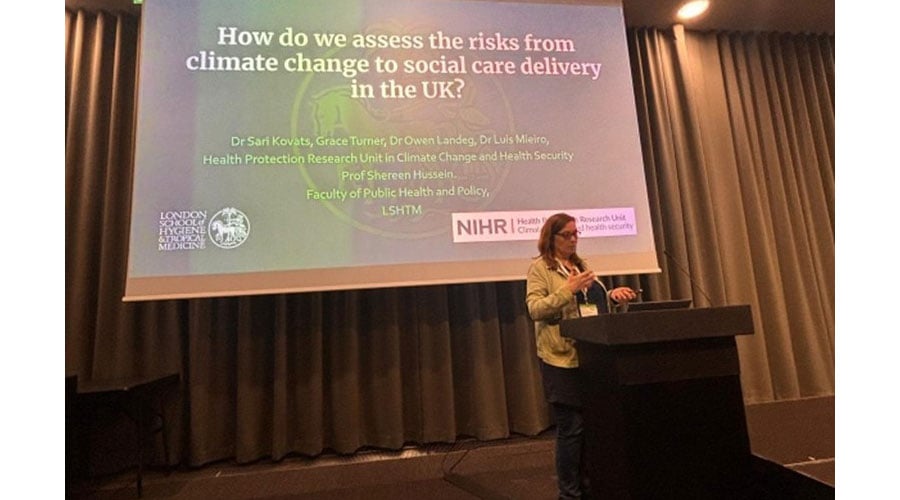
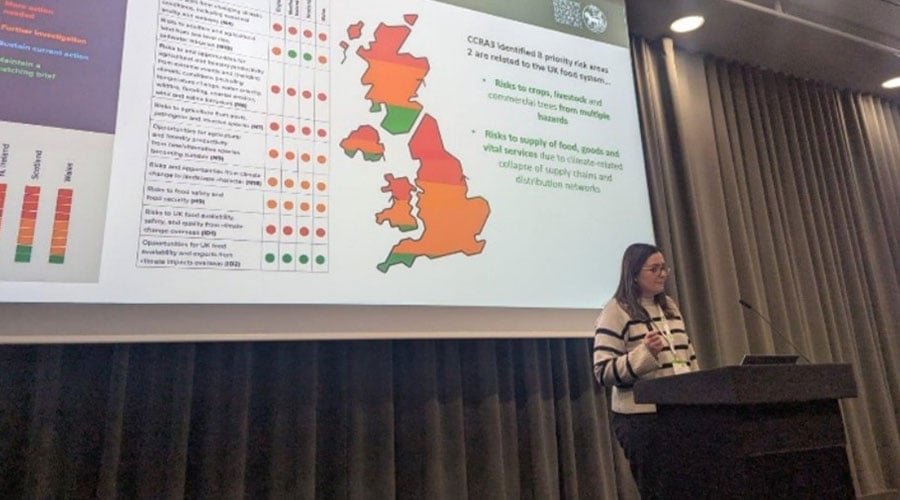
The NIHR Health Protection Research Unit (HPRU) in Climate Change and Health Security recently took part in two major European conferences that brought together researchers, policymakers, and practitioners working at the intersection of climate and health. Across both conferences, a clear message emerged: climate change is already reshaping health risks across sectors, and evidence-driven action is urgently needed.
Insights from the ENBEL Climate Change and Health Conference in Tallinn, Estonia
At the ENBEL Conference in Tallinn, Estonia in October 2025, our team presented a series of studies addressing diverse climate-related health challenges in the UK and beyond. Grace Turner (LSHTM) presented the findings from interviews with UK food system stakeholders on climate risks to the UK food system highlighting growing concern over gaps in policy response. Katya Brooks (UKHSA) shared the protocol plans for interviews and preliminary survey results on the mental health impacts of extreme weather among UK farmers, illustrating how climate stressors are compounding existing pressures on rural communities.
As part of the nature-based solution session, Grace Turner also showcased work on integrating public health into greenspace planning policy, drawing on focus groups with public health and planning professionals. Joanna Orr (UKHSA) presented results from a systematic review examining water supply disruptions and associated health outcomes highlighted recurring vulnerabilities. Finally, Ross Thompson (UKHSA) introduced how to develop a national adverse weather and health plan to tackle the challenges of climate change following the launch of the UKHSA Adverse Weather and Health Plan in 2023 which is updated annually. Link here: AWHP.
Together, these contributions underscored the interconnected nature of climate risks and the importance of cross-sector collaboration in responding effectively. The team also enjoyed exploring Tallinn, known for being one of Northern Europe's best-preserved medieval cities.
NIHR HPRU Workshop at the European Public Health Conference in Helsinki, Finland
At the European Public Health Conference in Helsinki, we led a dedicated NIHR HPRU workshop on Climate Change and Health Security, delivered in partnership with colleagues from the London School of Hygiene & Tropical Medicine and the UK Health Security Agency’s Extreme Events group. The workshop featured five sessions focusing on progress in assessing and response to impacts from climate change and implications for public health. Firstly, the workshop opened with Sari Kovats (LSHTM) presenting the results from reviewing how climate risk assessment methods across the UK and Europe quantify risks to social care.
Grace Turner followed on with a presentation highlighting approaches to assessing climate risks to food systems across Europe. Dan Blake (UKHSA) introduced new survey results on the mental health impacts of extreme weather on UK farmers. Ross Thompson highlighted a project on identifying those most at risk during heatwaves with a specific focus on discussing AI. The final presentation was delivered by Joanna Orr, on the results from a systematic review of water supply disruption and associated health effects. The workshop generated strong international engagement including a featured article in Medscape, linked here: Farmers’ Mental Health Crumbles Under Climate Strain.
Looking ahead
Across both conferences, the need for robust evidence, integrated planning, and equitable adaptation was clear. The NIHR HPRU in Climate Change and Health Security remains committed to advancing research that supports healthier, climate-resilient communities in the UK and beyond.
Dan Blake, environmental public health senior scientist at the UK Health Security Agency presented the findings of an ongoing project on the mental health of farmers impacted by flooding and draught in England as part of the HPRU in Climate Change and Health Security at the 18th European Public Health conference.
You can read more about it here: Farmers' Mental Health Crumbles Under Climate Strain