















The aim of ISEP is to define and implement a sustainable strategy to expand capacity in applied medical statistics in SSA.
The partnership is unique in focusing on career pathways for early-mid career applied medical statisticians who, lack career and skills development opportunities, and report isolation which can lead to poor job satisfaction and retention. The ISEP structure is grounded in principles of equitable partnerships, African-centred and embedded with management and leadership training.
By the end of the grant, ISEP will increase capacity by creating a network of 20-30 applied medical statisticians at several sub-Saharan Africa institutions. It will do this via:
- Improving the skill set of medical statisticians by focusing on a) peer-support; b) training in technical and transferrable skills including management training; c) creation of a pilot mentorship scheme.
- Training in medical statistics and epidemiology, led by ISEP statisticians, for students and non-statisticians through: a two-year MSc Medical Statistics Fellowship scheme, short courses, training of trainers and PhD supervision.
- Stakeholder engagement with Directors of ISEP partner and non-partner institutes, policymakers and youth.
Established in January 2024, the MRC-funded International Statistics and Epidemiology Partnership (ISEP) aims to address a long-standing shortage of trained and experienced statisticians required for the ongoing explosion of data relevant and important to human health in Africa.
ISEP is unique in focusing on career pathways for early-mid career applied medical statisticians who, lack career and skills development opportunities, and report isolation which can lead to poor job satisfaction and retention. The ISEP structure is grounded in principles of equitable partnerships, African-centred and embedded with management and leadership training.
ISEP is working to increase capacity by creating a network of applied statisticians at several African institutions: African Population Health Research Centre (APHRC), Kenya; The Health Research Unit, Zimbabwe (THRU-ZIM); Mwanza Intervention Trials Unit (MITU), Tanzania; MRC/UVRI & LSHTM Uganda Research Unit; MRC Unit The Gambia; Zambart, Zambia; the London School of Hygiene & Tropical Medicine (LSHTM) and the MRC Clinical Trials Unit, UK.
ISEP complements existing initiatives for strengthening capacity for medical statistics in Africa, and will improve:
- The skill set of medical statisticians by focusing on a) peer-support; b) training in technical and transferrable skills including management training; c) creation of a pilot mentorship scheme.
- Training in medical statistics and epidemiology, led by ISEP statisticians, for students and non-statisticians through: a two-year MSc Medical Statistics Fellowship scheme, short courses, training of trainers and PhD supervision.
- Stakeholder engagement with Directors of ISEP partner and non-partner institutes, policymakers and youth to: a) reinforce the benefits of statistical leadership at research institutes; b) raise awareness of medical statistics, health research and data analysis as careers, the role of data and, the importance of training and research to guide public health policy.
The intended impact of ISEP, is to create a fully African-led network of early-mid career statisticians by the end of 2028.
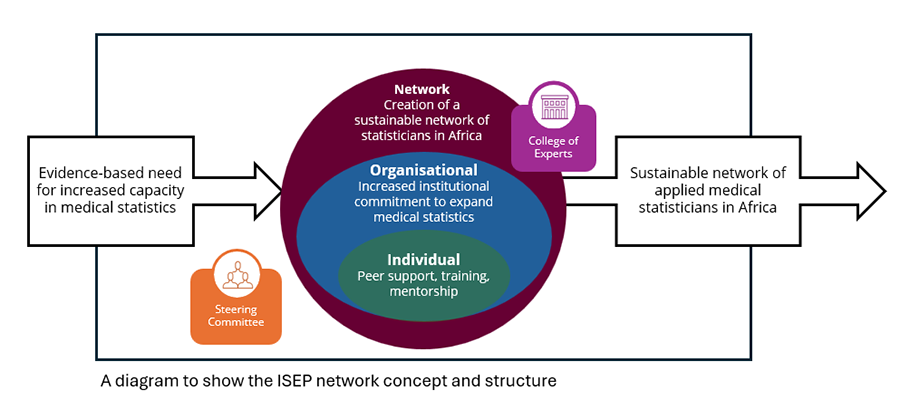
ISEP conceptual framework

Helen
Weiss
Professor of Epidemiology

Emily
Webb
Professor of Medical Statistics and Epidemiology

Sian
Floyd
Professor of Medical Statistics and Epidemiology

Vicky
Simms
Associate Professor

Andrew
Abaasa
Associate Professor
Philip
Ayieko
Assistant Professor

Thomas
Gachie
Research Fellow
Nuredin
Mohammed
Associate Professor

Agnes Kiragga
Head of Data Science Programme

Levicatus Mugenyi
Statistician

Neema Mosha
Medical Statistician and Research Associate
Eveline Konje
Research Associate
Abdul Khalie
Muhammad
MRC - Statistician*

Gaetan Kotanmi
Research Assistant

Frank Kiroro
PhD Student

Sylvia Muyingo
Biostatistician

Agnes Natukunda
Statistician at MRC/UVRI & LSHTM Uganda Research Unit

Elizabeth George
Senior Research Fellow, Statistician / UCL CTU
Dawn Duke
Head of Programmes / African Research Excellence Fund

Catherine Kansiime
Researcher Development Manager / African Research Excellence Fund

James
Carpenter
Professor of Medical Statistics

Jane Hutton
Professor of Medical Statistics / African Institute for Medical Sciences (AIMS) & University of Warwick
Jim
Todd
Emeritus Professor of Applied Biostatistics

Tobias Chirwa
Programme Director SSACAB / Head of the Division of Epidemiology and Biostatistics - School of Public Health of the University of the Witwatersrand
Kokou Alinon
Principal Technical Officer / Africa CDC
Thomas Achia
President, IBS Kenya / International Biometric Society / Sub-Saharan Africa Network
John Whittaker
Director, Medical Research Council Biostatistics Unit / University of Cambridge / MRC UK

Sarah
Harman
Research Programme Manager

Zofia
Kicinova
Project Coordinator

Miriam
Abdulla
Research Fellow
Mentoring scheme
Join our mentoring scheme as either a mentor or mentee and benefit from improving self-confidence, interpersonal skills, career progression and more.
To be a mentee you need to be actively working in global health research as a statistician and based in Africa.
To be a mentor we would expect that you are actively working in global health research with an understanding of the role of statisticians.
Each mentor-mentee pairing lasts 12 months, meeting 4 times a year. All mentors and mentees receive training in the form of a live or recorded training session (45-60 minutes).
To find out more about the scheme, complete the expression of interest form.
Theme meetings
Theme meetings are monthly online workshops of one hour where there will be a presentation of work in progress around a theme or a new methodology that people may be using.
The aim is that these meetings/workshops will promote knowledge, skills exchange and networking opportunities for applied medical statisticians.
Example meeting topics: missing data in health research, biostatistical methods for data triangulation and evidence synthesis, adaptive clinical trials, career trajectory.
To join our theme meetings, please email [email protected].
College of experts
The college is a group of experienced statisticians and epidemiologists who support ISEP's partnership activities, with the goal of building and sustaining a robust network of applied medical statisticians across Africa.
Roles may include:
- Leading or contributing to webinars on technical or disease topics, e.g. updates on new software and methods.
- Reviewing grant applications written by ISEP statisticians.
- Contributing to teaching on a short course, either online or at one of our research institutes in Africa.
- Provide advice from their professional experience (e.g. for grant applications).
Experience: working as an applied medical statistician or epidemiologist, preferably with experience in a global setting. Level of experience and expertise will depend on which area you wish to support in.
If you are interested in joining our college of experts, fill in the expression of interest form.
The International Statistics and Epidemiology Partnership (ISEP) MSc in Medical Statistics Fellowship Scheme is for students from sub-Saharan Africa and comprises of one year of MSc study, followed by a year’s placement at one of ISEP’s partner research centres in Africa: MRC/UVRI & LSHTM Uganda Research Unit; Mwanza Intervention Trials Unit (MITU); ZAMBART; THRU-Zim Biomedical Research Training Institute; African Population and Health Research Center (APHRC); MRC Unit at The Gambia, LSHTM.
All fellowship places are funded by the UK Medical Research Council (MRC) and will support fellows to study for the MSc degree in Medical Statistics at the London School of Hygiene & Tropical Medicine (LSHTM).
Applications for 2026 are open from 2nd Feb – 31st March 2026. Find out more about the fellowships.
Webinar: How to be a good trial statistician
Monday 13 October 2025
Hosts: ISEP & MRC Clinical Trials Unit at UCL Capacity Strengthening Hub
Event details: Three panel members working in Africa and the UK will share their experiences of being trial statisticians, their challenges and top tips. Audience members are encouraged to join in the discussion.
Watch a recording of the event
Launch Event: MRC International Statistics & Epidemiology Partnership
Thursday 24 October 2024
Speakers debated strategies to strengthen capacity in applied medical statistics in Africa during the MRC International Statistics Epidemiology Partnership launch event.
Watch a recording of the event
Trial Statistician Essential Reading List
A catalogue of resources with the aim of helping you gain the relevant knowledge and understanding required to work as a trial statistician. The list also contains pre-recorded videos, which cover topics such as, key concepts of cluster randomised trials.
Equitable Partnerships Framework
Co-authored by the ISEP Equitable Partnerships Working Group. This framework aims to help define the goals, roles, and expectations for achieving and sustaining equitable partnerships.
Download Equitable Partnerships Framework (pdf)
Courses
View our recommended list of free/low-cost technical training courses for applied medical statisticians below.
| Course name | Course topic | Fees |
|---|---|---|
| Rigorous training in longitudinal data science (RADIANCE) | Data Science (basics) Various courses provided on YouTube. e.g. Causal questions; Reproducible and Open Data Science; Data handling; Sampling ; Introduction to missing data | Free |
| Rigorous training in longitudinal data science (RADIANCE) | Data Science (Intermediate) Various courses on-demand e.g. Introduction to causal diagrams Regression models Longitudinal data preparation and visualisation for epidemiological and social research Addressing causal questions using real world data: an introduction Longitudinal data analysis | Around £75 - £175 |
| Rigorous training in longitudinal data science (RADIANCE) | Data Science (Advanced) 2-3 day on-line courses. Estimating causal effects Target trial emulation Machine learning and causal effects Causal mediation analysis | Around £50-£100 per course |
| Introduction to Causal Diagrams | This self-paced introductory course was organised by Professor Bianca De Stavola and Associate Lecturer Andrea Lisette Aparicio Castro for anyone wishing to learn how to graphically draw your assumptions. | £75 |
| Regression Models | This self-paced introductory course was organised by Professor Paola Zaninotto, Dr Giorgio Di Gessa, Associate Lecturer Andrea Lisette Aparicio Castro and Associate Lecture Meredith Martyn giving you an overview of commonly used regression methods. | £200 |
| Longitudinal Data Preparation and Visualisation for Epidemiological and Social Research | This self-paced course was organised by Dr Giorgio Di Gessa for anyone who needs to prepare longitudinal data for analysis. | £100 |
| Addressing Causal Questions using Real World Data: an Introduction | This self-paced introductory course was organised by Professor Bianca De Stavola, Dr Eduardo Fe and Research Fellow Eleonora Iob for those who wish to learn how causal questions can be investigated using real world data (RWD). | £175 |
| Longitudinal Data Analysis | This self-paced introductory course was organised by Senior Research Fellow Feifei Bu for anyone who wishes to enhance their knowledge and skills among researchers in analysing complex longitudinal biosocial data. | £100 |
| Using administrative data for research: a brief introduction | This self-paced introductory course was organised by Professor Pia Hardelid and Senior Research Associate Linda Wijlaars for those who are interested in whether they might want to use administrative data for research. | £100 |
| Causal mediation analysis | Online, 2 days | ~$1400 |
| Health data science | Modules under this pillar will introduce and train you to use a variety of large data analysis techniques, allowing you to process the ever-growing bank of electronic health record data for both research and real world applications. | Offered for free at Kings College through their Innovation Scholars Program |
| Omics | In the ‘Omics pillar there is a series of high-quality workshops, that are linked and integrated but can be taken separately and in any order at two different competency levels, beginner and applied. Most workshops are hands-on and have a ‘bring your own data’ to analyse component. | Offered for free at Kings College through their Innovation Scholars Program |
| AI | This training is led by the AI Centre for Value Based Health care (AI4VBH) which is a cross-institutional initiative pooling expertise from across the healthcare ecosystem, including technology companies to deliver AI, data science and advanced research into clinical practice | Offered for free at Kings College through their Innovation Scholars Program |
Our annual newsletters spotlight new members of the partnership, key accomplishments and ISEP's plans for the future.
Join our network via the below activities.
Mentoring scheme
Join our mentoring scheme as either a mentor or mentee and benefit from improving self-confidence, interpersonal skills, career progression and more.
To express your interest, complete the interest survey form.
Theme meetings
Join our knowledge-sharing monthly online meetings and learn about a new method or disease theme.
To register your interest, please email [email protected]
College of experts
To join our college of experts, complete the interest survey form.