We are already seeing the health impacts of climate change unfold around us in extreme heat, growing pressure on food systems, worsening air quality, the spread of infectious diseases, and the strain on health services. To meet these challenges, we need to understand the link between planetary and human health. That is why planetary health matters: it brings together environmental science, public health and policy to help us respond to today's risks and build a more resilient future.
The MSc in Climate Change and Planetary Health explores how environmental change affects human health and the systems that sustain human wellbeing. The programme examines the drivers of climate and ecological change, the mechanisms through which these changes influence health outcomes, and the strategies and solutions that can reduce risks and support more sustainable and resilient societies.
You will study climate change and planetary health at one of the world’s leading schools of public health. Drawing on interdisciplinary research across LSHTM, including leading work from experts within the Centre on Climate Change and Planetary Health, the programme will give you a strong foundation in planetary health. This will enable you to analyse and address the complex links between environmental sustainability and population health.
What you will learn
This will help you analyse climate-related health risks, assess environmental health data, and understand how evidence can inform policy and public health practice.
- Understand how global environmental systems, including heat stress, food systems, air pollution and biodiversity loss, affect human health
- Interpret research evidence and understand its theoretical foundations so you can make informed decisions and turn evidence into action
- Apply and evaluate methods to quantify the impacts of climate change on health, policy and practice
- Learn how to co-develop solutions and engage a wide range of audiences to support change
- Explore how to promote and protect population health in sustainable ways
Reflecting LSHTM’s global outlook, you will explore climate and planetary health challenges across a range of geographical and socio-economic contexts, including urban settings, low- and middle-income countries, and regions particularly vulnerable to climate-related hazards.
Key features
- A specialist focus on climate change and planetary health at a world-leading institution for public and global health
- Teaching from experts at LSHTM’s Centre on Climate Change and Planetary Health and the WHO Collaborating Centre on Climate Change, Health and Sustainable Development
- Strong connections between teaching and current research, with opportunities to build on these through your research project
- An interdisciplinary programme that combines scientific, analytical and policy perspectives for work in this rapidly developing field
Who is it for?
This programme is designed for applicants from a broad range of academic and professional backgrounds. As a student, you will learn alongside others with experience and interests across related disciplines.
It is well-suited to those who want to understand the complex relationships between environmental change and human health, and who are interested in building a career in planetary health. Some parts of the programme involve quantitative assessment, so a basic mathematical background is important.
Students join the programme with a range of career goals. Some are interested in policy and decision-making, others in roles within national or international organisations, and some plan to continue into academic or research careers. Whatever direction you take, you will develop specialist knowledge and skills to contribute to meaningful change in the field.
Duration
One year full-time; part-time or split-study over two years. Ways to study explained.
Intercalating study
Find out about intercalating this programme.
Climate Change & Planetary Health
Watch Programme Directors Pauline Scheelbeek and Priya Mondal talk about the programme.


Charlotte Gerard
MSc Climate Change & Planetary Health
This programme is also available online.
The below structure outlines the proposed modules for this programme. Programme and module specifications provide full details about the aims and objectives of each module, what you will study and how the module is assessed.
- Structure of the year
Term 1 (September - December) consists of ten teaching weeks for AB1 slot modules, plus one Reading Week* in the middle of the term. Followed by the Winter break.
Term 2 (January - March) consists of a further ten weeks of teaching for C and D slot modules, plus a Reading Week in the middle of the term. C modules are taught in five half-week blocks before Reading Week. D modules are taught in five half-week blocks after Reading Week. Followed by the Spring break.
Term 3 (April - September) consists of the project report.
*Reading Week is a week during term where no formal teaching takes place. It is a time for private study, preparing for assessments or attending study/computer skills workshops. There are two Reading Weeks at LSHTM: one in November and the other in February.
- Term 1
All students take five compulsory AB1 modules:
- Basic Epidemiology
- Basic Statistics for Public Health & Policy
- Environment, Health and Sustainable Development
- Fundamentals of Climate Change & Planetary Health
- Methods in Climate Change & Planetary Health
All students take one additional AB1 module, selected from the following:
- Health Policy, Process & Power
- Issues in Public Health
- Principles of Social Research
- Term 2
Students take a total of four study modules, one from each timetable slot (C1, C2, D1, D2).
C1 slot
- Research Design & Analysis
- Study Design: Writing a Study Proposal
C2 slot
- Health Systems
- Population, Poverty & Environment
- Statistical Methods in Epidemiology
D1 slot
- Planetary Health Research in Practice (compulsory)
D2 slot
- Environmental Epidemiology (compulsory)
- Term 3: Project report
Students will start working on their summer project mid-April for submission by early September. The project will typically involve formulating strategies and concepts, deciding and acting on own initiative, planning, organising and time keeping, analysing critically, systems thinking, relating and networking, adapting and responding to change, expressive writing and scientific reporting and presenting and communicating information.
Changes to the programme
LSHTM will seek to deliver this programme in accordance with the description set out on this programme page. However, there may be situations in which it is desirable or necessary for LSHTM to make changes in course provision, either before or after registration. For further information, please see our page on changes to courses.
Fees for 2026/27
| Fees 2026/27 | ||
|---|---|---|
| Home | Full-time | £14,930 |
| Part-time | £7,465 | |
| EU/Overseas | Full-time | £32,950 |
| Part-time | £16,475 |
*Mobile users, scroll right to view fees
Sources of funding:
In order to be admitted to an LSHTM master's degree programme, an applicant must:
- hold either a first degree at Second Class Honours (2:2) standard in a relevant discipline, or a degree in medicine recognised by the UK General Medical Council (GMC) for the purposes of practising medicine in the UK, or another degree of equivalent standard awarded by an overseas institution recognised by UK ENIC or the GMC.
or
- hold a professional qualification appropriate to the programme of study to be followed obtained by written examinations and judged by LSHTM to be equivalent to a Second Class Honours (2:2) degree or above.
or
- have relevant professional experience or training which is judged by LSHTM to be equivalent to a Second Class Honours (2:2) degree or above.
If you have not previously studied in the UK, you can check our guide to international equivalent qualifications for our master's degrees.
Additional requirement: applicants for the MSc Climate Change and Planetary Health will need to provide some evidence of ability in mathematics, post-16 year education. This could include:
- A-level or a higher school certificate
- a module within an undergraduate degree (such as quantitative methods, epidemiology or statistics)
- mathematics (including statistics) studied as part of a general research methods course
Applicants who do not meet the minimum entry requirement, but who have relevant professional experience may still be eligible for admission. Qualifications and experience will be assessed from the application.
English language requirements
If English is not your first language, you will need to meet these requirements: Band B.
Some applicants may be exempt if they have previously studied in English or meet other specified criteria. Please see our English language requirements for details.
It is possible to apply without English language test results however the results of a test may be listed as a condition of an offer of admission.
Intercalating students
You will need the equivalent of a bachelor's degree to undertake a master's degree. This will usually require you to have a BSc degree or have completed the first three years of your medical degree. More information on intercalating a Master's at LSHTM.
Access and widening participation
At LSHTM we are committed to ensuring that excellent students feel encouraged to apply for a course of study with us. We have introduced an innovative contextual admissions system that is designed to support those students who have faced the greatest barriers to their learning. More information on widening participation at LSHTM.
Applications for this programme are now closed for 2026/27 entry. Register your interest to be notified when applications next open.
Applications should be made online and will only be considered once you have provided all required information and supporting documentation.
Please also read LSHTM's Admissions policies (pdf) prior to submitting your application.
You can apply for up to two master's programmes. Make sure to list them by order of preference as consideration will be given to your top choice first.
Please ensure you pay careful attention to the content of your personal statement, as we do not invite applicants to interview for this programme, so the clarity and relevance of the information you can provide is of considerable importance to us. We would like to know your experiences in the relevant field(s), your reasons for applying to our programme, what you hope to gain from the training we offer, and how you intend to use the knowledge and skills you acquired to further your career and contribute to improving health.
Application fee
A standard non-refundable application fee of £50 applies to all Master’s degree programmes and is payable upon application submission. The application fee also applies to PG Diplomas and PG Certificates where appropriate. Income generated from the application fee is shared between scholarships and the student hardship funds.
Application deadline
The final closing dates for all Master’s applications for entry in the 2026/27 academic year is:
- Sunday 26 July 2026 at 23:59 UK time for all students requiring a Student visa
- Monday 31 August 2026 at 23:59 UK time for all UK, Irish and non-Student visa students
Tuition fee deposit
All applicants must respond to their offer of admission within 28 days or their place will be released and the offer automatically declined. The deposit is deductible from tuition fees upon full registration with LSHTM. Applicants in receipt of a full scholarship will not be required to pay the deposit.
- Home students: £500 non-refundable deposit, payable within 28 days of the offer date
- Overseas students: £2,000 non-refundable deposit
- Offers made before 31 January 2026: deposit due by 1 March 2026
- Offers made from 1 February 2026 onwards: deposit due within 28 days of the offer date.
Do you need a visa?
Please visit our Visa & Immigration pages for advice and guidance.
Important notice for nationals/citizens of Afghanistan, Cameroon, Myanmar or Sudan: If you require a UK student visa, the government has introduced a “visa brake”. As a result, LSHTM is currently unable to sponsor student visas for applicants from these countries.
The programme can prepare you for roles in:
- national and international public health agencies
- global organisations working on climate change and health
- government policy and advisory teams
- non-governmental organisations and international development agencies
- research institutes and universities
- climate and health consulting organisations
Graduates may go on to work as climate and health researchers, policy advisers, environmental epidemiologists, or analysts contributing to the design and evaluation of interventions that protect population health in a changing climate.
The programme also provides a strong foundation for doctoral study and specialist careers in climate and health research, environmental health and planetary health policy.
Employability
On average, 90% of our master's graduates from the 2019/20-2022/23 cohorts were in employment or undertaking further studies 15 months after graduation (Graduate Outcomes Surveys, 2020-2023).
Hear from a MSc Climate Change & Planetary Health alumni
Shahab shares his experience of studying the MSc at LSHTM and how it shaped his career after graduation.
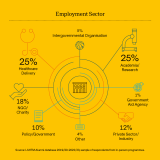
Employers and job titles examples for this programme
As a top-ranked institution for public health, our graduates' knowledge, skills and qualities are in demand in the field. Our graduates go on to various roles with a wide range of employers. Below you will find just a few of the positions and organisations that our graduates from this programme have entered:
LSHTM Alumni
LSHTM’s alumni community includes over 35,000 graduates across more than 190 countries. It offers a lifelong connection to LSHTM and to each other.
We are proud of our global alumni network, which includes many notable members, such as:
- Tedros Adhanom, the Director-General of the World Health Organization (WHO), who completed his MSc in Immunology of Infectious Diseases
- Karina Rando, the Minister of Public Health in Uruguay, studied MSc Public Health
- Christopher Whitty, Chief Medical Officer for England and Chief Medical Adviser to UK Government, studied MSc Epidemiology.
- Vanessa Bradford Kerry, founder of the non-profit Seed Global Health, director of the Program in Global Public Policy and Social Change at Harvard Medical School, and Special Envoy for Climate Change and Health for the World Health Organization (WHO), studied the MSc in Health Policy, Planning and Financing

- Career support - the LSHTM Careers Service provide a range of services from 1-1 appointments to events and workshops.
- Alumni blogs - did you know LSHTM has over 35,500 alumni in more than 190 countries.
- International alumni chapters - find an LSHTM network of alumni near you from our over 30 chapters.