
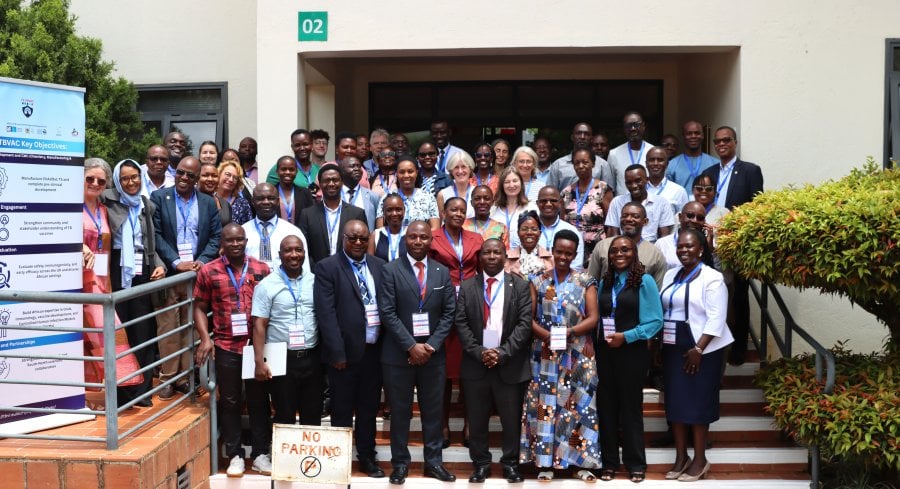
An international research collaboration is investigating a new approach to TB vaccination through T5-TBVAC, a five-year project that will evaluate ChAdOx1 T5 - a next-generation tuberculosis vaccine candidate, in early-phase clinical trials in the United Kingdom, Uganda and Senegal. Designed as a booster to the BCG vaccine, CHAdOx1 T5 combines five mycobacterial antigens and will be evaluated using two delivery approaches: aerosol vaccination, which delivers the vaccine into the respiratory tract, and intramuscular vaccination, which uses a conventional injection.
Funded by Global Health EDCTP3, the project brings together scientists from the MRC/UVRI & LSHTM Uganda Research Unit, the Uganda National Health Research Organisation (UNHRO), the Jenner Institute at the University of Oxford, the Institute de Recherche en Santé, de Surveillance Épidémiologique et de Formation (IRESSEF) in Senegal, and the Tuberculosis Vaccine Initiative (TBVI) in the Netherlands.
The study will generate early evidence on the vaccine candidate's safety and its ability to stimulate immune responses, while investigating whether different methods of delivering the vaccine could influence the potential protection it may offer against TB.
Investigating new approaches to TB vaccination
The respiratory tract is the primary site of TB infection, making it an important area of interest for vaccine researchers. Aerosol delivery could stimulate immune responses at this site, potentially complementing the responses generated by vaccination into muscle. The study will compare the safety and immune responses generated by the two approaches to understand whether aerosol delivery offers potential advantages.
Before clinical evaluation, ChAdOx1 T5 will be manufactured under Good Manufacturing Practice (GMP) standards and undergo the required preclinical safety assessments. The three early- phase clinical trials planned in the UK, Uganda and Senegal form part of the candidate’s development plan. They will assess its safety and immune responses following vaccination using the different delivery methods.
Comparing findings across the three settings will generate evidence to inform the candidates further development and the design of subsequent studies.
Strengthening TB vaccine research in Uganda
A major component of T5-TBVAC is the establishment of a BCG - Controlled Human Infection Model (BCG - CHIM) in Uganda. The model uses an intradermal injection of BCG into the skin of carefully selected, consenting and medically monitored healthy volunteers. Researchers then assess how the body responds to the BCG challenge, providing an early measure that can help evaluate vaccine activity.
For the initial study to establish the model in Uganda, BCG will be injected into the skin of the forearm. Two weeks later, researchers will take a small skin biopsy from the injection site and measure the amount of BCG present using culture and PCR (polymerase chain reaction) tests. This will help determine the appropriate dose for use in subsequent studies. The model uses BCG, a licensed vaccine containing a weakened form of Mycobacterium bovis, which is related to the bacterium that causes TB.
The skin BCG-CHIM does not expose volunteers to the bacterium that causes TB and does not directly establish whether a vaccine prevents TB disease. Instead, it provides an early way to compare how well vaccinated and unvaccinated participants control the BCG challenge. The findings can help researchers decide which vaccine candidates and approaches warrant further investigation, but they cannot replace larger clinical trials that assess protection against TB disease.
This model has already been established in the United Kingdom. Establishing it in Uganda will make it possible to evaluate vaccine activity in an African setting and compare findings across populations. It will also build local expertise in conducting controlled human infection studies, skin biopsy procedures and immunological assessments, creating a platform that could support the evaluation of other TB vaccine candidates in the future.
T5 TBVAC project co-ordinator and Professor of Vaccinology at the University of Oxford, Professor Helen McShane says;
We are incredibly excited about this programme of work which will evaluate a novel TB vaccine candidate, ChAdOx1 T5, in 4 different settings – the UK, rural and urban Entebbe and coastal Dakar. Understanding if there are differences in immune responses induced in these different settings will help us develop a more universally effective TB vaccine.
Building research capacity and public trust
Beyond evaluating a new vaccine candidate, T5 TBVAC will invest in the expertise and infrastructure needed to support future vaccine development.
The project strengthens practical research skills across the Uganda and Senegal trial teams through training in Good Clinical Practice (GCP), study protocols and procedures, laboratory techniques and immunological assays. Clinical staff from Uganda and Senegal will also receive training in skin biopsy procedures, while laboratory teams will receive hands-on training in assays used to assess immune responses. The project will support four PhD students, including three in sub-Saharan Africa, and four master’s students, as well as workshops for early-career African scientists on vaccinology, TB vaccine product development and regulatory requirements.
Community engagement will be another important part of the project. Community Advisory Boards (CABs) will provide a link between researchers and the communities involved in the study. They will help review the research plans and participant information, raise questions and concerns from community members, and advise on how the study and its procedures are explained. Researchers will also engage research participants, health workers, policy makers, regulators and local communities to support informed participation and open communication throughout the study.
Feedback from CABs, participants and community members will help researchers adapt the study protocols, participant information and consent processes to local contexts. The project will also use discussions, interviews and focus groups to understand community perspectives on TB vaccine research, aerosol vaccination and controlled human infection models. This feedback will inform how researchers communicate about the study and support people to make informed decisions about participation.
Strengthening Africa’s contribution to global TB vaccine research
T5-TBVAC brings together research institutions in Africa and Europe to advance the early development of a new TB vaccine candidate while strengthening the capacity to conduct vaccine research in high-burden settings.
By comparing safety and immune responses following aerosol and intramuscular vaccination in the UK, Uganda and Senegal, the project will generate evidence to guide the next stages of ChAdOx1 T5 development. The studies will also assess early vaccine activity using the skin BCG-CHIM in the UK and Uganda; they are not designed to establish whether the candidate prevents TB disease.
The work will contribute to the wider TB vaccine pipeline by generating evidence on a five-antigen vaccine candidate and testing approaches that could inform future vaccine development. Establishing the skin BCG-CHIM in Uganda will also provide an additional research tool for evaluating TB vaccine candidates in an African setting.
Through training, research partnerships and community involvement, T5-TBVAC will strengthen African scientific leadership and ensure that researchers and communities in countries affected by TB contribute to shaping future approaches to prevention.
T5 TBVAC forms part of the Unit's Vaccines research theme, where researchers work across the vaccine development pipeline, from understanding immune responses to conducting clinical trials and generating evidence to inform vaccine use in different settings.
If you enjoyed this article and would like to build a career in global health, we offer a range of MSc programmes covering health and data, infectious and tropical diseases, population health, and public health and policy.
Available on campus or online, including flexible study that works around your work and home life, be part of a global community at the UK's no.1 public health university.