
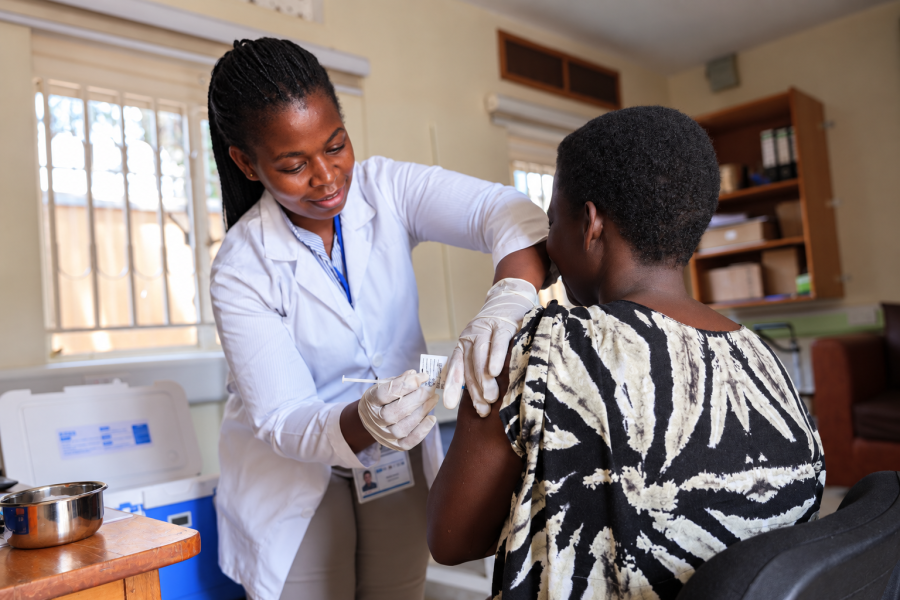
Entebbe, Uganda – 6 October 2026 – The Medical Research Council/Uganda Virus Research Institute and London School of Hygiene and Tropical Medicine (MRC/UVRI & LSHTM Uganda Research Unit) has launched a Phase I clinical study evaluating the safety and immunogenicity of a candidate vaccine against Bundibugyo virus disease (BVD), a severe form of Ebola virus disease caused by Bundibugyo virus (BDBV). The study is part of an international effort to develop vaccines against Ebola virus species for which no licensed vaccines are currently available.
Conducted in partnership with the Oxford Vaccine Group and Pandemic Science Institute, at the University of Oxford, the study will evaluate the safety of a ChAdOx-based Bundibugyo Ebola vaccine candidate, ChAdOx BDBV, and its ability to stimulate an immune response in healthy adult volunteers.
The first participants were vaccinated today, Tuesday 6th October 2026, in Masaka City, and follows the launch of a first-in-human Phase I trial in the United Kingdom evaluating the same vaccine candidate.
Both trials are funded by the Coalition for Epidemic Preparedness Innovations (CEPI), as part of a programme to advance the development of the vaccine candidate.
The ChAdOx BDBV vaccine candidate was developed by scientists at the University of Oxford, with production and quality-testing of the viral seed stock that formed the starting material for large-scale vaccine manufacture carried out onsite by the Clinical Biomanufacturing Facility.
The Serum Institute of India (SII), based in Pune, India, has collaborated to manufacture and stockpiled approximately 620,000 doses of the ChAdOx1 BDBV vaccine candidate in two weeks for potential future use. SII has supplied 300 vials to UK and additionally ~3000 investigational doses for this Phase I trial in Uganda.
The Uganda study is led by Professor Eugene Ruzagira, Head of Clinical Research and Trials at the MRC/UVRI&LSHTM Uganda Research Unit, and will be conducted at the Unit's internationally recognized clinical research site in Masaka City, southwestern Uganda. With more than three decades of experience in vaccine research and clinical trials, the site combines state-of-the-art laboratory and clinical infrastructure, and long-standing community partnerships, providing an ideal setting for conducting early-phase clinical studies to the highest scientific, ethical and regulatory standards.
The study launches at a critical time as countries in the region respond to the ongoing Bundibugyo virus disease outbreak. While Uganda has contained local transmission through rapid surveillance and response measures, Ugandan scientists and public health experts continue to support regional efforts to control the outbreak in the Democratic Republic of the Congo.
Bundibugyo virus was first identified during an outbreak in western Uganda in 2007 and remains one of the Ebola virus species for which no licenced vaccine is currently available. Developing an effective vaccine against Bundibugyo virus is therefore an important priority for global epidemic preparedness.
The study further strengthens the MRC/UVRI& LSHTM Uganda Research Unit's longstanding contribution to research on emerging infectious diseases and reinforces Uganda's role as a trusted partner in international efforts to develop vaccines and other interventions against epidemic-prone diseases.
The study is sponsored by the University of Oxford and implemented in Uganda by the MRC/UVRI & LSHTM Uganda Research Unit. It will be conducted in accordance with Uganda's regulatory requirements and international standards for ethical clinical research.
If early-stage trials are successful, CEPI anticipates working with the University of Oxford and SII to support late-stage trials to generate data for emergency use authorisation or licensure.
CEPI, SII and the University of Oxford are committed to enabling rapid, affordable supply of Bundibugyo virus vaccines to affected countries and to the populations that need them.
ChAdOx1 BDBV uses the same vaccine technology as the Oxford/AstraZeneca COVID-19 vaccine, which is estimated to have saved around six million lives during its first year of use.
Professor Eugene Ruzagira, Principal Investigator for the Uganda study, said:
“Bundibugyo virus disease is a form of Ebola with no approved vaccine or specific treatment. By evaluating the ChAdOx-based Bundibugyo Ebola vaccine candidate in Uganda, we are generating the evidence needed to determine whether it is safe and capable of stimulating the immune responses that could help protect at-risk communities in future outbreaks.”
Professor Simon Drysdale, Oxford Vaccine Group, Chief Investigator of the study said:
“This is an important moment in a truly global effort to strengthen preparedness against Bundibugyo ebolavirus. A vaccine developed and first tested at the University of Oxford, and manufactured and stockpiled in India, is now being evaluated in Uganda with our expert partners, and supported by CEPI — bringing together expertise and commitment across continents with a shared goal.
We are delighted to be working with such an experienced group to advance our candidate vaccine against Bundibugyo ebolavirus, and enormously grateful to the volunteers taking part in this trial. Their contribution is critical to generating the evidence needed to help ensure that vaccines can progress to where they are needed the most”
Professor Moffat Nyirenda, Director of the MRC/UVRI&LSHTM Uganda Research Unit said:
“This trial demonstrates how sustained investment in scientific excellence, research infrastructure and long-term partnerships has positioned Uganda as a leading centre for vaccine research in Africa. Working alongside collaborators in Uganda, across Africa and internationally, we are contributing high-quality science that will accelerate the development of vaccines against emerging infectious diseases and strengthen global epidemic preparedness.”
Dr Nicole Lurie, Executive Director of Emergency Preparedness and Response at CEPI, the funders of the study, said:
“The Bundibugyo ebolavirus outbreak raging in the DRC is now the fastest-growing Ebola epidemic in history – and the deadliest Ebola outbreak the nation has ever experienced. We urgently need a safe and effective vaccine that could help bring this crisis to an end. The findings from this Uganda trial will be essential in building the robust data to rapidly advance ChAdOx BDBV to the next stage of testing and bring the prospect of protection closer.”
Dr. Umesh Shaligram, Executive Director, Serum Institute of India said:
“The initiation of the Phase I clinical study of the ChAdOx1 BDBV vaccine candidate in Uganda is a significant step forward in addressing an important unmet need in Ebola preparedness. The rapid manufacture, stockpiling and supply of investigational doses for clinical evaluation reflect what can be achieved when global collaborators work with urgency and shared purpose.
We are pleased to contribute our manufacturing expertise to this collaborative effort and remain committed to supporting the development of innovative vaccines that can help protect communities at risk from emerging infectious diseases worldwide.”
END
Notes to editors
Media Contact-Uganda
Media Contact – Oxford
Media Contact – CEPI
Email: [email protected]
Phone: +44 7387 055214
About the MRC/UVRI & LSHTM Uganda Research Unit
The MRC/UVRI and LSHTM Uganda Research Unit is part of the London School of Hygiene & Tropical Medicine (LSHTM), core funded by UK Research and Innovation/Medical Research Council (UKRI/MRC), and a partnership with the Uganda Virus Research Institute (UVRI). For more than three decades, the Unit has been at the forefront of clinical research to improve health in Uganda, Africa and globally.
The Unit has internationally recognised expertise in designing and conducting clinical trials, including early- and late-phase evaluations of vaccines, therapeutics and other health interventions. Supported by experienced multidisciplinary research teams, state-of-the-art laboratories, robust clinical research infrastructure and long-standing partnerships with communities, the Unit conducts research up to high scientific, ethical and regulatory standards.
In addition to research on infectious and non-communicable diseases, the Unit contributes to epidemic preparedness, strengthens the next generation of African researchers through research capacity building, and works with governments, communities and global partners to ensure that research informs health policy, strengthens public health programmes and contributes to tangible health benefits.
About the Oxford Vaccine Group
The Oxford Vaccine Group is part of the Department of Paediatrics at the University of Oxford. It led the rapid clinical development of vaccinations against COVID-19 in the pandemic and has made significant contributions to knowledge, supporting national and global policy on immunisation over three decades. OVG was founded in 1994 by Professor E. Richard Moxon. It is one of the world’s leading academic vaccine research teams, and has been led by Professor Sir Andrew Pollard since 2001. The OVG undertakes vaccine research spanning basic science and preclinical studies through to epidemiological studies, human challenge models and phase I-III clinical trials. Current research includes the study of vaccines for outbreak pathogens and pandemics, enteric pathogens, bacterial and viral respiratory infections, and use of human challenge models to accelerate vaccine development.
About the University of Oxford
The University of Oxford has been ranked number 1 in the Times Higher Education World University Rankings for the ninth year running, and number 3 in the QS World Rankings 2024. At the heart of this success are the twin-pillars of our ground-breaking research and innovation and our distinctive educational offer. Oxford is world-famous for research and teaching excellence and home to some of the most talented people from across the globe. Our work helps the lives of millions, solving real-world problems through a huge network of partnerships and collaborations. The breadth and interdisciplinary nature of our research alongside our personalised approach to teaching sparks imaginative and inventive insights and solutions.
About CEPI
CEPI is an innovative partnership between public, private, philanthropic and civil organisations. Its mission is to accelerate the development of vaccines and other biologic countermeasures against epidemic and pandemic threats so they can be accessible to all people in need. Central to CEPI’s pandemic-beating plan is the ‘100 Days Mission’ to develop safe, effective and accessible vaccines against new threats in just 100 days. CEPI is seeking $2.5 billion to execute CEPI 3.0, its 2027-2031 strategy which will systematically reduce the likelihood, impact and cost of epidemics and pandemics by driving the 100 Days Mission towards an operational reality. Learn more at CEPI.net.
About Serum Institute of India Pvt. Ltd.
Serum Institute of India Pvt. Ltd., part of Cyrus Poonawalla Group is a global leader in vaccine manufacturing, dedicated to providing affordable vaccines worldwide. Present across 170+ countries, including the US, UK, and Europe, SII holds the distinction of being the world’s largest vaccine manufacturer. SIIPL’s multifunctional production and one-of-the-largest facilities in Hadapsar & Manjari, Pune, with an annual capacity of 4 billion doses, has saved over 30 million lives over the years.
Founded in 1966, SIIPL’s primary mission is to produce life-saving immunobiological drugs, with a particular emphasis on affordability and accessibility. Guided by a strong commitment to improving global health, the company has played a pivotal role in reducing the prices of essential vaccines, such as Diphtheria, Tetanus, Pertussis, HIB, BCG, r-Hepatitis B, Measles, Mumps, and Rubella. Notably, they are the manufacturers of ‘Pneumosil,’ the world’s most affordable PCV, ‘Cervavac’ the first indigenous qHPV vaccine in India, and R21/Matrix-M™, the second Malaria vaccine to be authorized for use in children in malaria-endemic regions, ‘MenFive’, the first in the world Pentavalent (ACYWX) Meningococcal Polysaccharide Conjugate Vaccine, approved and WHO-prequalified for use in the pediatric and adult population. Moreover, SIIPL has been at the forefront of the global fight against COVID-19, delivering over 2 billion doses of the COVID-19 vaccine worldwide.
To further expand its global presence and ensure widespread vaccine availability, SII has established Serum Life Sciences Ltd, a subsidiary in the UK and Serum Inc., a subsidiary in the US. Through relentless pursuit of innovation, SII continues to champion the cause of affordable vaccines, making a positive impact on the lives of millions worldwide.
If you enjoyed this article and would like to build a career in global health, we offer a range of MSc programmes covering health and data, infectious and tropical diseases, population health, and public health and policy.
Available on campus or online, including flexible study that works around your work and home life, be part of a global community at the UK's no.1 public health university.