
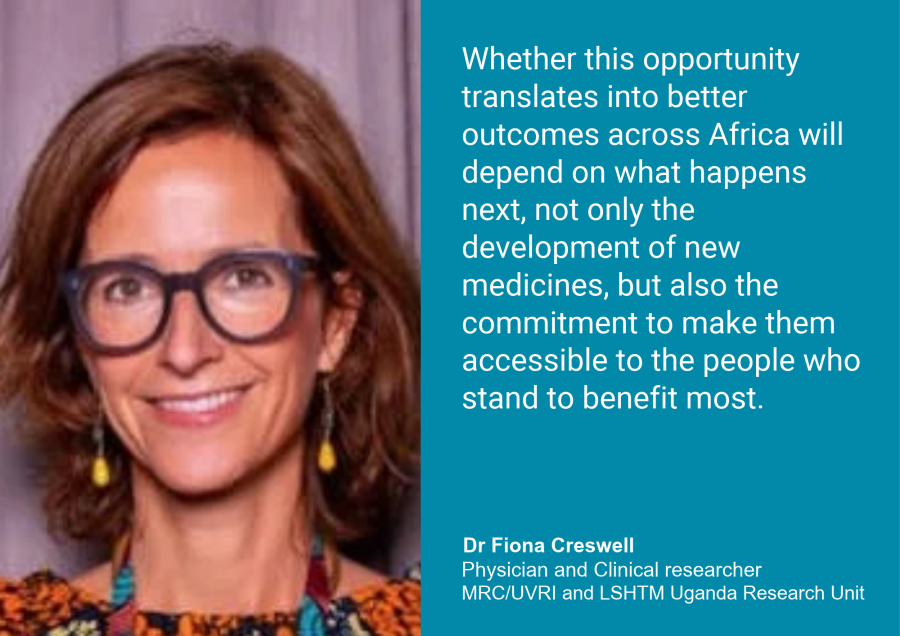
In this blog, Dr Fiona Creswell, a physician and clinical researcher at the MRC/UVRI & LSHTM Uganda Research Unit explores what the IMPALA trial tells us about the potential of long-acting HIV treatment in Africa, and why affordability, access and health-system readiness will be critical to ensuring that the people who need it most can benefit.
Imagine taking a pill every day for the rest of your life, sometimes while hiding your HIV status from your partner or your family. Missing doses can allow the virus starts to rebound, putting your health at risk and increasing the possibility of onward transmission.
For many people living with HIV in Africa, sustaining daily treatment is not simply a matter of remembering to take a pill. Stigma, poverty, competing priorities, pill fatigue and overstretched health services can all make lifelong treatment difficult. Around one million people receiving antiretroviral therapy (ART) in eastern and southern Africa are not virally suppressed, with difficulties sustaining treatment contributing to the challenge.
The consequences can be serious. Prolonged interruptions in ART allow HIV to replicate, weaken the immune system and increase vulnerability to opportunistic infections such as tuberculosis and cryptococcal disease. They can also increase the risk of HIV transmission. Inconsistent adherence is associated with a substantially higher risk of death.
The challenge, therefore, is no longer just diagnosing HIV and starting treatment. It is helping people remain on effective treatment throughout their lives.
Could long-acting injectable treatment offer a different way forward?
What the IMPALA trial found
In the Improving HIV Outcomes in Africa with Long-acting Antiretrovirals (IMPALA) trial, recently published in the New England Journal of Medicine, investigated whether long-acting injectable treatment could help people who had experienced difficulties adhering to oral ART maintain viral suppression.
The trial enrolled 540 adults in Kenya, South Africa and Uganda. Participants had a history of challenges with treatment adherence, including a viral load above 1,000 copies/ml in the preceding two years or difficulties remaining engaged in care. Although they had experienced these challenges, participants were virally suppressed at the point they were randomly assigned to their treatment groups.
The study population included people with substantial experience of HIV treatment: 60% of participants were women, 26% had a previous AIDS-defining illness, and 79% had previously received non-nucleoside reverse transcriptase inhibitor (NNRTI)-based ART.
Half of the participants switched to long-acting cabotegravir and rilpivirine injections administered every eight weeks, without baseline drug-resistance testing. The other half continued daily oral tenofovir-lamivudine-dolutegravir (TLD), the standard treatment regimen.
At 48 weeks, viral suppression was maintained at 91% of participants receiving injectable treatment, compared with 89% of those taking daily pills. The injectable regimen also had fewer episodes meeting the global definition of virological failure for long-acting injectable therapy: seven compared with 18 in the oral-treatment group. On this measure, injectable treatment met the trial's pre-specified criteria for superiority.
These findings suggest that injectable treatment can be an effective alternative for people who find daily oral therapy difficult to sustain. However, the results also highlight an important clinical trade-off.
Five participants receiving injectable treatment (1.9%) experienced virological failure compared with none receiving daily pills. Of the four participants in the injectable group with available resistance-test results, all had resistance to both drugs. Four of the five participants who experienced failure were switched to daily oral treatment, and all regained viral suppression.
Meanwhile, participants receiving oral treatment also responded well to adherence counselling, regaining viral suppression on repeat testing. The findings therefore do not suggest that oral treatment is ineffective. Rather, they demonstrate the importance of having alternatives for people whose circumstances make consistent daily treatment difficult.
The experience of participants also matters. Injections were administered on time in 98% of cases and 94% of participants preferred injectable treatment to daily pills. A qualitative sub-study also found that injectable treatment was highly acceptable and reduced the daily burden of taking HIV medication.
For people who struggle with daily treatment, that difference could be significant. But the benefits must be weighed against the risk of treatment failure and drug resistance, which can complicate subsequent treatment choices.
Long-acting ART is not a perfect solution for everyone, nor does it eliminate the challenges of lifelong HIV care. It does, however, offer another option for people who need one.
Who stands to benefit most?
The next question is how to make long-acting treatment available to the people most likely to benefit from it.
Other studies are beginning to broaden the evidence base. The LATA trial demonstrated the superiority of eight-weekly cabotegravir and rilpivirine compared over oral therapy in reducing the risk of treatment failure among adolescents. The CROWN trial also demonstrated the superiority of long-acting over oral ART when initiating injections in people with high viral loads.
Modelling of rollout strategies among African adults identified people with viral loads over 1000 copies/ml while receiving oral ART, a population similar to that studied in IMPALA, as a group that could gain substantially from injectable treatment through improved viral suppression, and reduced HIV-related mortality, with comparatively limited additional resistance risk.
Prioritisation may also need to consider the immediate risk of HIV transmission. Pregnant or breastfeeding women with detectable viral loads, for example, may warrant particular attention, although decisions about treatment must account for individual clinical circumstances and the suitability of the regimen.
These findings point towards a more targeted approach to introducing long-acting ART. Where resources are constrained, prioritisation should consider not simply who wants injections, but who is most likely to benefit clinically, the alternatives available to them, and the potential consequences of continued difficulties with oral treatment.
Such decisions will become increasingly important as demand grows and health systems weigh the cost of introducing injectable treatment against competing healthcare needs.
From clinical evidence to veritable access
Despite the promise of long-acting ART, access in Africa remains limited. Cabotegravir and rilpivirine are not yet licensed in the majority of African countries, and pricing for African markets has not been established.
This creates a significant affordability challenge. Daily oral ART costs approximately US$45–60 per person annually. Long-acting treatment will need to demonstrate that its additional costs are justified by the benefits it offers, particularly for people who struggle to remain on oral therapy.
Affordability is only part of the problem. Introducing injectable treatment also requires health services to adapt how they deliver HIV care.
Clinics must be able to schedule and administer injections reliably every eight weeks, manage missed appointments and provide oral medication to bridge delayed injections when necessary. Staff need appropriate training, and services require systems for tracking patients and ensuring that they return within the permitted dosing window.
Clinical monitoring is equally important. Programmes need appropriate hepatitis B screening and vaccination arrangements before switching eligible patients, alongside regular viral-load monitoring and access to resistance testing when treatment fails. They must also be able to move patients promptly to an alternative effective regimen when needed. The cold-chain requirements for rilpivirine add another logistical consideration, potentially making delivery more practical in facilities equipped to manage these requirements.
These demands make initial implementation more feasible in selected facilities with the necessary clinical and logistical capacity. Bit limiting access to well-resourced centres could also create barriers for the very people who stand to benefit from treatment alternatives.
The funding environment adds another layer of uncertainty. Reductions in donor funding, changes in HIV programme support and the integration of HIV services into already stretched primary healthcare systems may make it harder for countries to introduce new treatment options without additional resources.
This is particularly concerning given the longstanding delays in access to new HIV medicines in African countries compared with high-income settings, where long-acting ART has been available for several years and has generated encouraging experience in routine care.
The question is no longer simply whether injectable treatment works, but whether countries can establish the financing, regulatory arrangements and delivery systems needed to make it a realistic option for the people who need it.
For decades, breakthroughs in HIV treatment have transformed the lives of millions of people. Yet the success of ART has always depended on more than the availability of effective medicines. People need treatment they can access, services they can return to and support that reflects the realities of their lives.
IMPALA provides important evidence that long-acting cabotegravir and rilpivirine can maintain viral suppression among adults who have experienced difficulties adhering to oral ART, with high levels of treatment acceptability and preference for injections. It also demonstrates why careful patient selection, monitoring and the capacity to manage treatment failure remain essential.
Further long-acting options are also in development, and there is hope that regimens requiring less frequent administration and offering a higher barrier to drug resistance will become available.
However, waiting for a ‘perfect’ treatment option is not a substitute for preparing health systems to deliver the options already supported by evidence. Governments, funders and pharmaceutical companies need to work together to address affordability, strengthen delivery systems and determine how injectable treatment can be introduced safely and equitably because long-acting ART represents an important opportunity to rethink how lifelong HIV treatment is delivered. Whether that opportunity translates into better outcomes across Africa will depend on what happens next, not only the development of new medicines, but also the commitment to make them accessible to the people who stand to benefit most.
If you enjoyed this article and would like to build a career in global health, we offer a range of MSc programmes covering health and data, infectious and tropical diseases, population health, and public health and policy.
Available on campus or online, including flexible study that works around your work and home life, be part of a global community at the UK's no.1 public health university.