
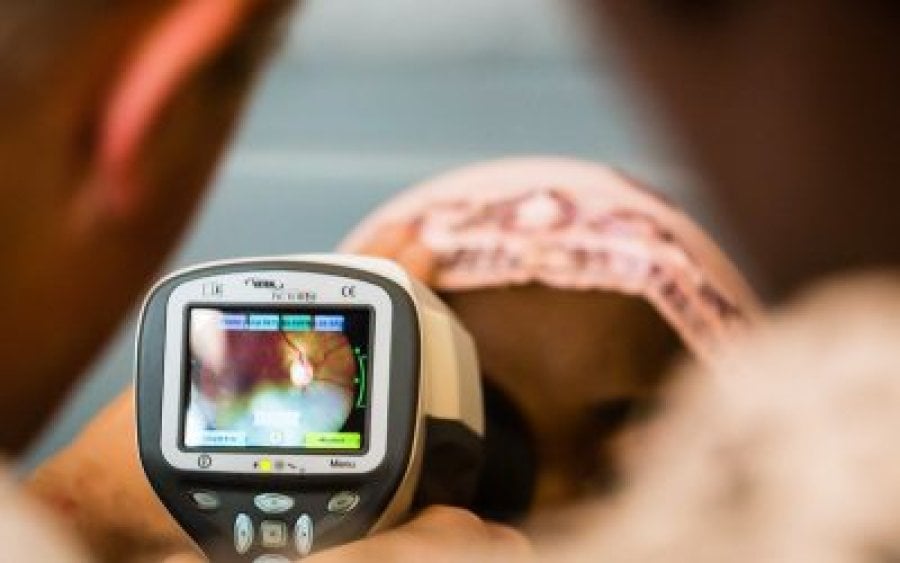
A major new international research collaboration is set to explore how the eye can reveal early signs of several diseases, bringing cutting-edge artificial intelligence and imaging technology to populations that stand to benefit most.
The Africa Oculomics Research Programme, led by the International Centre for Eye Health (ICEH) at the London School of Hygiene & Tropical Medicine in partnership with the MRC/UVRI & LSHTM Uganda Research Unit, Makerere University and the UCL Institute of Ophthalmology, will investigate how retinal imaging can be used to detect and predict a wide range of non-communicable diseases (NCDs), including cardiovascular, kidney and neurological conditions.
Oculomics, the study of how changes in the eye reflect wider health, has emerged rapidly in recent years, driven by advances in high-resolution imaging and artificial intelligence. The eye is the only place in the body where blood vessels and neural tissue can be seen non-invasively in real time.
This ambitious eight-year programme, funded by a Wellcome Discovery Award, combines expertise in ophthalmology, public health, and data science. Together, the partners aim to generate one of the most comprehensive datasets linking retinal imaging to systemic disease outcomes.
At the heart of the programme is Uganda’s long-established General Population Cohort (GPC), which has tracked population health since 1989. By embedding retinal imaging within this cohort, researchers will be able to link changes in the eye to detailed, longitudinal health data, thereby unlocking new insights into how diseases develop and progress over time.
A central innovation of the project is the development and application of AI models tailored to African populations. Historically, many AI systems in healthcare have been trained on limited or non-representative datasets, reducing their effectiveness in different populations. This programme will help address that gap by creating a large, high-quality dataset and refining AI tools specifically for use in African contexts.
Professor Moffat Nyirenda, Study Co Principal Investigator and Professor of Medicine at LSHTM, said the programme brings together advanced imaging, artificial intelligence and long-term population health data to better understand how diseases develop and how they might be detected earlier.
“The eye provides a unique window into the health of the whole body. By combining advanced imaging with artificial intelligence in one of Africa’s most established population cohorts, this programme could open new possibilities for earlier, simpler detection of many major diseases.”
He also acknowledged the partnerships supporting the programme.
“We are grateful to the many local and international collaborators whose partnership and expertise are making this ambitious programme possible.”
The potential benefits are significant, particularly for low- and middle-income countries. AI-assisted, low-cost retinal imaging could enable rapid, non-invasive screening for multiple conditions in a single encounter, reducing the need for multiple tests, easing pressure on overstretched health systems, and supporting earlier diagnosis and treatment.
By enabling diagnosis at the point of screening, the approach could also improve patient pathways and reduce loss to follow-up, while portable imaging technologies make it feasible to reach underserved and remote populations.
Beyond its immediate research goals, the programme places strong emphasis on capacity strengthening. It will support training for African clinicians and researchers, including PhD opportunities, and contribute to the development of local expertise in data science and AI through collaborative, open-source approaches.
Ultimately, the Africa Oculomics Research Programme aims to advance understanding of this emerging field while translating innovation into real-world impact, demonstrating how eye-based technologies can support more predictive, preventive, and equitable healthcare systems.
If you enjoyed this article and would like to build a career in global health, we offer a range of MSc programmes covering health and data, infectious and tropical diseases, population health, and public health and policy.
Available on campus or online, including flexible study that works around your work and home life, be part of a global community at the UK's no.1 public health university.