
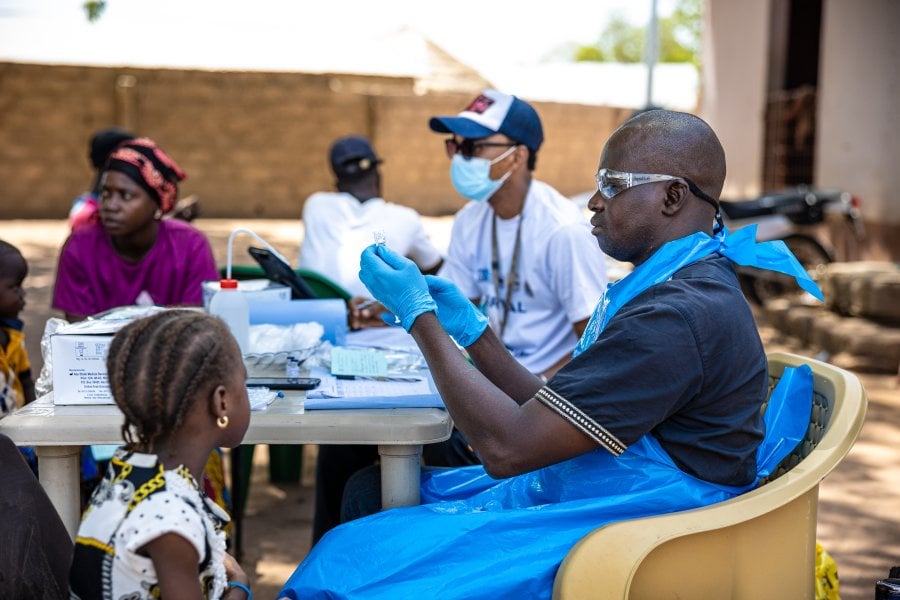
Published in The Lancet, the study was conducted in The Gambia, where malaria is seasonal with low-to-moderate transmission and in Burkina Faso where transmission is intense. It found that mass vaccination with the R21/Matrix-M (R21) vaccine, given to entire communities ahead of the rainy season, significantly reduced the proportion of individuals infected, especially at peak transmission periods in both countries. It also substantially reduced the number of patients with clinical malaria. Commonly known as SERVAL, this is the first study that vaccinated whole communities against malaria with a vaccine, R21, including small children. Seasonal mass vaccination can become a vital additional tool to reduce the burden of malaria and help in progressing towards elimination efforts.
“The study clearly shows that R21 can decrease malaria in older children, adolescents and adults, disproving previous assumptions that the vaccine would not be effective in these age groups. This is important as it can provide, besides an additional intervention against malaria, some insights on the mechanisms of immunity against malaria infection". Prof. Umberto D'Alessandro, Principal Investigator, MRC Unit The Gambia at London School of Hygiene & Tropical Medicine (MRCG at LSHTM).
Thanks to funding from the UKRI Medical Research Council (MRC) and the UK Foreign, Commonwealth and Development Office (FCDO), more than 54 villages, 30 in The Gambia and 24 in Burkina Faso, were included in the study and half of them received three monthly doses of R21 between May and August, ahead of the peak transmission season. Standard malaria control interventions, including seasonal malaria chemoprevention (SMC), continued in both countries.
Findings showed that the odds of malaria infection were reduced by 70% in The Gambia and by 25% in Burkina Faso. In The Gambia, the reduction in prevalence was seen across all age groups. In Burkina Faso, where transmission is intense and exposure is already high, the highest reduction rates were seen among children under 5 years, who are most at risk. However, some protective effect could be seen also in older age groups.
"In Burkina, where children are intensely and repeatedly exposed to malaria each rainy season, we found that the protective effect of the vaccine was concentrated among the youngest children, those who bear the heaviest burden of the disease. Thus, even in a context of high transmission, seasonal mass vaccination combined with chemoprevention enabled a measurable reduction in infection. This is an encouraging outcome for communities in the Sahel region", said Professor Halidou Tinto, principal investigator, Clinical Research Unit of Nanoro, Burkina Faso.
The study demonstrates that the vaccine was safe and well tolerated in both countries, with mostly mild headache and fever reported.
"These results are an important signal for our national malaria control programme. Mass vaccination, added onto the interventions we already deliver, could significantly lessen the burden of the disease on our communities. We look forward to working with our research partners to assess how this strategy could be integrated into our national malaria control and elimination plans", said Wandifa Samateh, Programme Manager, National Malaria Control Programme, Ministry of Health, The Gambia.
Malaria continues to be life-threatening in many communities. Children under 5 years, pregnant women and people living with HIV or AIDS are at higher risk of severe infection. Global progress against malaria has stalled over the past decade, with cases and deaths well above the levels needed to reach elimination targets. Seasonal Mass Vaccination with R21 reduced malaria prevalence in both The Gambia and Burkina Faso, bringing renewed hope as an additional strategy for malaria.
About the SERVAL Study
Seasonal mass vaccination with R21/Matrix-M is a cluster-randomised controlled trial implemented in the Upper River Region of eastern Gambia and in the Nanoro health district of Central Burkina Faso. It is designed to test whether seasonal mass vaccination with the R21 malaria vaccine can reduce community-wide malaria prevalence and clinical incidence, in addition to standard malaria control tools. The R21/Matrix-M malaria vaccine is manufactured by Serum Institute of India Pvt. Ltd., part of Cyrus Poonawalla Group. More information: seruminstitute.com
Lancet article link: https://www.sciencedirect.com/science/article/pii/S014067362601562X
About MRC Unit The Gambia at LSHTM
MRC Unit The Gambia at the London School of Hygiene & Tropical Medicine (MRCG at LSHTM) is one of Africa’s leading centres for health research, with a vision to save lives and improve health in The Gambia and around the world.
For almost 80 years, we have worked with the Government, communities and partners to reduce the burden of disease and death and train the next generation of African scientists.
As a centre of excellence for research and training, the Unit remains committed to improving public health, by generating scientific evidence that informs policy, drives implementation and delivers impact.
Contact
Isatou Njai-Cham
Head of Communications and Engagement
MRC Unit The Gambia at LSHTM
P. O. Box 273, Banjul
The Gambia
About the Nanoro Clinical Research Unit (IRSS-URCN)
The Clinical Research Unit of Nanoro (URCN) is a specialized unit of the Institute of Health Sciences Research (IRSS), one of the four research institutes of the National Center for Scientific and Technological Research (CNRST), under the supervision of the Ministry of Higher Education, Research and Innovation of Burkina Faso. Created in 2009, it offers a clinical trial platform compliant with Good Clinical Practices (PCP), with the mission of producing evidence data for the health of populations living in tropical countries. The URCN now has an operational platform to conduct research to high quality standards. Its activities mainly focus on malaria, but other topics, notably febrile and cardiometabolic diseases, have gained increasing importance in public health over the past decade. Several diagnostic, drug, and vaccine trials have been conducted there over the past ten years, including the phase 3 trial of the RTS,S antimalarial vaccine and, more recently, the phase 2 and 3 studies of R21/Matrix-M, as well as the new generation of antimalarial vaccines combining R21 with RH5 and R78C blood stage candidates.
Contact:
Sister Djamila TOPAN
Communications Officer
IRSS – Nanoro Clinical Research Unit
Campus URCN, BP 18, Nanoro
Burkina Faso
If you enjoyed this article and would like to build a career in global health, we offer a range of MSc programmes covering health and data, infectious and tropical diseases, population health, and public health and policy.
Available on campus or online, including flexible study that works around your work and home life, be part of a global community at the UK's no.1 public health university.