
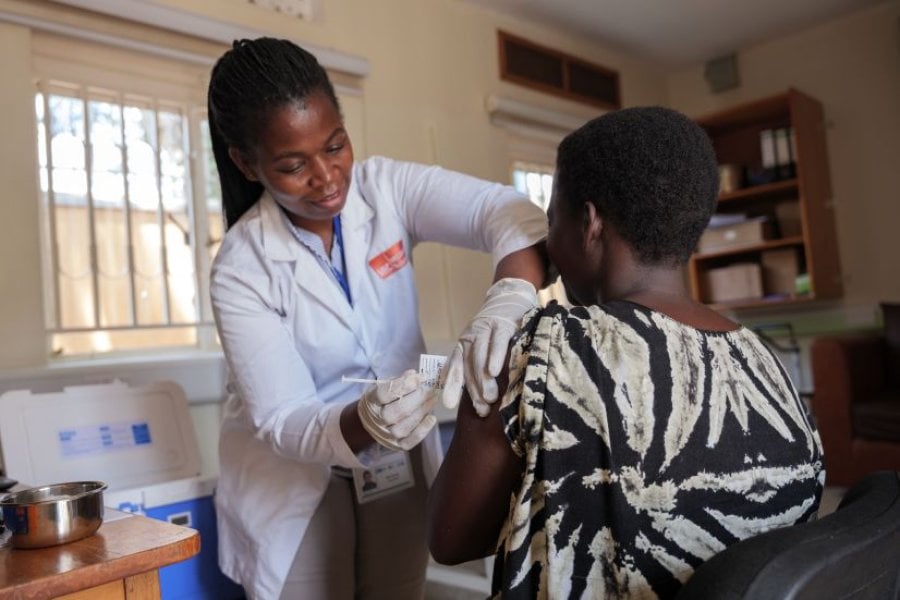
This week, The Medical Research Council/Uganda Virus Research Institute and London School of Hygiene & Tropical Medicine Research Unit (MRC/UVRI & LSHTM Uganda Research Unit) has launched a Phase I clinical study evaluating the safety and efficacy of a candidate vaccine against the Ebola Bundibugyo virus disease (BDBV). Undertaken in partnership with the Oxford Vaccine Group and Pandemic Science Institute at the University of Oxford, the first participants were vaccinated in Masaka City, with the Ugandan trial following the launch of the same first-in-human Phase I trial in the United Kingdom in July.
The Bundibugyo Ebola outbreak in the Democratic Republic of the Congo (DRC) and Uganda is one of the biggest disease outbreaks in the region in recent memory. As of 23 September, the DRC has reported a total of 7,890 confirmed cases, including 3,799 deaths, according to the World Health Organization (WHO). Furthermore, on 6 October, Kenya reported its first imported Bundibugyo Ebola case. The WHO first declared this Ebola outbreak a public health emergency of international concern on 17 May 2026, prompting a significant humanitarian and public health response.
Importantly, developing a new vaccine is of paramount importance as previously licensed vaccines designed for the Zaire strain are species specific, so deploying the current vaccines would provide little or no protection against this Bundibugyo strain. If early-stage trials are successful, the Coalition for Epidemic Preparedness Innovations (CEPI) will look to work with the University of Oxford and The Serum Institute of India (SII) to support late-stage trials to generate data to enable the vaccine to be authorised and licenced as quickly as possible. All partners involved have committed to enabling rapid, affordable supply of Bundibugyo virus vaccines to affected countries and to the populations that need them such as healthcare workers, household caregivers and family members of infected individuals.
The SII, based in Pune, India, has manufactured and stockpiled approximately 620,000 doses of the ChAdOx1 BDBV vaccine candidate in two weeks. SII has supplied 300 vials to the UK and around 3,000 additional doses for this Phase I trial in Uganda.
Professor Moffat Nyirenda, Director of the MRC/UVRI&LSHTM Uganda Research Unit said:
“This trial demonstrates how sustained investment in scientific excellence, research infrastructure and long-term partnerships has positioned Uganda as a leading centre for vaccine research in Africa.
Working alongside collaborators in Uganda, Africa and internationally, we are contributing high-quality science that will accelerate the development of vaccines against emerging infectious diseases and strengthen global epidemic preparedness.”
Commenting on the launch of the Phase I Ugandan Trial, LSHTM Vaccine Centre Co-Director, Associate Professor Muhammed Afolabi said:
“This is a significant milestone towards the development of a real-world vaccine against this strain of Ebola. By running a clinical trial in Uganda, scientists are building on the MRC/URVI & LSHTM Uganda Research Unit’s three decades of experience in vaccine research and clinical trials. Additionally, they are ensuring that communities who need the vaccine most have a direct role in its manufacturing.
“To ensure a truly equitable vaccine roll-out after successful testing, all partners must follow through on their commitments to ensure the rapid and affordable supply of the vaccine to those who have been most affected.”
The study launches at a critical time as countries in the region respond to the ongoing Bundibugyo virus disease outbreak. While Uganda has contained local transmission through rapid surveillance and response measures, Ugandan scientists and public health experts continue to support regional efforts to control the outbreak in the DRC.
Professor Martin Antonio, Co-Director of LSHTM’s Centre for Epidemic Preparedness and Response at The School’s Medical Research Council Unit The Gambia said:
“By obtaining robust safety and efficacy data of a vaccine candidate through this clinical trial, we are one step closer to bringing this Ebola outbreak to an end.
“I am delighted that this clinical trial is being led by African scientists, using local knowledge and expertise with support from international partners, as it cements the African continent’s position at the forefront of global pandemic preparedness.
“This is not a time for complacency however, as waiting for the vaccine to bring the outbreak to an end will lead to the further tragic loss of lives. Outbreak response efforts must continue: led by local and national governments and informed by communities who are affected most.”
Both trials in the UK and Uganda are funded by CEPI, as part of a programme to advance the development of the vaccine candidate.
If you enjoyed this article and would like to build a career in global health, we offer a range of MSc programmes covering health and data, infectious and tropical diseases, population health, and public health and policy.
Available on campus or online, including flexible study that works around your work and home life, be part of a global community at the UK's no.1 public health university.