
Six in 10 pregnant women had folate levels below those needed to protect their developing baby, with levels lowest among women with multiple previous pregnancies, according to a new study in Addis Ababa, Ethiopia.
Folate is an essential vitamin crucial for babies’ development during the early stages of pregnancy, and low levels can lead to neural tube defects – serious malformations of the brain and spinal cord. These conditions are largely preventable by ensuring the mother has sufficient folate in her diet or through taking folate supplementation before conception and in early pregnancy.
However, this new study led by Addis Ababa University and the London School of Hygiene & Tropical Medicine, shows that many women in Addis Ababa are entering pregnancy with low folate status, increasing risks of poor outcomes for mother and child.
The study, which assessed folate concentration in blood samples collected from 404 women attending their first early pregnancy care visit across three public health centres in Addis Ababa, found that 61% of women had levels below those understood to be protective against neural tube defects.
Researchers also found that women with previous pregnancies had significantly lower folate levels, with the folate levels reducing with each additional prior pregnancy. The findings suggest that repeated pregnancies and periods of breastfeeding are depleting mothers’ folate stores. During pregnancy and breastfeeding, a mother’s body has high demand for folate to meet the needs of their growing child. Without sufficient time between pregnancies or adequate replacement through diet or supplements, these folate stores may not be fully restored before the next pregnancy.
Only 3% of women in the study reported taking folic acid supplements before or in early pregnancy, and the study found no strong link between diet diversity and folate status. This suggests that, in this context, diet alone may not be sufficient to meet the increased demand for folate during pregnancy.
The World Health Organization recommends daily folic acid supplementation from three months before becoming pregnant through the first 12 weeks of pregnancy, a guideline which Ethiopia has adopted. These findings emphasise the need to strengthen the implementation of the folic acid supplementation guidelines, including through improved care before pregnancy, targeted support for women with repeated pregnancies, and potentially extending supplementation into the postpartum period to support folate replenishment. Researchers in Ethiopia are also assessing the potential to increase folate status of the wider population through folic acid fortification of common table salt, which is already fortified with the essential nutrient iodine.
The findings highlight both the scale of folate deficiency as a public health issue in Ethiopia, and the groups most at risk, particularly women with repeated pregnancies. Building further evidence across Ethiopia and other low- and middle-income countries will be important to guide targeted interventions and reduce preventable birth defects.
Hasset Tamirat Molla, Assistant Professor of Nutrition at Addis Ababa University and lead author of the study, said: “What is striking in our study is the clear, stepwise decline in folate status with each additional pregnancy. This provides strong evidence that repeated pregnancies can leave women nutritionally depleted, particularly in settings where supplementation is rare, and helps explain why some women may face higher risks of having babies affected by neural tube defects.”
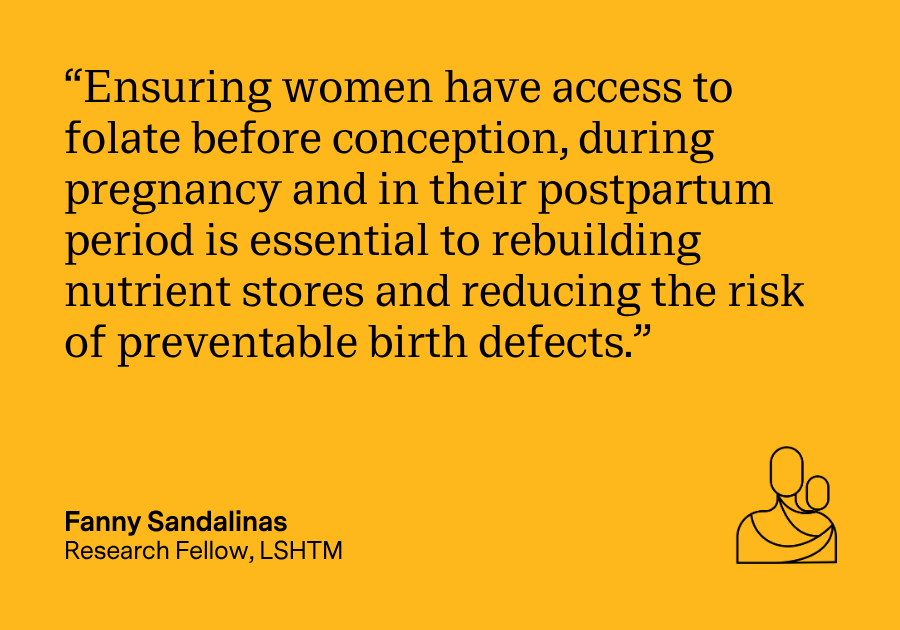
Fanny Sandalinas, Research Fellow at LSHTM and senior author of the study, said: “These findings highlight the need to strengthen interventions across the entire reproductive cycle. Ensuring women have access to folate before conception, during pregnancy and in the postpartum period is essential to rebuilding nutrient stores and reducing the risk of preventable birth defects. This will require coordinated efforts, from improving preconception care to scaling up folic acid supplementation and food fortification.”
These findings build on earlier research led by the same team, which found that folate deficiency among women in Ethiopia is not evenly distributed, but instead varies geographically in ways linked to local farming systems. That study showed that the foods available and grown in a given area shape women's folate status before they become pregnant. Together, the two studies point to a compounding problem: many Ethiopian women enter pregnancy with already-low folate reserves shaped by what their local food system provides, and each subsequent pregnancy further depletes those reserves further.
Edward Joy, Associate Professor in Nutrition and Sustainability at LSHTM and co-author on the studies, said: "Taken together, these two studies give us a much stronger understanding of what's driving folate status and NTD risk in Ethiopia.
"We can now see how local agriculture and food systems combine with demographic factors like gravidity to shape a woman's folate status at the critical stage of early pregnancy. That combined picture is what will let us design effective, targeted interventions, whether through food fortification, agricultural diversification, or clinical supplementation."
Publication
Tamirat et al. Prior Pregnancies Deplete Maternal Folate Status and Increase Risks of Neural Tube Defects in Addis Ababa, Ethiopia. The Journal of Nutrition, 2026. DOI: 10.1016/j.tjnut.2026.101666
Funding
The study was funded by the Gates Foundation through the GeoNutrition project and the Micronutrient Action Policy Support (MAPS) project.
If you enjoyed this article and would like to build a career in global health, we offer a range of MSc programmes covering health and data, infectious and tropical diseases, population health, and public health and policy.
Available on campus or online, including flexible study that works around your work and home life, be part of a global community at the UK's no.1 public health university.