A new technical brief and interactive framework recently launched explore how plastic pollution moves through agrifood systems, revealing interconnected impacts on soils, plants, animals, ecosystems and human health.
The resources were developed through work co-led by the Agriculture, Nutrition & Health (ANH) Academy Science-Policy Platform at the London School of Hygiene & Tropical Medicine (LSHTM) and the Food and Agriculture Organization of the United Nations (FAO), bringing together evidence and expertise from researchers and practitioners across disciplines, sectors and regions.
The technical brief, Plastic pollution in agrifood systems and One Health: Impact pathways and policy implications, brings together evidence on how plastic pollution can cascade and compound across interconnected systems. Using a One Health approach, which recognises the close links between human, animal, plant and environmental health, the brief sets out four illustrative impact pathways, alongside four areas for action to support more coordinated responses.
The new resources build on several years of research and policy engagement by ANH Academy researchers and collaborators working to raise the profile of plastic pollution as a food-systems issue. A systematic review in Nature Food mapped evidence on the environmental, food security and health impacts of plastics used across food systems, identifying substantial gaps in the evidence base. More recent work has explored how plastics could be better reflected in food-systems monitoring and policy, including through engagement with the negotiations for a global treaty on plastic pollution.
Plastics are embedded throughout modern agrifood systems, from agricultural films and mulches used in crop production, irrigation equipment and fertilisers to food processing, packaging, transport and waste management. An estimated 13.4 million tonnes of agricultural plastics are used globally each year, alongside more than 37 million tonnes in food packaging.
The brief highlights how plastic pollution does not remain confined to the place where it is produced or used. Plastic fragments and chemicals can accumulate in soils, move through waterways, enter food chains and expose animals and people. Agrifood systems can also receive plastic pollution from other sectors through wastewater, runoff, atmospheric deposition and contaminated irrigation water.
The four illustrative pathways showing how the effects of plastic pollution can move through interconnected systems are:
- Cascading impacts through soils, including effects on soil structure, microorganisms, plant growth and the movement of micro- and nanoplastics and chemicals into crops.
- Animals at risk across land and water, from ingestion and entanglement to the potential movement of pollutants and pathogens through food webs.
- Human exposure and system feedbacks, including exposure through food, the environment and occupations across agrifood systems, and the recirculation of pollutants through wastewater and agricultural soils.
- Climate and nature under pressure, exploring how pollution and emissions across the plastics life cycle contribute to climate change, biodiversity loss and wider pressures on the ecosystems that food production depends on.
The brief calls for plastic pollution not to be treated solely as a waste-management issue. Pollution is generated throughout the plastics life cycle, from fossil-fuel extraction and production to use, recycling and disposal, meaning action is needed both upstream and downstream.
It identifies four mutually reinforcing areas for action: building a shared evidence base across sectors; co-designing inclusive solutions with affected communities; coordinating action across policies and international agreements; and using continuously developing, or “living”, evidence to inform future policy review.
This includes strengthening links between environmental, food safety, veterinary and public health evidence, as well as ensuring groups particularly affected by plastic pollution – including smallholders, waste pickers, Indigenous Peoples, artisanal fishers and women’s groups – are meaningfully involved in developing solutions.
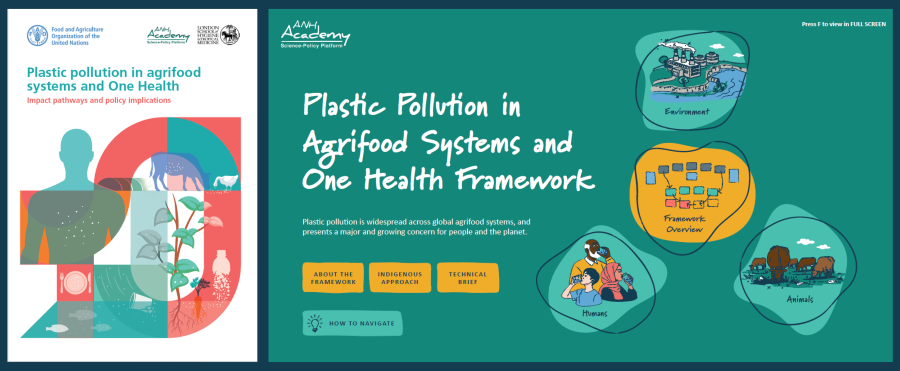
The technical brief is accompanied by the Plastic Pollution in Agrifood Systems and One Health Framework, an interactive tool created by the ANH Academy Science-Policy Platform to help users explore the four pathways visually and trace how the effects of plastic pollution can move between environments, animals and people.
Joe Yates, Director of Networks, Partnerships & Impact of the ANH Academy Science-Policy Platform at LSHTM and lead author of the technical brief, said: “Food systems are under growing threat from pollution throughout the plastics lifecycle, much of which they are driving. The impacts are reverberating around the environment, humans and other animals, posing new and compounded risks. Recognising the scale and interconnectedness of this problem is critical to co-designing urgent actions.”
This work developed from a workshop held at FAO headquarters in Rome in November 2025, jointly organised by FAO, the ANH Academy Science-Policy Platform at LSHTM and Università Cattolica del Sacro Cuore. Participants subsequently worked together through virtual consultations to develop the evidence-based impact pathways presented in the new resources.
The brief and framework were formally launched in Rome on 23 September at an event at the FAO Conference, with a second launch taking place the same day at the 2026 Plastics and Human Health Symposium in New York.
Explore the interactive Plastic Pollution in Agrifood Systems and One Health Framework.
Read the technical brief, Plastic pollution in agrifood systems and One Health: Impact pathways and policy implications.
If you enjoyed this article and would like to build a career in global health, we offer a range of MSc programmes covering health and data, infectious and tropical diseases, population health, and public health and policy.
Available on campus or online, including flexible study that works around your work and home life, be part of a global community at the UK's no.1 public health university.