The Plus Project, a large-scale research initiative led by Population Services International in partnership with the London School of Hygiene & Tropical Medicine (LSHTM), implemented an innovative travel policy that successfully reduced the project’s travel-related carbon emissions.
The policy, developed at the Plus Project’s outset, supported staff in planning and booking travel, ensuring air travel was only booked when essential.
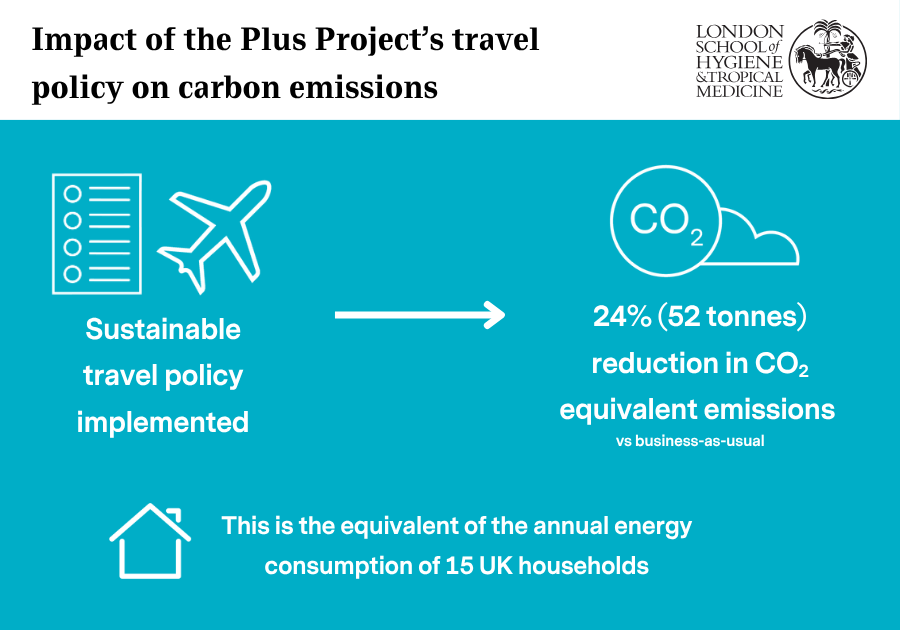
The results, published in a new case study report, show that the policy led to a reduction in the project’s travel-related carbon emissions by 24% compared to the business-as-usual approach. This avoided nearly 52 tonnes of CO2 equivalent (a unit used to measure the impact of various greenhouse gases), which is equal to the annual energy consumption of about 15 UK households.
The Plus Project worked with partners globally to co-develop, pilot and evaluate interventions to prevent malaria in infants, specifically using a method called Perennial Malaria Chemoprevention (PMC). This involves administering antimalarial medicine at specific times in the first 24 months of vulnerable infants’ lives, and the Plus Project was assessing the effectiveness of the treatment in four focus countries: Benin, Cameroon, Côte d’Ivoire, and Mozambique.
The international nature of the project required a lot of air travel – a key contributor to human-induced climate change.
However, the researchers were aware that the negative impacts of climate change threaten any advances made in public health worldwide, so were keen to pilot innovative solutions to reduce the project’s carbon footprint.
The project developed a travel policy to help staff plan and book lower-emission travel. It encouraged air travel only when essential, combining journeys into fewer, longer trips, choosing direct flights over routes with multiple stopovers, and using rail for travel within Europe wherever possible.
By following the travel policy, the project generated an estimated 167,776 kg CO₂ equivalent from travel – 51,967 kg less than the 219,743 kg CO₂ equivalent expected under a business-as-usual approach.
A further 14,415 kg CO₂ equivalent (an additional 9%) could have been avoided if every journey had followed the lowest-emission travel option.
Roly Gosling, Professor of Global Health at LSHTM and Plus Project Lead said:
“I am delighted that the Plus Project has showcased that international public health research projects can be made more sustainable. We’ve shown that better travel decisions, not fewer partnerships, reduced our carbon footprint by almost a quarter.
Sustainable travel means making every journey count and that reducing carbon doesn't mean reducing vital collaborations.”
The new case study not only outlines the methods used by the Plus Project but also provides lessons learned for any future research projects looking to lower their travel-related environmental impact. These include:
- Establish shared priorities early
At the outset, agree a clear decision-making framework for travel, involving both travellers and booking staff. Early alignment ensures that those responsible for booking feel empowered to prioritise sustainability.
- Leadership is critical
Principal Investigators and senior staff play a key role in setting expectations. Visible commitment to low-carbon travel – through both advocacy and personal practice – helps embed these principles across the team.
- Start early and embed tracking process
Emissions tracking should begin at project inception. Assign clear lines of responsibility and time, integrating carbon tracking into routine project processes to ensure consistent monitoring without creating undue administrative burden.
- Capture decisions not to travel
Maintain a register of decisions cancel, combine, or replace trips to strengthen future analyses and provide a more complete picture of emissions reductions.
- Validate external data sources
Travel data from external sources, like a corporate travel management company, and emissions calculations should be periodically verified against benchmark figures and methods for accuracy.
The Plus Project’s travel policy also plays an important part in helping LSHTM hit its ambitious target of reaching net zero carbon emissions by 2030. The School is encouraging thoughtful travel, divesting from fossil fuels and instituting energy and carbon management plans across its buildings to embed sustainability across its operations.
LSHTM staff interested in reducing their work-related travel carbon footprint are encouraged to join the Sustainable Air Travel Community of Practice which exchanges ideas and best practices of how to implement global health research projects whilst aiming to reduce carbon emissions generated by air travel.
Read the full case study report: The Plus Project - Project level carbon tracking.
If you enjoyed this article and would like to build a career in global health, we offer a range of MSc programmes covering health and data, infectious and tropical diseases, population health, and public health and policy.
Available on campus or online, including flexible study that works around your work and home life, be part of a global community at the UK's no.1 public health university.