

Job title: Senior Lecturer
Organization: Makerere University
Location: Kampala, Uganda
Email address: [email protected] [email protected]
Tell us about your current role.
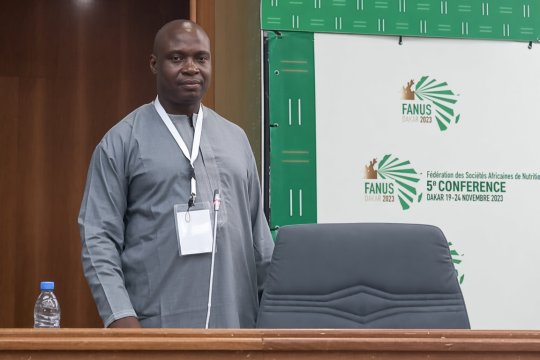
I’m a Senior Lecturer at Makerere University in Uganda and, since 2023, I’ve served as President of the Federation of African Nutrition Societies (FANUS). As a nutritionist and food technologist, my work focuses on how local foods, such as beans, and food systems can improve nutrition and food security for women and children in low- and middle-income African countries.
I'm also one of the Co-Chairs of the Research Consortium's Nutrition Community of Practice.
What’s something exciting that you’ve worked on recently?
As President of FANUS, I’ve been delighted to support the organisation’s growing contribution to school feeding research, policy and practice across Africa. One important achievement has been the establishment of the African Technical Working Group on School Feeding (ATWG), together with the African Nutrition Society, the Research Consortium, and the International Malnutrition Task Force of IUNS.
The ATWG brings together researchers, governments and partners from across the region to strengthen collaboration, harmonise standards, promote home-grown approaches and address shared challenges, including sustainability and dietary quality. I’m particularly excited about its potential to help countries learn from one another and build stronger school meal programmes across Africa.
What did school meals look like when you were growing up?
In the mid-1980s, when I began my primary education in Kampala, my school prepared and served our meals. My parents contributed financially so I could eat what was provided-usually stiff porridge prepared from maize flour commonly referred to as “posho/Ugali” or matooke with beans. Occasionally they also gave me money for a canteen snack.
The same arrangement continued with my secondary education in the 1990s. The school provided the meals, mainly posho or rice with beans, supported by my parents’ financial contribution. From time to time they gave me extra money to buy a snack from the canteen. At University from 1999, I ate the meals prepared by the university dining halls-typically posho or rice with beans. As before, my parents sometimes provided money for additional canteen snacks.
Across all three stages of my education, my parents supported my feeding through regular financial contributions to the school and university meals, with occasional extra money for snacks.
What impact do you hope your work will have?
I’m already seeing encouraging progress, which motivates me greatly to continue my research and advocacy.
In Uganda, an important recent development has been the establishment of the Uganda Working Group on School Feeding under the Ministry of Education and Sports. The group is strengthening coordination across sectors and generating new evidence on programme coverage, meal quality and implementation gaps. This work is highlighting persistent challenges, including heavy reliance on parent contributions, low dietary diversity and regional disparities, while also identifying opportunities to strengthen home-grown procurement and the use of biofortified crops.
Uganda’s progress reflects a wider shift in how countries around the world view school meals. There is growing recognition that well-designed school meal programmes are not simply a social protection measure, but a powerful investment in children’s nutrition, health, education and long-term wellbeing. My hope is that stronger evidence, collaboration and political commitment will help more countries realise the full potential of school meals.
How can people get involved or stay up to date with your work?
You can stay up to date with my work and get involved by following me on X (Twitter), connecting with me on LinkedIn, and viewing my publications on ResearchGate and Google Scholar. For professional correspondence or collaboration inquiries, please email me at [email protected] or [email protected] or [email protected]. You are also welcome to follow the activities of the Federation of African Nutrition Societies (FANUS) through the official website at www.fanus.org.
If you enjoyed this article and would like to build a career in global health, we offer a range of MSc programmes covering health and data, infectious and tropical diseases, population health, and public health and policy.
Available on campus or online, including flexible study that works around your work and home life, be part of a global community at the UK's no.1 public health university.