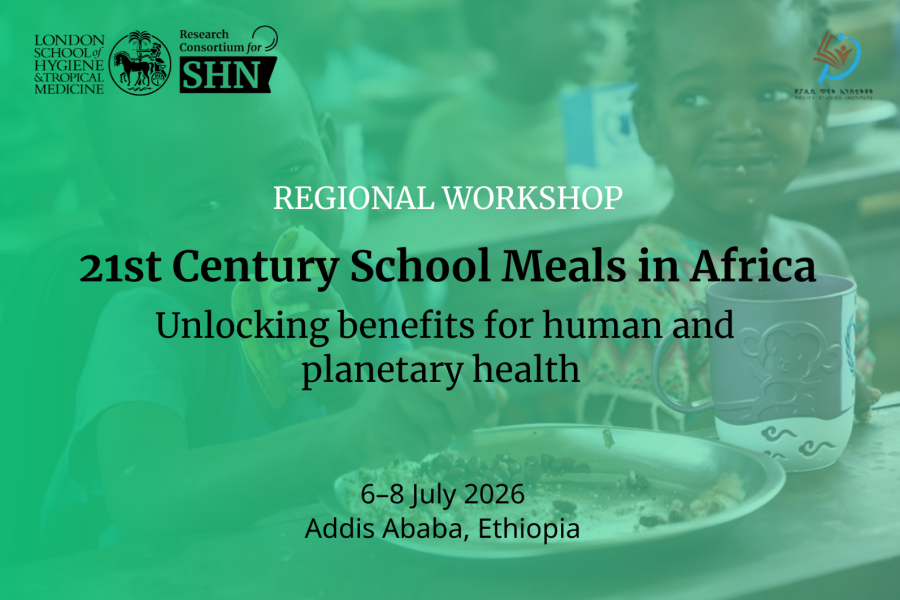
In July 2026, policymakers, researchers, and technical experts from Ethiopia, Ghana, Kenya, Lesotho, Rwanda, Uganda and Zambia gathered in Addis Ababa, Ethiopia, for a regional workshop convened by the Research Consortium, to set shared priorities for strengthening the evidence base behind school meals programmes across the region.
The workshop, 21st Century School Meals in Africa: Unlocking Benefits for Human and Planetary Health, was co-convened with the African Population and Health Research Center (APHRC) and hosted by the Policy Studies Institute (PSI) Ethiopia. It was held under the banner of the School Meals Coalition, of which all seven participating countries are members, and supported by the Novo Nordisk Foundation (NNF).
Together, the delegations represent national school meals programmes reaching more than 33 million children – around a third of all school meals coverage on the continent – making the workshop a significant moment for regional collaboration on the future of school meals research.
Two interconnected 21st century food challenges
The workshop responded to a dual-crisis facing governments across the region: rising rates of diet-related illness alongside increasingly vulnerable food systems. Over two and a half days, delegates explored how school meals programmes could be strengthened to improve children's diets and long-term health, while also building more sustainable and resilient food systems.
To advance progress towards addressing these challenges, workshop discussions centred on two complementary strands of work. The first was the design of a proposed multi-country dietary quality study, informed by early findings from the Research Consortium's forthcoming White Paper on School Meals and Cardiometabolic Disease Prevention. The second explored country interest in a growing suite of decision-support tools being developed by the Consortium to help governments plan and deliver school meals that are healthier, more sustainable and more cost-effective.
Strong appetite for better school meals across the African region
All seven countries expressed strong commitment to participating in the proposed dietary quality study, recognising the value of generating comparable evidence to inform national policy and strengthen programme implementation. Delegations were consistent in stressing that any collaboration must be underpinned by a governance structure that puts governments at the centre of study design, ensuring the research reflects national systems, priorities and contexts.
There was equally clear demand for practical tools to help translate evidence into action. Across the region, a new School Meals Planner tool, which will support governments to design nutritious and cost-effective school meals menus based on their local context, and its Food Systems Transformation plugin, emerged as the strongest shared priorities, reflecting a common ambition to improve menu quality, strengthen local procurement and build more resilient food systems within existing resource constraints. Other tools in the Consortium's suite – including those addressing nutrition ecology, clean cooking and WASH – were identified as important complements, according to national priorities.
Beyond the technical agenda, the workshop underscored a shared vision for regional collaboration: research that is scientifically rigorous but also directly applicable to policy and implementation in national contexts, built on existing national systems and accompanied by practical support for delivery – and strengthened by peer-to-peer learning and knowledge exchange.
Next steps
The Research Consortium and partners will now take forward this shared agenda, working with governments to co-develop a governance structure for the dietary quality study, refine its design in partnership with participating countries, and continue supporting the adaptation and uptake of the School Meals Platform tools.
The workshop was supported by the Novo Nordisk Foundation, the School Meals Accelerator and the Rockefeller Foundation, with further participation from the African Union, the International Development Research Centre (IDRC) Canada, the Gates Foundation, GIZ and the UN Food and Agriculture Organization.
More information about the School Meals Platform tools will be made available via the Research Consortium’s monthly Evidence Digest in Autumn 2026. Make sure you are signed up here to be notified.
If you enjoyed this article and would like to build a career in global health, we offer a range of MSc programmes covering health and data, infectious and tropical diseases, population health, and public health and policy.
Available on campus or online, including flexible study that works around your work and home life, be part of a global community at the UK's no.1 public health university.