
Children living through conflict, displacement and other humanitarian emergencies face an increased risk of dying from infectious diseases. While humanitarian responses prioritise interventions such as vaccination, nutrition support and improved water and sanitation, these measures can take time to reach affected populations.
A new review by researchers from the London School of Hygiene & Tropical Medicine (LSHTM), City St. George’s University of London, Médecins Sans Frontières and UNICEF explores whether mass drug administration (MDA) of azithromycin could provide a temporary, life-saving intervention while these essential services are being established.
Published in PLOS Global Public Health, the review examines existing evidence from non-humanitarian settings to assess whether azithromycin MDA could help reduce childhood mortality during acute humanitarian crises.
Azithromycin is a broad-spectrum antibiotic already used in mass drug administration to eliminate trachoma. Mass drug administration involves distributing an antibiotic to a large population over a short period, regardless of individual disease status. Recently, large clinical trials have shown that mass administration can reduce deaths among young children living in areas with very high childhood mortality, leading to the planned roll-out of azithromycin MDA on a national scale in Niger, Burkina Faso and Mali.
The review asks whether these benefits could extend to humanitarian emergencies, where children often experience higher rates of malnutrition, overcrowding, interrupted healthcare and outbreaks of infectious diseases.
The authors conclude that azithromycin MDA has the potential to reduce child deaths if used as an emergency measure alongside established humanitarian interventions. Rather than replacing vaccination, nutrition programmes or water, sanitation and hygiene (WASH) measures, it could serve as a short-term bridge while these longer-term responses are being delivered.
However, the review also highlights important challenges. Widespread antibiotic use can contribute to antimicrobial resistance (AMR), reducing the effectiveness of treatments for diseases such as pneumonia and other bacterial infections. The balance between the potential mortality benefits and the long-term risks of AMR is therefore central to decisions about whether and how azithromycin should be used in humanitarian settings.
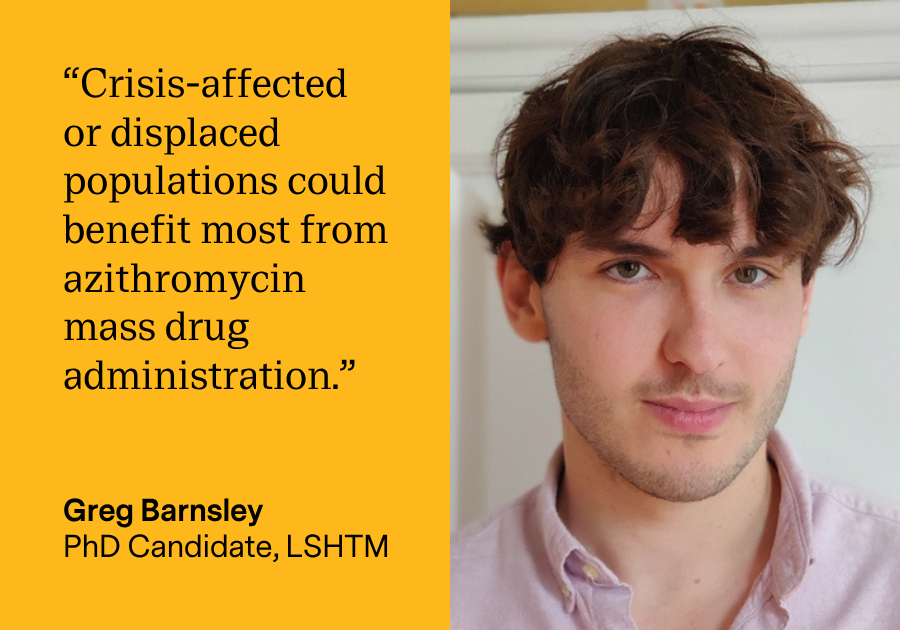
Greg Barnsley, lead author and PhD Candidate at LSHTM, commented:
“While azithromycin MDA will be an important tool to reduce childhood mortality, concerns regarding antibiotic resistance and its unclear mechanism of impact might limit its uptake. It is time to also consider more specific populations which may benefit the most from short-term reductions in infectious disease mortality, such as crisis-affected or displaced populations.”
As there is currently no direct evidence from humanitarian crises, the authors identify several priorities for future research. These include understanding which populations would benefit most, whether a single round of treatment would be sufficient, how best to monitor antimicrobial resistance, and how azithromycin could be integrated with other emergency health interventions.
The review argues that carefully designed pilot studies and implementation research are now needed to determine whether this promising intervention can safely improve child survival in some of the world's most challenging humanitarian contexts.
Publication
Barnsley G et al. Azithromycin mass drug administration to reduce childhood mortality in humanitarian crises. PLOS Global Public Health. 2026. DOI: 10.1371/journal.pgph.0006684
If you enjoyed this article and would like to build a career in global health, we offer a range of MSc programmes covering health and data, infectious and tropical diseases, population health, and public health and policy.
Available on campus or online, including flexible study that works around your work and home life, be part of a global community at the UK's no.1 public health university.