
Infectious and tropical diseases remain a major cause of morbidity and mortality worldwide and continue to present significant health, economic and societal challenges, particularly in low- and middle-income countries. There is a critical need for researchers with the skills, insight and commitment to design and deliver innovative work that addresses these challenges and reduces the global burden of disease.
This Master of Research (MRes) is a research-focused degree designed to train the next generation of researchers in infectious and tropical diseases. At the centre of the programme is a substantial research project of 9-10 months’ duration, through which you will become embedded within the research environment of LSHTM’s Faculty of Infectious & Tropical Diseases.
The Faculty operates across laboratory- and field-based science, clinical medicine and population health. Its portfolio spans fundamental biology, clinical investigation and the translation of evidence into policy and practice. A wide range of MRes projects will be offered, drawing on this multidisciplinary expertise. Projects may also be undertaken, wholly or in part, with UK-based and international collaborators.
Alongside project work, you will develop your theoretical understanding through selected taught modules and participation in LSHTM’s research seminar programmes.
Key features
- Exceptional research training within a vibrant and world-leading research environment, providing strong preparation for PhD progression and research-led careers
- Research projects that address real-world health challenges to deliver global health impact
- Ability to undertake research with external partners in the UK and overseas
- Integration into a global community of scholars, practitioners and alumni, that enriches the programme and provides invaluable opportunities for networking and future employment
What you will learn
- Demonstrate a systematic and critical understanding of a subdiscipline of infectious and tropical diseases, with the ability to define and critically assess key challenges and current priorities.
- Understand the role of research in shaping policy and practice for the control, prevention and surveillance of infectious diseases.
- Develop the skills to design, conduct and communicate a rigorous research project that advances knowledge and understanding within the field of infectious diseases.
The research project that forms the core of this MRes provides direct experience of conducting original scientific investigation, alongside advanced training in research communication, study design, scientific integrity, research ethics, and the management and analysis of scientific data. You will be supported by a dedicated supervisory team of academic staff with recognised expertise in their respective disciplines.
This training is complemented by taught components that strengthen your theoretical understanding. Through engagement with LSHTM’s seminar programmes, you will gain exposure to the wider research community and develop an appreciation of multidisciplinary approaches to improving global health.
Further information can be found in the Programme Specification.
The research project
The research project is the defining component of this MRes. You will undertake an original piece of work within the Faculty of Infectious & Tropical Diseases or with one of its national or international collaborators. A broad selection of projects will be offered, including projects related to:
- Molecular and cellular biology of infectious agents
- Host–pathogen interactions
- Clinical infectious diseases research and translational studies
- Infectious disease epidemiology and modelling
- Antimicrobial resistance and drug discovery
- Vaccinology
- Data science and quantitative analysis
- Implementation science and health systems research
- Translation of evidence into policy and practice
The portfolio of projects is available on the "MRes project" tab.
Who is it for?
This programme is designed for graduates with a strong interest in infectious diseases who wish to build a career in research, policy or practice. It is particularly suited to those from biomedical sciences, life sciences, medicine or related disciplines who want intensive, project-based training across the full research process - from ethical design and implementation through to analysis and reporting.
Students who enjoy interdisciplinary work and wish to apply advanced quantitative and/or qualitative methods to real-world health challenges will benefit most from this programme, equipping them with the skills to contribute to future strategies for the control of global infectious diseases.
Duration
One year full-time or two years part-time. Ways to study explained.
Please note: The part-time mode of study will influence the type of project work that is possible within the MRes. Any student wishing to enquire about part-time study and the potential research projects available should contact the Programme Director.
Intercalating study
This programme is also ideal for medical students seeking to intercalate and gain a clear advantage in academic medicine. It provides a strong bridge between undergraduate medical training and clinical research through intensive, project-based research training and close mentorship from leading academics, building a solid foundation for future PhD study and/or a career as a research-active academic clinician.
Discover the MRes in Infectious & Tropical Diseases
Find out more about our new MRes Infectious & Tropical Diseases programme, including its focus on research and advanced training in infectious and tropical diseases.
This section outlines your journey through the MRes programme.
The research project forms the core of the MRes and runs throughout the academic year. The programme also includes taught elements that support the development of your project and enhance your understanding of the research process.
Click on the MRes Projects tab to find out more about the projects on offer.
- Term 1
In Term 1, you will develop a research proposal and attend seminars covering research design, ethics, integrity and analysis. The proposal provides the foundation for your project and develops skills that are transferable to future academic and professional work.
Throughout the year, you will participate in relevant seminar programmes. These will support the development of your project and broaden your understanding of the research environment within which it sits.
- Terms 2 and 3
In Terms 2 and 3, you will select two elective modules from LSHTM’s intensive and/or distance learning module list, allowing you to extend your subject-specific knowledge.
Assessment takes place throughout the year and includes the research proposal, written assignments and oral presentations.
Before you apply, please review the project portfolio below and select up to two projects that match your research interests.
As part of the application process, please upload a project choice statement of up to 500 words. Your chosen project(s) should be listed in preference order with a supporting rationale explaining how they align with your research interests and how they will support your future career. Please note that the project choice statement is separate from your personal statement, which you will also need to complete as per the instructions on the application portal.
Eligible applications submitted via the application portal will be reviewed as they are received and suitable applicants will be invited to interview.
The project portfolio is updated regularly as projects are allocated and is intended to reflect current availability as closely as possible. However, because applications are processed on an ongoing basis, the list below may not always provide a complete picture of project availability. Early application is therefore strongly recommended to maximise your chances of securing your preferred project.
ID | Location | Project title |
|---|---|---|
Disease Control - See project summaries | ||
| DC1 | London | Delayed Malaria Following Perennial Malaria Chemoprevention in Côte d'Ivoire |
| DC2 | Uganda | Genomic Characterization & Transmission Dynamics of Mpox Virus in Uganda: A Multi-Platform Approach |
| DC3 | London | Paratyphi Mykrobe – a tool for enhanced genomic epidemiology of enteric fever pathogens *provisionally allocated* |
| DC4 | Zambart, Zambia | New Tools for TB screening |
| DC5 | London and The Gambia | Development of a multivalent poultry vaccine to prevent Campylobacter and Salmonella infection |
| DC6 | Uganda | Rural–urban residence and parasitic infections in yellow fever vaccine waning in Ugandan adolescents |
| DC7 | London | Malaria parasite infection measurements to understand temporal changes in endemic populations - *provisionally allocated* |
| DC8 | London and Ghana | Developing Multiplex Tools for Detecting Invasive Vectors and Pathogens in Field Settings |
| DC9 | London | The role of economic development in historical success stories of malaria elimination *provisionally allocated* |
Pathogen biology (viruses) - see project summaries | ||
| PB1 | UKHSA, Porton Down, UK | Tools for differentiating Chikungunya (CHIKV), Ndumu (NDUV), and O'nyong-nyong (ONNV) viruses |
Pathogen biology (bacteria) - see project summaries | ||
| PB2 | London | Dissecting the role of the T6SS to antagonize the gut microbiome by enteric pathogens - *provisionally allocated* |
| PB3 | London | Beyond the model strain: decoding Campylobacter genome function through C. coli |
| PB4 | London | Dissecting the antibacterial role of Campylobacter's T6SS and its effectors |
| PB5 | London | Investigating menaquinone-mediated resensitisation of drug-resistant tuberculosis |
| PB6 | London | Vitamin B12-dependent remodeling of the Mycobacterial surfaceome |
| PB7 | London | Characterising mycobacterial genomic diversity using sequencing, bioinformatics, and AI |
Pathogen biology (protozoal parasites) - see project summaries | ||
| PB8 | London | Dissecting the mechanistic role of PfACS-ADP in regulating mitochondrial energy metabolism |
| PB9 | London | Drug resistance by dormancy: How do trypanosomes sleep and avoid elimination? |
| PB10 | London | Bacterial expression, enzyme kinetics and protein structure of a novel malaria lactate dehydrogenase |
| PB11 | London | Characterisation of novel invasion genes in the malaria parasite Plasmodium knowlesi |
| PB12 | The Gambia | Adaptive variation in parasite sexual commitment for transmission of malaria in The Gambia |
| PB13 | London | How haptomonad promastigotes influence Leishmania transmission from sand flies |
| PB14 | London | Decoding rDNA transcriptional regulation in trypanosomatid parasites |
Pathogen-host cell interactions - see project summaries | ||
| PB15 | London | Complement evasion in Klebsiella pneumoniae: the role of Factor H |
| PB16 | London | Investigation of cell-autonomous immune responses to pathogenic bacteria |
| PB17 | London | Modulating antibody production through adaptation of secretory cargo machinery |

| Fees 2026/27 | ||
|---|---|---|
| Home | Full-time | £15,650 |
| Part-time | £7,825 | |
| EU/Overseas | Full-time | £35,070 |
| Part-time | £17,535 |
*Mobile users, scroll right to view fees
Sources of funding:
In order to be admitted to the MRes, an applicant must:
- hold either a first degree at Upper Second Class Honours (2:1) standard in a relevant discipline, or a degree in medicine recognised by the UK General Medical Council (GMC) for the purposes of practising medicine in the UK, or another degree of equivalent standard awarded by an overseas institution recognised by UK ENIC or the GMC.
or
- hold a professional qualification appropriate to the programme of study to be followed obtained by written examinations and judged by LSHTM to be equivalent to an Upper Second Class Honours (2:1) degree or above.
If you have not previously studied in the UK, you can check our guide to international equivalent qualifications for our master's degrees.
English language requirements
If English is not your first language, you will need to meet these requirements: Band B.
Some applicants may be exempt if they have previously studied in English or meet other specified criteria. Please see our English language requirements for details.
It is possible to apply without English language test results however the results of a test may be listed as a condition of an offer of admission.
Intercalating students
This option is available for in-person MSc programmes. You will need the equivalent of a bachelor's degree to undertake a master's degree. This will usually require you to have a BSc degree or have completed the first three years of your medical degree. More information on intercalating a Master's at LSHTM.
Access and widening participation
At LSHTM we are committed to ensuring that excellent students feel encouraged to apply for a course of study with us. We have introduced an innovative contextual admissions system that is designed to support those students who have faced the greatest barriers to their learning. More information on widening participation at LSHTM.
Applications for the MRes programme are now closed for 2026/27 entry. Register your interest to be notified when applications next open.
Applications should be made online and will only be considered once you have provided all required information and supporting documentation.
You can apply for up to two master's programmes. Make sure to list them by order of preference as consideration will be given to your top choice first. Please also read LSHTM's Admissions policies (pdf) prior to submitting your application.
Before applying to our MRes programme, please review the current project portfolio in the "MRes projects" tab and select up to two projects that match your research interests. These should be listed in preference order in your project choice statement with a supporting rationale explaining how they align with your research interests and how they will support your future career (up to 500 words). You will need to upload this to the application portal as a separate supporting document.
In addition, your personal statement should describe your experiences in relevant field(s), your reasons for applying to our MRes programme, what you hope to gain from the training we offer, and how you intend to use the knowledge and skills you acquire to further your career and contribute to improving health.
As part of the admissions process, we'll invite all suitable applicants for an online interview.
Application fee
A standard non-refundable application fee of £50 applies to all Master’s degree programmes and is payable upon application submission. The application fee also applies to PG Diplomas and PG Certificates where appropriate. Income generated from the application fee is shared between scholarships and the student hardship funds.
Application deadline
All applicants are encouraged to apply as early as possible to ensure availability of a place and a timely decision on their application. This is particularly important for applicants with sponsorship deadlines.
Closing dates for all taught face-to-face MSc, PG Diploma and PG Certificate applications for entry in the 2027/28 academic year is:
- Sunday 25 July 2027 at 23:59 UK time for all students requiring a Student visa
- Tuesday 31 August 2027 at 23:59 UK time for all UK, Irish and non-Student visa students.
Applicants will be required to meet the conditions of their offer and provide all necessary documents by the date of their Offer of Admission.
Tuition fee deposit
All applicants must respond to their offer of admission within 28 days or their place will be released and the offer automatically declined. The deposit is deductible from tuition fees upon full registration with LSHTM. Applicants in receipt of a full scholarship will not be required to pay the deposit.
- Home students: £500 non-refundable deposit, payable within 28 days of the offer date
- Overseas students: £2,000 non-refundable deposit
- Offers made before 31 January 2027: deposit due by 1 March 2027
- Offers made from 1 February 2027 onwards: deposit due within 28 days of the offer date.
Do you need a visa?
Please visit our Visa & Immigration pages for advice and guidance.
Important notice for nationals/citizens of Afghanistan, Cameroon, Myanmar or Sudan: If you require a UK student visa, the government has introduced a “visa brake”. As a result, LSHTM is currently unable to sponsor student visas for applicants from these countries.
Our graduates work in academic institutions, research institutes, public health agencies, international organisations and policy settings worldwide. The MRes Infectious & Tropical Diseases is specifically designed to support progression to research-intensive pathways by providing advanced methodological training and substantial experience of independent investigation.
Graduates are well prepared to progress to:
- PhD and doctoral training programmes
- Research positions within academia and industry
- Clinical academic training pathways
- Roles within global health organisations and international research collaborations
- Public health agencies and advisory bodies
- Research translation and policy-focused positions
The programme provides a strong foundation for careers that combine scientific rigour with public health impact.
Employability
On average, 90% of our master's graduates from the 2019/20-2022/23 cohorts were in employment or undertaking further studies 15 months after graduation (Graduate Outcomes Surveys, 2020-2023).
Careers at LSHTM
In this video, LSHTM students share why they chose public health and reflect on their studies, student experience and future career goals.
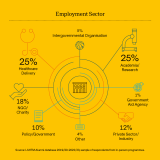
- Career support - the LSHTM Careers Service provide a range of services from 1-1 appointments to events and workshops.
- Alumni blogs - did you know LSHTM has over 35,500 alumni in more than 190 countries.
- International alumni chapters - find an LSHTM network of alumni near you from our over 30 chapters.