
New findings involving the London School of Hygiene & Tropical Medicine suggest that taxes around food, either less-healthy or high-carbon, would offer significant benefits for the environment and people’s health. However, such taxes would need to be balanced with subsidies to prevent trade-offs from increased food prices.
Based on the findings, the authors note that a combination of taxes and subsidies (or other price reducing measures) were the best way to capture the environmental and health benefits, while mitigating inequalities from increasing costs for taxed food.
Published in Social Science & Medicine, these findings were based off simulations of multiple different policy packages of food taxes and subsidies that could be implemented in Great Britain. Each policy package was assessed by its projected impacts the environment, people’s nutrition, and food spend.
The UK’s food system, similar to many countries, struggles with both poor nutrition and high environmental impact. In 2024, over 64% of adults and 26% of children in the UK were living with either overweight or obesity with UK diets characterised by low levels of fruit and vegetables and fibre, and too much sugar and saturated fats. The UK food system also contributes to 38% of the country’s greenhouse gas (GHG) emissions, and decarbonisation is twice as slow as that of the wider economy.
The simulations analysed the impact of a range of financial policies around food products which were co-designed with public and policymakers. A 20% tax on foods high in fats, sugar or salt (HFSS) provided benefits for people’s health, providing the biggest cut to sugar content of the purchases (6.4%). The HFSS tax also had positive benefits for the environment, albeit limited as the tax does not target meats which are among biggest contributors to environmental impacts.
A high carbon tax, which targets high-emissions foods such as meat, dairy, chocolate, tea, coffee, had the greatest environmental impact. Reductions between 8.4 and 14.6% were found for a range of environmental indicators such as GHG emissions, land use, water use and damage from fertilisers (eutrophication). Co-benefits were also provided to people’s health, as the tax reduced sugar, fat and sodium content of purchases by 5-10%.
Despite the health and environmental benefits, the authors noted several trade-offs. Both taxes lowered fibre content of purchases, which are already lacking in the average UK diet. Higher carbon taxes increased a household’s average annual food costs by £220 while HFSS taxes by £119, the latter tax also disproportionately affecting people living in the most deprived areas.
One option to mitigate these trade-offs would be to provide subsidies that encourage swapping to healthier and less carbon intensive foods. Subsidies on fruit and vegetables were found to substantially increase the level of purchases, up to 41% (approximately one portion per day), and also support with fibre content of purchases, though even a 50% subsidy on all fresh and frozen fruits and vegetables would still not help people reach their recommended five-a-day in diets. As the subsidies drove up some other purchases too (particularly dairy) as it frees up some food spend, this also led to overall negative environmental impacts.
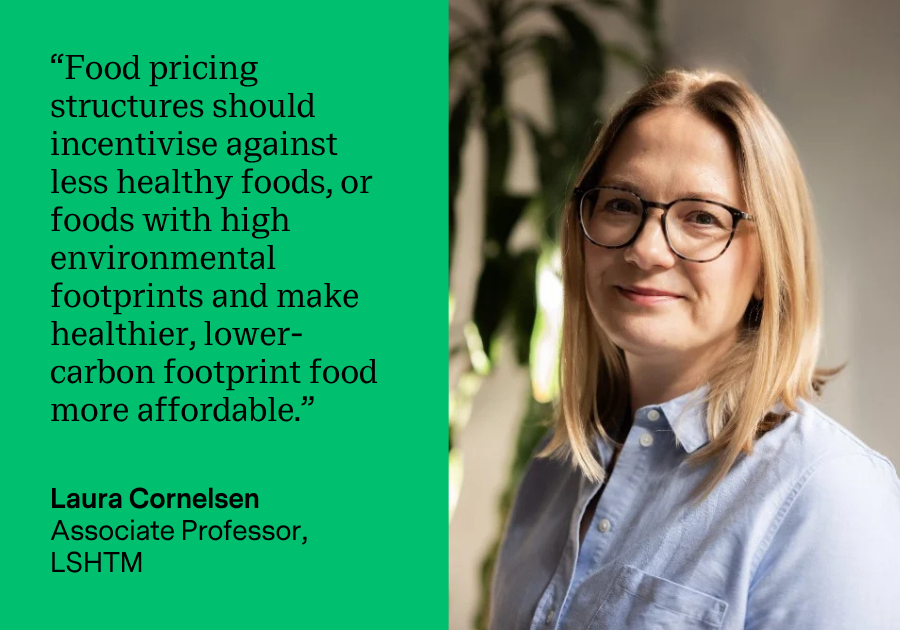
Laura Cornelsen, Associate Professor at LSHTM, said: “Equitable, non-regressive systems that optimise outcomes for both health and the environment are unlikely to come from taxes alone. Food pricing structures should incentivise a move away from less healthy foods or foods with high environmental footprint but also make the move towards healthier, lower-carbon footprint more affordable.”
As the paper focused on simulating scenarios and modelling outcomes, it did not focus on practical questions as to how taxes could be implemented as policy. This includes details as to how the tax would work, and whether it is a viable policy to implement, questions that would require further research.
The research, conducted by a group of researchers at LSHTM, the University of Exeter, the University of Oxford, and the University of Reading, is part of the CO-designing for healthy People and Planet: food system Economic Research (COPPER) project. The project aims to design food subsidy and tax policies, with policymakers and the general public, to measure their impact on people’s health and household budgets, as well as the UK economy and environment.
Publication
Cornelsen L et al. Designing fiscal policies for health and climate: Trade-offs, co-benefits and distributional effects in Great Britain. Social Science & Medicine, 2026. DOI: https://doi.org/10.1016/j.socscimed.2026.119654
If you enjoyed this article and would like to build a career in global health, we offer a range of MSc programmes covering health and data, infectious and tropical diseases, population health, and public health and policy.
Available on campus or online, including flexible study that works around your work and home life, be part of a global community at the UK's no.1 public health university.