
A new approach to help malaria programmes decide which interventions to prioritise when resources are limited has been proposed by researchers at the London School of Hygiene & Tropical Medicine (LSHTM) and Imperial College London, with partners from the national malaria control programmes in Guinea and Cameroon
Published in The Lancet Global Health, the paper argues that economic evaluation should play a more central role in malaria priority-setting, allowing decision-makers to compare the costs and health benefits of different intervention options and identify those that could deliver the greatest health impact within available budgets.
Malaria programmes face increasingly difficult choices as funding falls short of what is needed to meet the World Health Organization (WHO) Global Technical Strategy targets. The funding shortfall increased from US$2.6 billion in 2019 to US$5.3 billion in 2024. The situation became even more challenging in 2025 following major cuts to international aid.
At the same time, national malaria programmes have a growing range of interventions to choose from, including different types of insecticide-treated nets, chemoprevention, and vaccines. Decisions must account for differences in malaria risk, intervention effectiveness, delivery costs, and other priorities across areas and populations.
WHO-supported subnational tailoring has improved malaria planning by using local data to target interventions to different settings. However, the authors argue that the current process does not systematically compare all feasible options according to both their health benefits and the resources required to deliver them.
To address this, the paper proposes incorporating economic evaluation directly into the prioritisation process. Eligible intervention packages would be compared according to their costs and health benefits, then ranked to identify the combination expected to deliver the greatest overall health benefit within the available budget.
The approach could also help programmes respond when funding changes. An “expansion pathway” would show which interventions to add as more resources become available, while a “contraction pathway” would indicate which could be scaled back first to minimise the health impact of budget reductions.
Using Guinea’s 2023 subnational malaria planning exercise as a case study, the authors illustrate how the approach could be integrated into existing decision-making. Rather than considering interventions largely within separate categories, different intervention packages could be compared across districts and ranked nationally according to their incremental cost-effectiveness.
The authors stress that maximising health is not the only consideration in malaria priority-setting. Equity, ethical considerations, political priorities, and operational feasibility may also shape decisions. Their proposed approach would provide a transparent health-maximising benchmark, allowing decision-makers to understand the health trade-offs when other priorities take precedence.
The paper also calls for greater health economics expertise within malaria priority-setting teams and better use of existing evidence. The authors say the approach could be implemented using data already available, while further improvements in costing, modelling, and economic evaluation would strengthen future decisions.
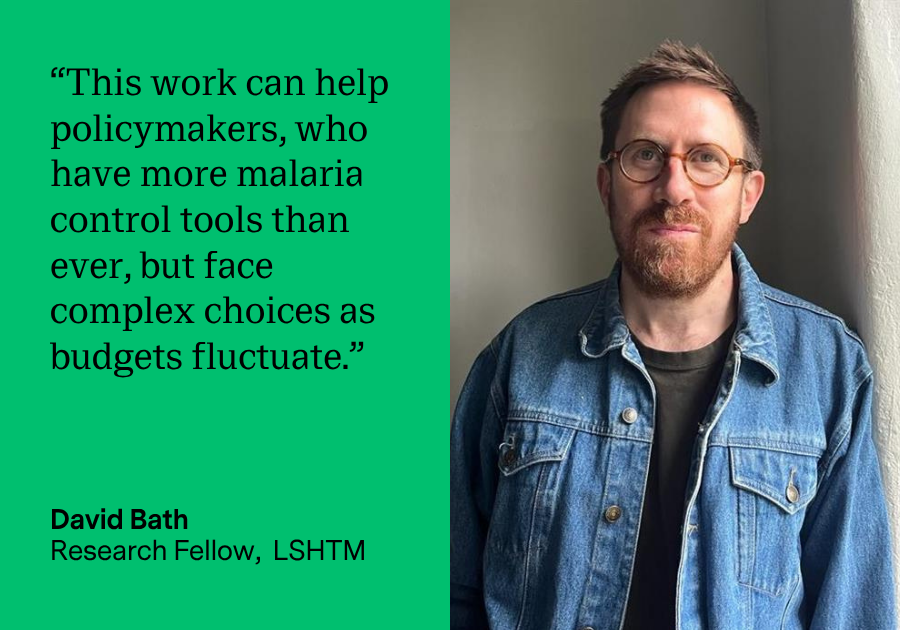
David Bath, Research Fellow in Health Economics and first author of the paper, said “Policymakers have more malaria control tools than ever but face new challenges and complex choices. Mapping clear expansion and contraction pathways subnationally clarifies trade-offs and gives programmes a transparent roadmap when budgets fluctuate.”
Catherine Pitt, Professor of Health Economics and senior author of the paper, said “With more than 600,000 malaria deaths each year and limited funding, economic evaluation can help decision-makers save more lives.”
The research was funded by UK International Development through the Resilience Against Future Threats through Vector Control (RAFT) programme.
Publication
David Bath, et al. Prioritising malaria interventions to maximise health: the role of economic evaluation. The Lancet Global Health. DOI: 10.1016/j.langlo.2026.104080
If you enjoyed this article and would like to build a career in global health, we offer a range of MSc programmes covering health and data, infectious and tropical diseases, population health, and public health and policy.
Available on campus or online, including flexible study that works around your work and home life, be part of a global community at the UK's no.1 public health university.