
Researchers from the Global Typhoid Genomics Consortium, co-coordinated by members at the London School of Hygiene & Tropical Medicine including Assistant Professor Zoe Dyson, Dr Megan Carey, and Professor Kathryn Holt, as well as colleagues from Universities of Oxford and Cambridge, have developed Typhi Mykrobe – a new open-source software tool. Typhi Mykrobe provides rapid genomic analysis of Salmonella Typhi bacteria that cause typhoid fever.
Typhoid fever is responsible for over 10 million illness worldwide, of which more than 100,000 are associated with deaths. Typhoid fever has been treated with antibiotics for decades, and as a result, the causative Typhi bacteria have evolved resistance to antibiotics. Some drug-resistant lineages have undergone several waves of intercontinental spread over the last several decades.
The new tool, designed to support genomic pathogen surveillance and genomic epidemiology, identifies a broad range of genetic factors that contribute to antimicrobial resistance (AMR) within the bacteria. Moreover, unlike previous generations of analysis software, Typhi Mykrobe can analyse raw read data from either short-read Illumina platforms or from portable Oxford Nanopore Technologies long-read sequencing devices.
The results, published in Genome Medicine in an article led by Dr Danielle Ingle, found that Typhi Mykrobe provided a full genetic profile of a sequenced Typhi bacterium in under one minute. The new software was able to detect genetic features driving AMR towards up to eight different classes of antibiotics commonly used to treat Typhi infections, and detect mobile genetic elements that facilitate the spread of antimicrobial resistance. Typhi Myroke was also able to assign pathogens to genotypes lineages according to the GenoTyphi genotyping scheme.
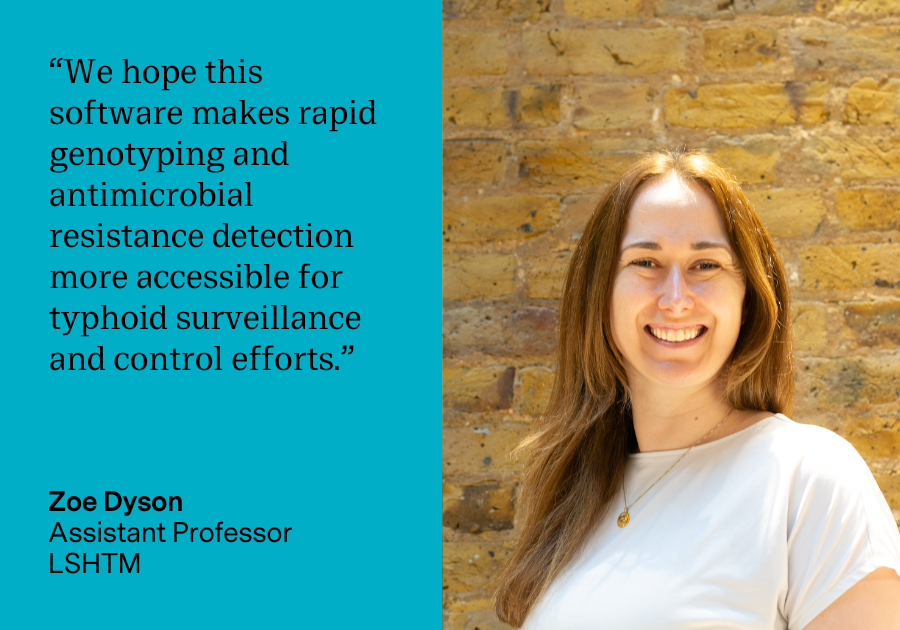
Zoe Dyson, Assistant Professor at LSHTM, said: “We hope that Typhi Mykrobe helps make rapid genotyping and AMR detection more accessible to the pathogen genomics and public health communities to support ongoing typhoid surveillance and control efforts.”
This information could more effectively provide vital information to support enhanced public health measures including appropriate treatment guidelines based on the type of drug-resistant typhoid circulating, the deployment of typhoid conjugate vaccines, and outbreak investigation and control strategies.
Publication
Ingle D et al. Typhi Mykrobe: fast and accurate lineage identification and antimicrobial resistance genotyping directly from sequence reads for the typhoid fever agent Salmonella Typhi. Genome Medicine, 2025. DOI: https://doi.org/10.1186/s13073-025-01551-4
If you enjoyed this article and would like to build a career in global health, we offer a range of MSc programmes covering health and data, infectious and tropical diseases, population health, and public health and policy.
Available on campus or online, including flexible study that works around your work and home life, be part of a global community at the UK's no.1 public health university.