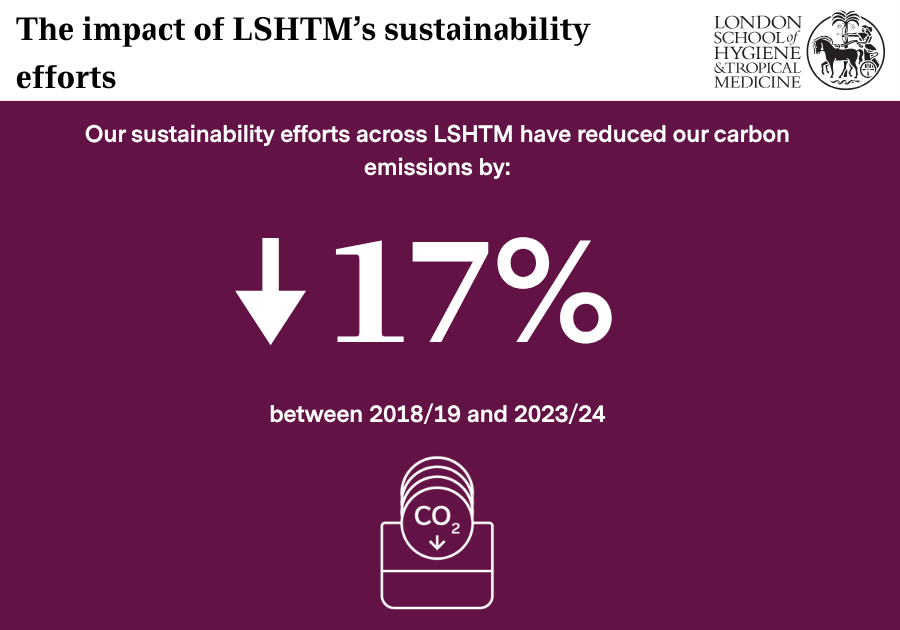
The London School of Hygiene & Tropical Medicine (LSHTM) reduced its carbon emissions by 17% since 2018/19, according to its newly published 2026 Sustainability Update Report. The report documents LSHTM’s progress towards achieving Net Zero by 2030 across its operations and research.
Since the 2018/19 baseline, LSHTM has also risen substantially in the independent People & Planet University League, moving from 88th place in 2023/24 to 27th place in 2025/26. Further, LSHTM placed first among universities with fewer than 5,000 students.
As a global public health research institution, LSHTM recognises that its responsibility to generate robust evidence to improve health and health equity, and within that, address the health impacts of climate change, also includes reducing its own emissions and building a sustainable future for the institution.
Professor Liam Smeeth, Director of LSHTM said: “The impacts of climate change have become increasingly apparent, with 2025 breaking historical climate records for warmth and sunshine in the UK. We must act quickly and decisively to prevent a further escalation of the climate emergency, and to protect vulnerable regions and communities.
“At LSHTM we believe our shared future depends on our shared health. We recognise the impact our work to improve health and health equity is having on the environment. And we want to take responsibility for our emissions. This report, alongside the midpoint review of our Energy and Carbon Management Plan (ECMP) indicates that we are on the right track.”
Reducing LSHTM’s environmental impact
The report highlights action across LSHTM’s operations, from travel and laboratory practices to waste, water and the energy performance of its buildings.
Between 2018/19 and 2023/24, LSHTM reduced its carbon emissions from work-related travel by 44%, mainly due to people flying less frequently. Furthermore, a recent travel survey found that LSHTM’s staff and students rarely rely on cars for their commute, with cycling, walking and public transport playing an important role.
Waste generated by LSHTM has fallen by 54% compared to 2018/19. Initiatives include recycling IT equipment and furniture, and exploring more circular approaches to procurement.
Water consumption has also reduced by 53% since 2018/19. Across LSHTM’s London estate, water efficiency taps and mains-fed chilled water points have been installed, removing the need for around 10,500 plastic water bottles to be delivered each year.
Laboratories can generate up to ten times more emissions than office spaces. To address this, LSHTM introduced measures to reduce lab energy and water use, through simple switches such as reducing the frequency and running time of lab autoclaves that are used to clean equipment. Most LSHTM labs have also received the LEAF (Laboratory Efficiency Assessment Framework) Silver certification.
Changes to LSHTM’s estate are also part of these efforts. The new Tavistock Learning and Teaching Centre, opened in 2026, is LSHTM’s first operationally zero-fossil-fuel building in the UK, using solar-generated electricity, green tariffs for power, and air-source heat pumps.
Sustainability across LSHTM
Sustainability initiatives extend across LSHTM’s MRC Units. In the MRC Unit The Gambia at LSHTM, an anaerobic digestion plant transforms food waste from the Unit and surrounding communities into biogas and compost for farming. At the MRC/UVRI & LSHTM Uganda Research Unit, solar panels now offset 40% of electricity demand, equivalent to the annual energy usage of 2188 Ugandan households.
Sustainability is also being embedded in teaching, including through LSHTM’s MSc in Climate Change and Planetary Health, and wider opportunities for all students to enrol in individual modules from this MSc, ensuring that key planetary health concepts and the climate-health nexus are integrated across its educational offering.
Pauline Paterson, Associate Professor and Co-Programme Director of the MSc, said: “We want to make sure that future health leaders graduating from LSHTM receive a world class education and are also equipped to deal with public health challenges caused by a changing climate. Our students learn the importance of promoting and supporting population health in a sustainable way.”
The report also highlights LSHTM’s socially responsible investment policy, including its divestment from direct holdings in fossil fuel companies, alongside work to embed climate risk into institutional decision-making.
What comes next
Despite the progress reported, significant challenges remain. LSHTM’s supply chain (all goods and services that support its work), now accounts for 69% of its overall carbon footprint.
The Sustainability team are working closely with current suppliers, and choosing new ones based on their capacity to provide more accurate data on emissions associated with their goods and services. They are also aiming to embed circular economy principles when buying through its supply chain - considering paths for reuse, repurposing and refurbishment.
The full Sustainability Update Report sets out further progress across LSHTM and the actions planned for the years ahead. Staff and students can get involved through sustainability representatives and the Sustainable Air Travel Community of Practice.
If you enjoyed this article and would like to build a career in global health, we offer a range of MSc programmes covering health and data, infectious and tropical diseases, population health, and public health and policy.
Available on campus or online, including flexible study that works around your work and home life, be part of a global community at the UK's no.1 public health university.