1 in 5 young people in UK regret health decision based on misinformation
28 September 2026 London School of Hygiene & Tropical Medicine London School of Hygiene & Tropical Medicine https://lshtm.ac.uk/themes/custom/lshtm/images/lshtm-logo-black.png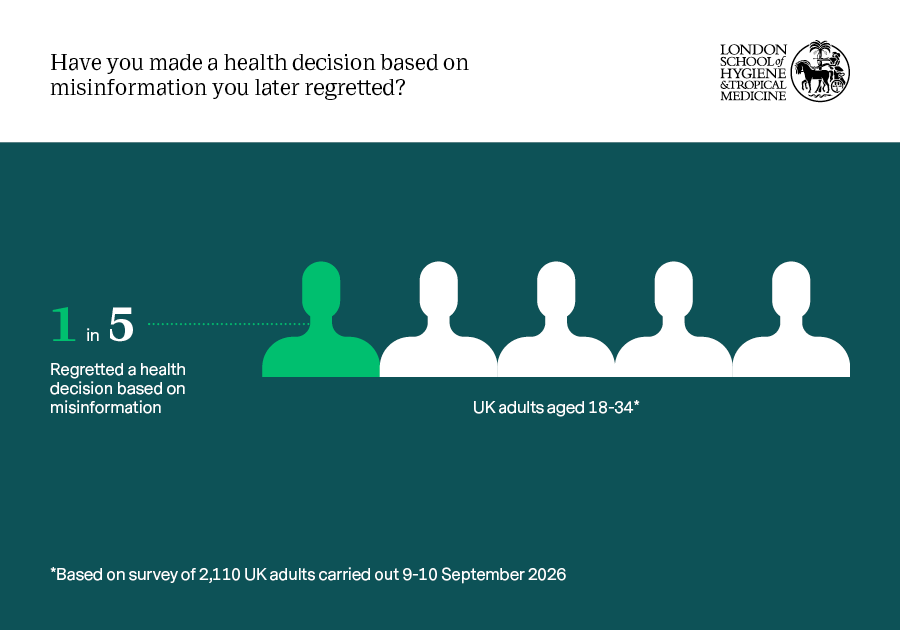
A fifth of 18-34-year-olds in the UK have made a health decision based on false or misleading information they later regretted, according to a report from the London School of Hygiene & Tropical Medicine (LSHTM).
The report, launched today (28 September 2026), analyses a survey of 2,110 UK adults which also found over a third (38%) of those aged 18-24 said they knew someone who has suffered serious harm as a result of making a health decision based on false or misleading information. Examples of serious harms include contracting a preventable disease, delaying medical treatment, or suffering symptoms for longer than necessary.
Half (49%) of all UK adults surveyed worried about family members being harmed by health decisions they make based on false or misleading information (misinformation).
The findings are published in a new LSHTM report, Health Misinformation: Public Perceptions of Threat to the UK. The survey was commissioned by LSHTM and conducted by Survation on 9-10 September 2026.
The survey also found that almost 1 in 5 people (19%) were either not very confident or not at all confident at judging whether a health claim was accurate. 4 out of 10 of respondents (42%) also worried about family members sharing health claims without first checking if they were accurate.
More than half (61%) of people who said they had previously come across health misinformation had come across it on social media and nearly a third (30%) on websites or blogs. A quarter gave family or friends (27%) or traditional news media (26%) as a source of health misinformation, 20% work colleagues and 19% AI chatbots.
When asked about health misinformation topics they had seen in the last six months, 24% said they had come across false or misleading claims about vaccines, 21% about dietary supplements/weight-loss injections, 18% about climate change, and 16% about mental health.
Around 6 out of 10 people agreed it is very or somewhat likely that health misinformation could cause people to believe in or buy fake cures, undermine trust in health services, influence people to refuse essential treatment, and divide people and lead to more extreme views.
Nearly half (47%) of those surveyed said the UK Government should be doing more to address false or misleading health information.
When asked which actions the UK Government should prioritise, the most popular answers were to introduce laws to penalise those profiting from false or misleading health information, to educate the public about how to identify false or misleading health information, and to make social media firms add warning labels to potentially false or misleading health content.
Professor Liam Smeeth, the Director of LSHTM, said: “With a fifth of UK adults saying they have made a health decision they regret based on health misinformation, rising to a third of those aged under 34, and a fifth saying they know someone who has suffered serious harm as a result of health misinformation this is a problem that we can no longer ignore.
“In a world of invisible algorithms and closed networks, both online and offline, we often don’t know what kinds of false or misleading health information our families, friends, and neighbours are being exposed to. This report gives us a detailed picture of the health misinformation people in the UK are encountering, their concerns about it, the harm they believe it is causing, and what they think we should do about it.
“Health misinformation is sometimes dismissed as a fringe problem but this new evidence suggests the false and misleading claims in our feeds, online, and in everyday conversations, are seriously damaging the UK’s health. We hope these findings will motivate institutions across the UK to consider what more they can do to help people identify and resist harmful health misinformation and find the accessible, trustworthy health information they need.”
Limitations of the study include that it relied on self-reported information and the sample sizes for UK regions outside of England were relatively small.
Publication
The report, Health Misinformation: Public Perceptions of Threat to the UK, is published on the LSHTM website.
This independent survey and report was funded entirely by LSHTM.
If you enjoyed this article and would like to build a career in global health, we offer a range of MSc programmes covering health and data, infectious and tropical diseases, population health, and public health and policy.
Available on campus or online, including flexible study that works around your work and home life, be part of a global community at the UK's no.1 public health university.