A London School of Hygiene & Tropical Medicine report
- Author affiliations
Pete Wilton: Media Manager at LSHTM/organiser of the Health Information Integrity Network.
Dr Ben Kasstan-Dabush, Assistant Professor in Global Health & Development at LSHTM.
Foreword
The London School of Hygiene & Tropical Medicine (LSHTM) has a long track-record of developing innovative approaches to countering false or misleading health information (health misinformation). While health misinformation has always been with us, in the last few years changes to the technological and political landscape have enabled it to spread further and faster around the world, threatening to undermine trust in health experts and institutions.
That was why in January 2025 LSHTM launched a new initiative focusing on fighting dangerous health misinformation in the UK through interventions in the media, online, and on social media. While misinformation is global the response often has to be national or even local and what we quickly realised is that there is still a lot we don’t know about the prevalence and impact of health misinformation in the UK.
How equipped are Britons to identify false or misleading health claims? What do they do to factcheck if these claims are true? Are our fears about the harms of health misinformation on the UK population justified? And, if they are, who is being harmed and how can we help them to protect themselves? These were just some of the questions we had.
Of course one survey was never going to give us all the answers, but we believe the findings detailed in this report are an important first step towards gathering some of the ‘missing evidence’ on health misinformation in the UK. We hope that this report will help to motivate and inform all those working to make ours a healthier, stronger society.
Professor Liam Smeeth
Director, London School of Hygiene & Tropical Medicine
Executive summary
Misinformation is incorrect or misleading information that can be ‘fake news’ shared deliberately for fun or profit (disinformation) or political ends (propaganda) or shared out of genuine belief. In 2026 the World Economic Forum ranked misinformation/disinformation as the second most severe global risk over the next two years.
The London School of Hygiene & Tropical Medicine (LSHTM) has undertaken a range of activities to counter false or misleading health information (health misinformation) in the UK. These activities have included publishing its own counter-misinformation principles for communications (January 2025), delivering the flagship event Health Misinformation UNPACKED (September 2025), launching the Health Information Integrity Network (February 2026), as well as numerous interventions in the media, on social media, and online.
As part of this work LSHTM commissioned Survation to survey 2,110 UK adults on 9-10 September 2026 via online panel. The survey was designed to gather evidence about public attitudes and exposure to health misinformation. The aim of this report is to share findings from the survey that will be useful for anyone interested in understanding and countering dangerous health misinformation in the UK.
Key findings
- Nearly 1 in 5 UK adults said they were either not very confident or not at all confident at judging if a health claim is accurate
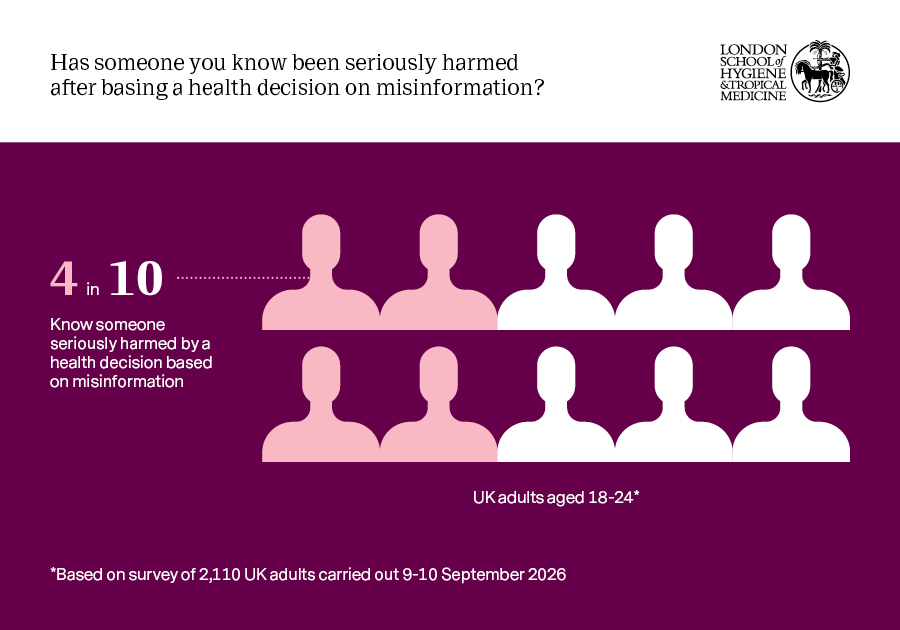
- 1 in 5 of those aged 18-34 said they had made a health decision based on misinformation that they later regretted
- Nearly 4 out of 10 of those aged 18-24 said they knew someone who has come to serious harm as a result of making a health decision based on misinformation
- Overall a fifth of UK adults said they knew someone who has come to serious harm as a result of making a health decision based on misinformation
- Around 6 out of 10 people believe likely effects of spreading health misinformation include causing people to believe in or buy fake cures, undermining trust in health services, influencing people to refuse essential treatment, and dividing people and leading to more extreme views
- Nearly half of UK adults said the UK Government should be doing more to address health misinformation
- The most favoured Government actions were new legislation to prevent people from profiting from health misinformation, education initiatives, and making social media firms label potentially false or misleading health content
Checking health claims
Being able to identify a false or misleading health claim is a vital first step towards avoiding harm from dangerous health information. However, nearly 1 in 5 (19%) UK adults said they were either not very confident or not at all confident at judging if a health claim is accurate, compared to 4 out of 10 (45%) who said they were very or somewhat confident. A third (30%) were neither confident nor unconfident.
Income and educational attainment appear to be factors in this ‘confidence gap’: Over half (56%) of those earning more than £40,000 a year said they were very or somewhat confident at judging if a health claim is accurate compared to only a third (34%) of those earning less than £20,000 a year. A similar gap in confidence at judging the accuracy of health claims is reported between those with the highest level of educational attainment, level 4 qualifications [1] or above (55%), and those with the lowest level, lacking any level 1 qualifications (34%).
While half (51%) said they were very or somewhat confident at checking the facts behind a health claim, 16% were either not very confident or not at all confident. The youngest and oldest age groups were the least confident at factchecking health claims with 1 in 5 of both those aged 18-24 (22%) and aged over 65 (20%) either not very confident or not at all confident.
By contrast only 1 in 8 people (13%) said they were not very confident or not at all confident that they could find reliable health information about a health issue. However, while two-thirds (69%) of those earning more than £40,000 a year were very or somewhat confident at finding reliable health information only just under half (46%) of those earning under £20,000 a year had a similar level of confidence.
When asked how they would check if health claims were accurate, half said they would check the details against an NHS or government website (51%) or ask their GP or local community pharmacist (47%). 1 in 5 people (22%) would ask family or friends, while almost 1 in 6 would ask AI chatbots (18%) or follow how a claim was being discussed on social media (18%).
| How people check if health claims are accurate | Response rate |
|---|---|
| Check NHS or government website | 51% |
| Ask GP or local community pharmacist | 47% |
| Ask family or friends | 22% |
| Ask AI chatbots | 18% |
| Follow discussions on social media | 18% |
Londoners were the least likely to check an NHS or government website (40%) and the most likely to ask an AI chatbot (27%), follow how a claim was being discussed on social media (25%), and ask family or friends about claims (24%) compared to those in other regions of England.
- [1] Note on educational attainment levels
Level 4 qualifications are: certificate of higher education (CertHE), higher apprenticeship, higher national certificate (HNC), level 4 award, level 4 certificate, level 4 diploma, level 4 NVQ
Level 1 qualifications are: first certificate, GCSE - grades 3, 2, 1 or grades D, E, F, G, level 1 award, level 1 certificate, level 1 diploma, level 1 ESOL, level 1 essential skills, level 1 functional skills, level 1 national vocational qualification (NVQ), music grades 1, 2 and 3
Health decisions and harms
Age appears to be a key factor in whether or not UK adults report that they or someone they know has been harmed by health misinformation.
1 in 5 of those aged 18-24 (22%) and aged 25-34 (21%) said they had made a health decision based on false or misleading information that they later regretted compared to only 1 in 20 (5%) over-65s. Overall 1 in 8 (14%) of respondents said they had made a health decision based on false or misleading information that they later regretted.
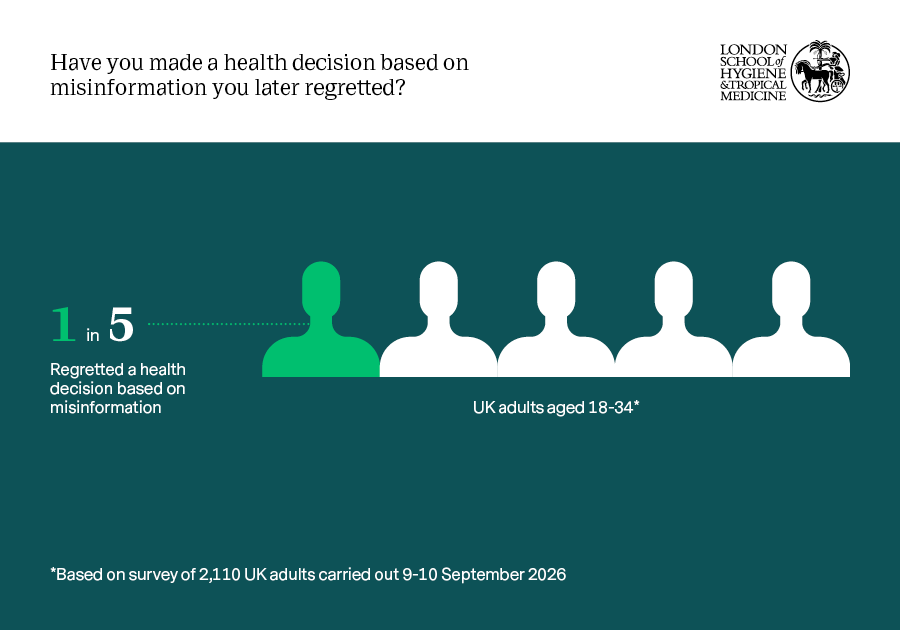
Nearly 4 out of 10 (38%) of those aged 18-24 said they knew someone who has come to serious harm as a result of making a health decision based on false or misleading information compared to 3 out of 10 of those aged 25-34 (31%) and 35-44 (31%), a fifth (20%) of 45-54 year-olds, 1 in 8 (13%) 55-64 year-olds, and only 1 in 16 (7%) over-65s. Overall a fifth of respondents (21%) said they knew someone who has come to serious harm as a result of making a health decision based on false or misleading information. Examples of serious harm included contracting a preventable disease, delaying medical treatment, or suffering symptoms for longer than necessary.
Half (49%) of UK adults worried about their family members being harmed by health decisions they make based on false or misleading information.
4 out of 10 (42%) worried about family members sharing health claims without first checking if they were accurate. This rose to half among those aged 18-24 (50%), aged 25-34 (53%), and aged 35-44 (52%). By contrast only 3 out of 10 (28%) of over-65s worried about family members sharing health claims without first checking if they were accurate.
| People worried about family members sharing unchecked health claims | Response rate |
|---|---|
| UK adults of all ages | 42% |
| Aged 18-24 | 50% |
| Aged 25-34 | 53% |
| Aged 35-44 | 52% |
| Aged 45-54 | 42% |
| Aged 55-64 | 34% |
| Aged over-65 | 28% |
Exposure to health misinformation
Among UK adults exposure to health misinformation varied significantly between younger and older age groups. On some topics there was also variation in the reported exposure of men and women and of those in different regions of the UK.
When asked where they had previously come across health information they believed was false or misleading, 61% of people said they had encountered it on social media, 30% on websites or blogs, 27% said family or friends, 26% on traditional news media, 20% work colleagues and 19% AI chatbots. 41% said they had not come across health misinformation in the past.
| Where people have previously come across health misinformation | Response rate |
|---|---|
| Social media | 61% |
| Websites or blogs | 30% |
| Family or friends | 27% |
| Traditional news media | 26% |
| Work colleagues | 20% |
| AI chatbots | 19% |
| Not come across health misinformation in the past | 41% |
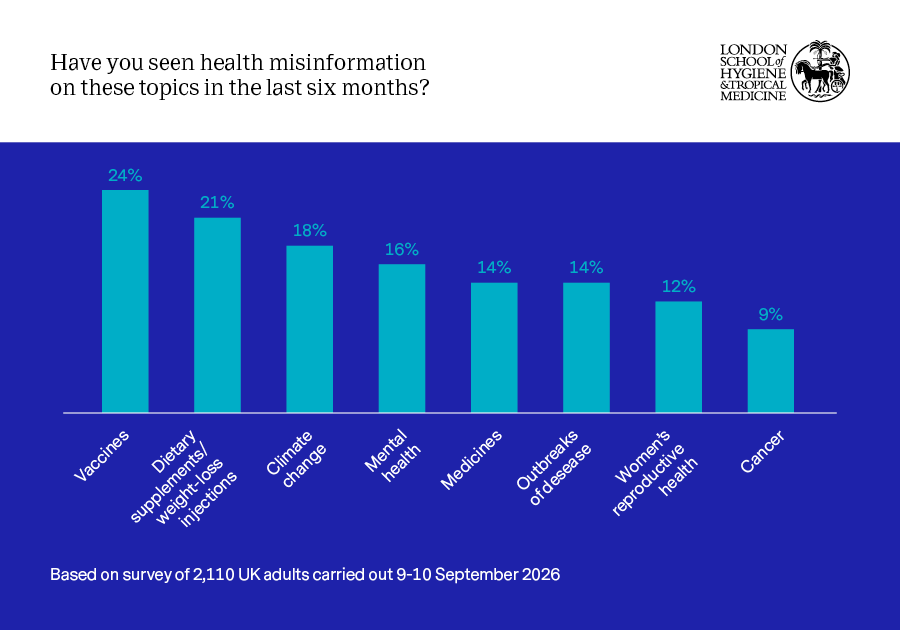
Asked if they had come across false or misleading claims on eight health topics in the last six months nearly 1 in 4 (24%) people said they had encountered false or misleading claims about vaccines, just over a fifth (21%) about dietary supplements/weight-loss injections, 1 in 6 (18%) about climate change, 1 in 7 (16%) about mental health, 14% about medicines, 14% about outbreaks of disease, 12% about women’s reproductive health, and 9% about cancer.
A third (32%) of those aged 18-24 reported exposure to misinformation about women’s reproductive health, falling to 1 in 6 (18%) of those aged 25-34 and then declining with age.
1 in 4 of those aged 18-24 (26%) and aged 55-64 (26%) reported encountering misinformation about dietary supplements/weight-loss injections, a higher proportion than reported in any other age groups.
22% of men reported exposure to misinformation about climate change compared to 15% of women, while 16% of women reported exposure to misinformation about women’s reproductive health compared to 7% of men.
Across the eight topics exposure to misinformation about vaccines and outbreaks of disease varied most regionally, with those in the South of England (27%), The Midlands (23%) and Scotland (29%) most likely to report encountering misinformation about vaccines and those in the Midlands (18%) and Scotland (23%) most likely to report coming across misinformation about outbreaks of disease.
Actions and recommendations
Nearly half of UK adults (47%) said the UK Government should be doing more to address false or misleading health information. Only 1 in 5 (20%) said UK Government was doing enough.
When asked about five potential effects of spreading health misinformation on UK society around 6 out of 10 people agreed that it was very or somewhat likely that health misinformation could cause people to believe in or buy fake cures (62%), undermine trust in health services (59%), influence people to refuse essential treatment (57%), and divide people and lead to more extreme views (57%). Over half said it was likely to persuade people to ignore government advice (55%).
Out of six potential methods for UK Government to combat health misinformation, nearly 6 out of 10 (57%) people ranked introducing laws to penalise those profiting from false or misleading information among their top three priorities, with the next most popular top three priorities being educating the public on how to identify false or misleading health information (54%) and making social media firms add warning labels about potentially false or misleading health content (46%).
4 in 10 people included doing more to support organisations that produce trustworthy health information (44%) and creating a dedicated UK body to respond to false or misleading health information (43%) in their top three priorities, with a quarter of people including funding more research into false or misleading health information (27%) in their top three.
Funding
This independent survey and report was funded entirely by LSHTM.
- Author contributions/Conflicts of interest declaration
Pete Wilton is organiser of the Health Information Integrity Network hosted at LSHTM and led on the survey design and writing of this report in his capacity as Media Manager at LSHTM. He is the author of The Spectrum of Misinformation newsletter/blog.
Dr Ben Kasstan-Dabush contributed to the survey design and co-wrote the report in his capacity as Assistant Professor in Global Health & Development at LSHTM.
- Survey questions
1) How confident, if at all, do you feel doing each of the following?
- Judging whether a health claim is accurate
- Checking facts behind a health claim you come across
- Finding reliable health information about a health issue when you need it
- Telling the difference between opinion and scientific evidence
2) When you come across a claim about health*, which of the following, if any, do you do to decide whether it is accurate or not?
(For example, information about a vaccine, drug or treatment)- Check details of the health claim against NHS/government website
- Follow how the claim is being discussed on social media platforms or the internet to understand counter-arguments
- Ask family or friends
- Ask my GP surgery or local community pharmacist
- Ask AI chatbots (eg ChatGPT/Claude/Google Gemini/Copilot etc)
- None of the above
3) Thinking about past health decisions you have made, which of the following statements describes your experience better?
- I have made a health decision in the past based on information I later found to be false or misleading and I have regretted that decision.
- I have made a health decision in the past based on information I later found to be false or misleading but I have not regretted my decision.
- I have never made a health decision based on false or inaccurate information.
4) Thinking about your family members, which of the following statements best describes you?
- I worry about my family members sharing health claims without first checking if they are accurate.
- I do not worry about my family members sharing health claims without first checking if they are accurate.
- Don’t know
5) Still thinking about your family members, which of the following statements best describes you?
- I worry about my family members being harmed by health decisions they make based on false or misleading information.
- I do not worry about my family members being harmed by health decisions they make based on false or misleading information.
- Don’t know
6) To your knowledge, has anyone you know come to serious harm* after making a health decision based on false or misleading information?
(For example: contracted a preventable disease, delayed medical treatment, or suffered symptoms for longer than necessary)- No one I know has come to serious harm as a result of making a health decision based on false or misleading information.
- Someone I know has come to serious harm as a result of making a health decision based on false or misleading information.
- Don’t know
7) Thinking about health information you have come across, which of the following statements best describes you?
- I have previously come across health information that I thought was false or misleading.
- I have never come across health information that I thought was false or misleading.
- Don’t know
7.1) Where, if anywhere, have you previously come across health information that you believe to be false or misleading?
[tick all that apply]- I have not seen or heard any false or misleading health information
- Social media
- Traditional news media (newspapers/news websites/TV/Radio)
- Websites or blogs
- AI chatbots (eg ChatGPT/Claude/Google Gemini/Copilot etc)
- From family or friends
- From colleagues at work
- Other (please specify)
8) Thinking about the last six months, have you come across claims about the following topics that you believe to be false or misleading?
[tick all that apply]- Vaccines
- Women’s reproductive health (including fertility, contraception, abortion, menopause)
- Outbreaks of disease
- Climate change
- Medicines
- Mental health
- Cancer
- Dietary supplements/weight-loss injections
- None of the above
9) Thinking about potential effects of spreading false or misleading health information on the UK society, how likely or unlikely do you think each of the following effects is?
- Dividing people and leading to more extreme views
- Undermining trust in health services
- Causing people to believe in/buy fake cures
- Persuading people to ignore government health advice
- Influencing people to refuse essential medical treatment
10) Thinking about false or misleading health information, which of the following statements comes closest to your views?
- The UK Government should be doing more to address false or misleading health information.
- The UK Government is doing about the right amount to address false or misleading health information.
- The UK Government should be doing less to address false or misleading health information.
- The UK Government should not be involved in addressing false or misleading health information at all.
- Don’t know
11) Thinking about methods of combating false or misleading health information, which three of the following, if any, do you think the UK Government should prioritise?
Please rank them in order of importance, with your top issue as 1, second most important as 2, and third most important as 3.- Create a dedicated UK body to respond to false or misleading health information
- Fund more research into false or misleading health information
- Introduce laws to penalise those profiting from false or misleading health information
- Educate the public about how to identify false or misleading health information
- Make social media firms add warning labels to potentially false or misleading health content
- Do more to support UK organisations that produce trustworthy health information