
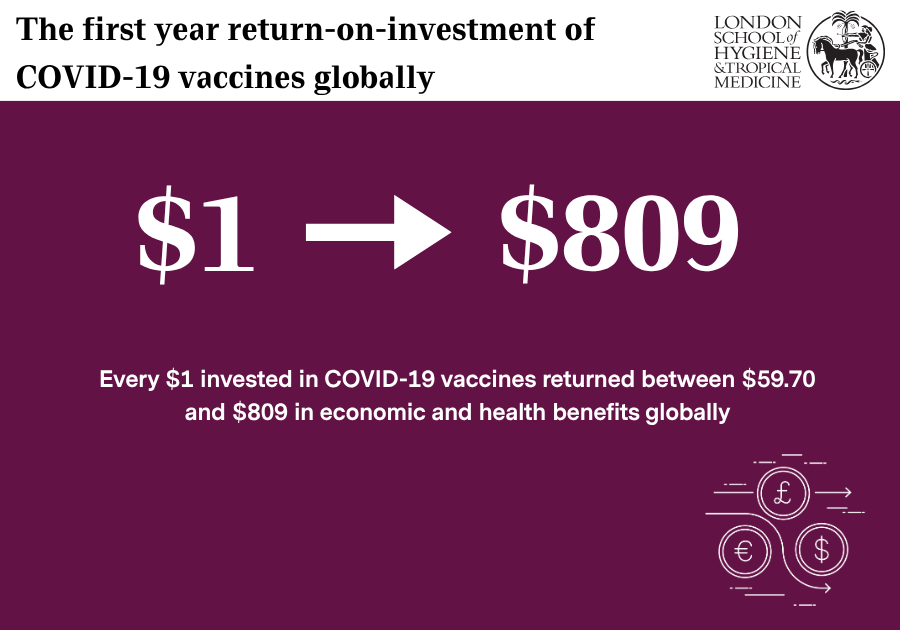
COVID-19 vaccines generated between $6.4 trillion and $64.3 trillion in benefits during their first year, according to a new global analysis from the London School of Hygiene & Tropical Medicine (LSHTM), Imperial College London and New York University. The study also found that the vaccines prevented 1.5 billion infections and 51.5 million hospitalisations and delivered returns of up to $809 for every dollar invested.
Published in PLOS Medicine, the findings highlight the long-term value of vaccine investment, with the study’s authors promoting the need for future investments in vaccines for both health and economic purposes.
Using previously published data from an epidemiological transmission model and conducting a return on investment analysis, the researchers quantified the global health, productivity, and healthcare benefits of COVID-19 vaccination in monetary terms. They then compared these benefits with the global costs of vaccine research, development, manufacturing and delivery.
In addition to reducing infections and hospitalisations, the analysis also found that during the first year of vaccination (8 December 2020 to 8 December 2021), the vaccines were estimated to have generated 364 million quality-adjusted life years through reducing deaths and illness. This is the equivalent of giving every person in the UK more than five additional years of life in perfect health.
From an economic perspective, while $79.4 billion was spent globally on COVID-19 vaccine development, manufacturing and delivery during the first year of vaccination, the total value of the benefits generated was estimated at between $6.43 trillion to $64.3 trillion. These benefits are roughly equivalent to between two and twenty years of the UK’s entire economic output, based on World Bank data from 2021.
Hallie Benjamin, lead author of the paper who worked on the research as a MSc Public Health student at LSHTM, said: “We found that the first year of COVID-19 vaccination delivered a significant return on investment. While developing and rolling out these vaccines at unprecedented speed required substantial upfront investment, the health and economic benefits far outweighed the costs within just one year.
“By preventing billions of infections and millions of hospitalisations and deaths, the vaccines generated enormous value for societies and economies worldwide. However, our research also shows that these benefits were not shared equally between higher- and lower-income countries, highlighting the importance of equitable and timely vaccine distribution. Through studying these inequalities, we hope our findings can help guide future research into how vaccination programmes can improve health and economic outcomes worldwide.”
For the global economy, the vaccination benefits saved $564 billion in productivity losses (around 0.73% of global Gross Domestic Product (GDP)) and $222 billion in healthcare costs (around 0.29% of global GDP). When the value of improved health was also included, the total benefits generated were worth 82.7% of global GDP, broadly equivalent to the 2021 annual economic output of the United States, China, Japan, Germany, the United Kingdom, India, France, Italy and Canada combined.
Despite the globally positive picture, the researchers also assessed differences in the benefits across World Bank income groups and found substantial disparities: High income countries gained the greatest economic benefits due to early access, higher coverage, and faster rollouts. They also benefitted from being able to afford vaccines that are the most effective against COVID-19, particularly mRNA vaccines. By contrast, many low- and middle-income countries (LMICs) had slower roll outs and achieved less overall vaccine coverage, leading to lower economic benefits. Importantly, low-income countries (LICs) had relatively high health benefits per-person vaccinated and averted the most healthcare and productivity costs per-person relative to GDP.
As such, the researchers highlight the importance of investments to lower vaccine costs and roll out times across LMICs and LICs and the sharing of vaccines and vaccine-related information across borders to achieve equitable vaccine distribution that enhances health equity and global economic stability. This echoes findings from other LSHTM researchers who also examined the equity of the COVID-19 vaccine roll out and recently published a United Nations (UN) University policy brief proposing an ‘equity-by-design’ framework to ensure better vaccine preparedness for future epidemics and pandemics.
By estimating the vaccination return on investment, the study provides important evidence in a long-running discussion around pandemic planning and whether similar public investments should be completed for future global health emergencies.
This evidence is timely, as countries met at the UN General Assembly in September to iron out disagreements around the Pathogen Access and Benefits Framework which is being negotiated as part of the UN’s Pandemic Agreement. News outlets reported that several HICs could not support the Agreement in its current form, forcing a further delay in its ratification as it moves to be ratified at a future meeting of the World Health Assembly.
Professor Melissa Parker, Co-Director of LSHTM’s Centre for Epidemic Preparedness & Response, said: “This study highlights in clear terms that investing in vaccine research and development is worth every dollar and that this vital work must continue before the next pandemic strikes.
“To truly prepare against future pandemics, it is vital that countries agree to work together for the greater public good by ratifying the UN Pandemic Agreement to ensure that the benefits of vaccine and outbreak research are available to all, regardless of income differences between countries.”
Mark Jit, Honorary Professor at LSHTM and Professor of Global Health at NYU School of Global Public Health and co-lead of the study, said: “There should be a way to get vaccines like this to countries that need it faster. Because of the delays, it wasn't as useful to many of those countries as it could have been.”
The findings of the paper were developed from the master’s dissertation of lead author Hallie Benjamin, who studied an MSc in Public Health at the London School of Hygiene & Tropical Medicine from 2023-24.
The authors note that the study does not examine the economic benefit of COVID-19 vaccines beyond their first year, when rates of infection were lower and most people had developed some immunity. However, in the face of a new viral threat, the findings show that rapidly investing in vaccine development can safeguard public health and preserve economic stability.
Publication
Benjamin, H et al. Global return-on-investment of COVID-19 vaccines in the first year of the vaccination programme: A model-based economic evaluation. PLOS Medicine. DOI: https://doi.org/10.1371/journal.pmed.1004772
If you enjoyed this article and would like to build a career in global health, we offer a range of MSc programmes covering health and data, infectious and tropical diseases, population health, and public health and policy.
Available on campus or online, including flexible study that works around your work and home life, be part of a global community at the UK's no.1 public health university.