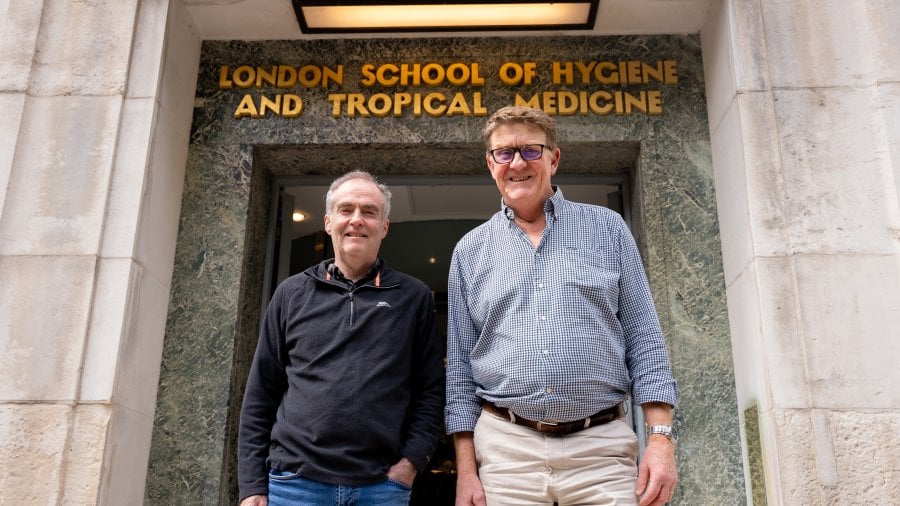
After decades of service to the London School of Hygiene & Tropical Medicine (LSHTM), Professors Colin Sutherland and David Baker are retiring, leaving behind extraordinary legacies that have helped shape modern malaria research and strengthened global efforts to combat one of humanity's oldest diseases.
Together, their careers span almost 80 years of scientific discovery, leadership, mentorship and service. Through pioneering research, dedicated teaching and institution-building, both have made lasting contributions to LSHTM, the global malaria community and the countless scientists they have trained and inspired.
Colin Sutherland: From Malaria Transmission to Drug Resistance
Professor Colin Sutherland joined LSHTM in 1998 and has since become one of the world's leading malaria parasitologists, combining laboratory science with a commitment to improving public health practice.
One of his earliest major achievements came through a series of clinical trials in The Gambia between 2000 and 2003. Supported by the Wellcome Trust, these studies were built on previous work by Geoff Targett and Chris Drakeley and examined how combination therapies for uncomplicated malaria could reduce transmission from humans to mosquitoes. The work produced landmark findings, including results of the first randomised controlled trial of six-dose artemether-lumefantrine treatment in African children, helping to establish evidence that would inform malaria treatment policy and contribute to efforts to curb transmission.
Professor Sutherland also played a key role in resolving a long-standing question in malaria biology. Working with colleagues in the UK and internationally, he demonstrated that Plasmodium ovale, first described more than a century ago, actually comprises two distinct malaria parasite species that coexist globally without recombining. The discovery transformed scientific understanding of this neglected malaria parasite and opened new avenues for research into its epidemiology and control.
More recently, he has been at the forefront of efforts to monitor and understand emerging antimalarial drug resistance. As artemisinin-resistant malaria parasites spread across Asia and parts of Africa, Professor Sutherland and collaborators established laboratory cultures from imported malaria cases in the UK and identified genetic variants associated with reduced susceptibility to key antimalarial medicines. These parasite isolates are now being shared internationally, supporting researchers worldwide in addressing one of the most pressing threats to malaria control. The work also helped identify important genetic variants linked to emerging antimalarial drug resistance in Africa.
Alongside his research achievements, Professor Sutherland has made significant contributions to LSHTM and the wider scientific community. He supervised 18 doctoral students to completion, served as Head of the Department of Immunology and Infection, co-directed the LSHTM Malaria Centre during the challenging years of the COVID-19 pandemic and, together with Professor Sian Clarke, helped secure substantial Unitaid funding for the PLUS PMC project, providing vital support for malaria research capacity and core salary support for many Malaria Centre members. He also led the British Society for Parasitology as both Vice-President and President. His leadership helped secure important funding that strengthened malaria research capacity across the School and beyond.
David Baker: Unlocking the Biology of Malaria Parasites
Professor David Baker's association with LSHTM began even earlier, when he joined the School in 1988 as a postdoctoral researcher under Professor Geoff Targett. Over nearly four decades, he has become internationally recognised for transforming our understanding of the molecular biology of malaria parasites.
His research has focused on deciphering the signalling pathways that control the complex life cycle of Plasmodium falciparum, the parasite responsible for the deadliest form of human malaria. Through pioneering work using genetics and molecular biology, Professor Baker and his collaborators identified key enzymes that regulate parasite development and demonstrated their potential as targets for new antimalarial drugs.
Supported by longstanding Wellcome Trust funding, including two Senior Investigator Awards, his discoveries have provided fundamental insights into parasite biology while laying the groundwork for the development of future malaria medicines.
Among his most influential scientific contributions was the discovery that the ApiAP2-G transcription factor acts as the master regulator of malaria parasite sexual conversion. This breakthrough deepened understanding of how parasites transition into the forms capable of infecting mosquitoes, a critical step in malaria transmission and therefore an important target for elimination strategies.
Professor Baker also helped bridge the gap between basic science and drug development. Working with partners at LifeArc, the Medicines for Malaria Venture and other organisations, he contributed to the development of highly potent inhibitors targeting key parasite enzymes, and later helped advance inhibitors targeting parasite phosphodiesterase enzymes, helping to expand the pipeline of promising antimalarial drug candidates.
Beyond the laboratory, Professor Baker has played a major role in training the next generation of scientists. He supervised 12 doctoral students and mentored around 20 postdoctoral researchers. As Research Degrees Director in the Faculty of Infectious and Tropical Diseases, he helped strengthen doctoral training and was instrumental in establishing the London Interdisciplinary Doctoral Programme (LIDo), which has supported hundreds of doctoral students since its launch.
His contributions to LSHTM also included serving as Deputy Director of the Malaria Centre and as a member of the Medical Research Council's Infections and Immunity Board. He has been equally committed to teaching, supporting generations of MSc students and leading field courses that provided many with their first experience of hands-on ecological and infectious disease research.
A Lasting Legacy
While their scientific interests differed, Colin Sutherland and David Baker shared a commitment to rigorous science, collaboration and mentorship, and also shared a lab for over twenty years. Their work has expanded understanding of malaria parasite biology, informed treatment and control strategies, strengthened research capacity, and helped train future leaders in global health.
Professor Liam Smeeth, Director of LSHTM spoke about their impact on LSHTM, leadership, mentorship and service saying: “Over the course of two remarkable careers, Colin and David have made contributions whose impact extends far beyond LSHTM's campuses and laboratories. Their discoveries have played a major role in shaping malaria research, whilst the leadership and mentorship they have shown to students, colleagues and collaborators across the world leaves a legacy that will be felt for many years to come. I wish them all the very best for their retirement.”
As they retire from LSHTM, colleagues across the School and around the world celebrate their remarkable careers and thank them for their outstanding contributions to malaria research, global health and the LSHTM community.
To mark their retirement, colleagues, collaborators and friends are invited to join a celebration at the Pumphandle Social Bar on 5 June at 16:00 BST. We hope many members of the LSHTM community will come together to recognise their achievements, share stories from across the years and wish Colin and David every success in the next chapter of their lives.
If you enjoyed this article and would like to build a career in global health, we offer a range of MSc programmes covering health and data, infectious and tropical diseases, population health, and public health and policy.
Available on campus or online, including flexible study that works around your work and home life, be part of a global community at the UK's no.1 public health university.