
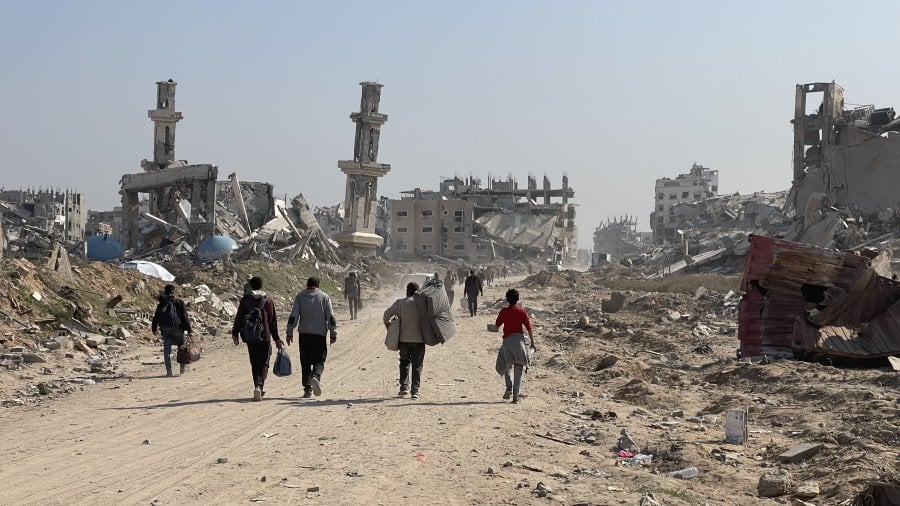
One day in the future, when we at last look back, will this have been the month when the progression of Israel’s campaign in Gaza turned from the undoubtedly atrocious to something far more extreme? Here are some simple signs of a long-feared, now almost-certain inflection point: even journalists, NGO workers and UN staff - surely a reasonably well-off sector of the population - are struggling to scrounge together enough food for a single daily meal, cannot find any to buy even if they have cash, can barely even get up and go assist everybody else. We know already of course that many Gazans have been starving because thousands of them every day attempt a march through militarised territory to stand in line under the baking sun at one of just four distribution points, where at any moment, perched atop overlooking turrets, masked gunmen will probably open fire on them. Over 1,000 have already been murdered in this way since the end of May. The risk is clearly extreme and the availability of sufficient food boxes entirely unpredictable. And yet the small ones are losing weight. Whom shall we send today? Dad, mum, previously-injured uncle? Whose life can we afford most to lose?
Amidst Gaza’s almanac of atrocities, is this what genocide actually looks like? One of the first things you discover after starting to conduct research on Palestine, as colleagues and I did after 7 October 2023, is that this is a conflict where language is also a theatre of intense operations. Of various contested terms, genocide is one I have been reluctant to employ so far, mainly because it is a legal, specific concept, the application of which implies a burden of evidence (notably on intentionality) that few outside a specialised tribunal can realistically supply. Its uninformed use may seed more confusion than clarity, as it suggests a binary choice with no significant in-betweens (i.e. a long list of war crimes) and in this case invites the illogical counter-argument that designating Israel’s operations as genocidal is antisemitic. To be clear, Jews are humans and thus capable of the widest spectrum of criminality as we all are; and that genocide is occurring does not imply that all Israeli Jews should be held accountable for it.
Does naming or acknowledging a genocide alter what should immediately be done? Within Gaza itself, arguably not. It is however noteworthy that leading scholars, including Israeli academics who study the Holocaust, have now begun to describe Israel’s action as genocidal. With all the humility that subject incompetence must impose, it appears likely even from a lay point of view that judicial processes will eventually reach the same conclusion. The implication for the UK and other Western countries is that they also have legal obligations under the existing genocide convention.
It is remarkable not only that most of these countries’ governing politicians don’t seem interested in ensuring that they (and by association we) fulfil these (e.g., by stopping arms sales), but also that they don’t take steps to avoid one day finding themselves upon the least desirable of seating options available within a courtroom.
A related question of whether a famine is unfolding in Gaza also implies an oversimplification, as its absence wouldn’t mean that malnutrition is under control. Moreover, there is no single definition of famine, though it is generally understood as a rarely occurring set of conditions, chief among which such an extreme level of food insecurity that people run out of coping mechanisms to keep feeding their families. Typically, pockets of famine are first observed, starting within the poorest, most marginalised communities. Public and private information I’ve seen suggests that this is now occurring in Gaza, and that the situation is rapidly escalating.
If Israel relaxes aid restrictions, as it did in April 2024, the trend could just as rapidly reverse. This would, however, need to happen now (as in, now; not even in ten days). If it does not, acute malnutrition, a clinical condition that exposes people (especially children and pregnant or lactating women) to a high risk of dying from otherwise common infections, will keep rising exponentially. The condition evolves over a few weeks, meaning the bulk of deaths occur with a lag. Otherwise put, a tidal wave of severely malnourished children dying of severe pneumonia or diarrhoea could be one or two months away.
Is any of this politics? Is it, indeed, a political statement to ask that states such as the UK halt any military sales to Israel and actively work to disable it from committing mass starvation, for example through sanctions? If by political we mean non-neutral, well, there are certainly fixed points of non-neutrality in both the public health and humanitarian gazes: war crimes, structural violence, and oppression compromise health; humanitarian assistance is beneficial; some form of international law is needed and must be enforced to protect people and humanitarian actors; root causes of poor health must be tackled; every life has the same value: Palestinian, Jewish, Solomon Islander. The extent of our professionally expressed ‘politics’ should thus be that, as public health specialists or humanitarian staff, we expect states and other institutions with effective power to act (and not just talk) in accordance with the above points.
To take a longer-term public health view, we might also go as far as to expect that our governments, especially those with a serious colonial legacy, extend their consideration to Israelis’ actual wellbeing. As Daniel Levy argues, none of this violence makes them any safer or better-off. For the first time in decades, Israel has net negative migration. Even assuming that its external security remains indefinitely guaranteed by the single point of failure it is reliant on (the United States), will the growing internal bullying of Israeli Arabs and Jews who criticise the war eventually turn into something more, let us say, physically persuasive?
Last but not least: anyone affected by crises other than Gaza (and Ukraine) may feel even more transparent than usual these days. I can confirm that we really can’t see you. What did you say? You’re cutting up. One of the many suppurating ethical wounds of this conflict is the vast disproportionality in attention between, on the one hand, Israeli versus Palestinian civilian lives, and, on the other hand, Palestinians versus, say, people affected by wars in the Central African Republic or Mali (I’m guesstimating roughly a 1:50:1000 ratio of how many deaths will attract serious media coverage). In my observation, segments of the pro-Palestinian movement display a worrisome nonchalance about this inequity. Perhaps the only thing going for Gazans now is how much aid stands ever-ready to be delivered to them; elsewhere, this year will see a precipice in humanitarian assistance to hundreds of millions needing it. This will have plausibly large effects on mortality, most of which will probably remain unquantified.
And yet Gaza does bear great significance beyond its barely-open borders and is worth taking an interest in even by those who are far removed from it and yet no strangers to some of the conditions – war, food insecurity, large-scale psychological trauma – currently visited upon Palestinians. A precedent is being established and indeed crossed, stress-tested and updated by Israel on a daily basis: war crimes carried out in plain daylight, with more real-time evidentiary material than human cognition can process, and the as-yet unfailing validation of impunity. A global precedent, too, for the effective nullification of public health and humanitarian principles and imperatives. The actual point being this: others may well be reading Israel’s playbook and – guess what – finding it a real page-turner.
What can we then - public health specialists, academics, other concerned professionals - possibly do from the sidelines, other than increasingly vigorous handwringing? Some robust science perhaps, which we and others, including, most admirably, scientists within Gaza, have undertaken with limited resources. It may not change anything on the ground, but scientific evidence has previously been upheld as evidence in war crimes tribunals. More recently a few of us published a letter in the British Medical Journal, asking for UK government action (please consider signing it if you are an academic or health professional in Britain). Our Director wrote to the government and I also wrote to my MP. Replicating such initiatives wherever you are may yet bear fruit through some weird stochastic cumulation of butterfly-wing events. It might just be preferable to doing nothing.
But anyway: month 21 of this increasingly grotesque dystopia has nearly ended. Choices, as ever, were available. Things could have conceivably been done. A rightful exercise of power could not have arrived too late, though it would have been woefully tardy nonetheless. The mark of further delays: more bodies lowered into Gaza’s sand. All this can certainly get much worse in month 22. Or it can certainly get much better. What is unchangeable is what we did about it.
Disclaimer: the author is a former humanitarian NGO staff member and a professor of epidemiology and international health at the London School of Hygiene & Tropical Medicine, but wrote this piece in a personal capacity.
If you enjoyed this article and would like to build a career in global health, we offer a range of MSc programmes covering health and data, infectious and tropical diseases, population health, and public health and policy.
Available on campus or online, including flexible study that works around your work and home life, be part of a global community at the UK's no.1 public health university.