
Researchers from the London School of Hygiene & Tropical Medicine have highlighted how climate change driven hazards and disasters impact menstrual health and hygiene (MHH), including worse access to menstrual products and facilities, care for menstrual discomfort or disorders, and increased social stigma for displaced people.
Their results also highlight significant gaps in our understanding, including no published evidence for hazards like extreme heat and inconsistent data and research between countries and regions.
The authors argue that much more needs to be done to support MHH in climate change preparedness and response frameworks, climate adaptation policy, and policy that intersects both of these fields.
Published in PLOS Climate, the researchers conducted a mixed-methods global systematic review of studies from 1947 to 2025 that have analysed how climate impact drivers and climate hazards affect menstrual health. Understanding how climate change and its associated hazards intersect with MHH is important; up to 80% of people displaced by climate disasters are women, which worsens MHH that is, in many cases, already poor or insufficient.
Ensuring that people have good MHH requires access to period products and materials, and the core infrastructure to support medical care and systems that provide clean water, sanitation and disposal options. Broader social support is also important in giving people timely, accurate and age-appropriate information and a supportive, positive environment to confidently care for their bodies throughout their menstrual cycle.
The review looked at studies that covered a range of climate drivers and hazards linked to anthropogenic climate change, and identified problems people experienced with MHH. Throughout all the hazard scenarios, studies found that people consistently experienced urinary tract infection and skin problems. In cases where people were displaced and living in shelters, there were consistently issues in finding private spaces and being exposed to verbal abuse and harassment.
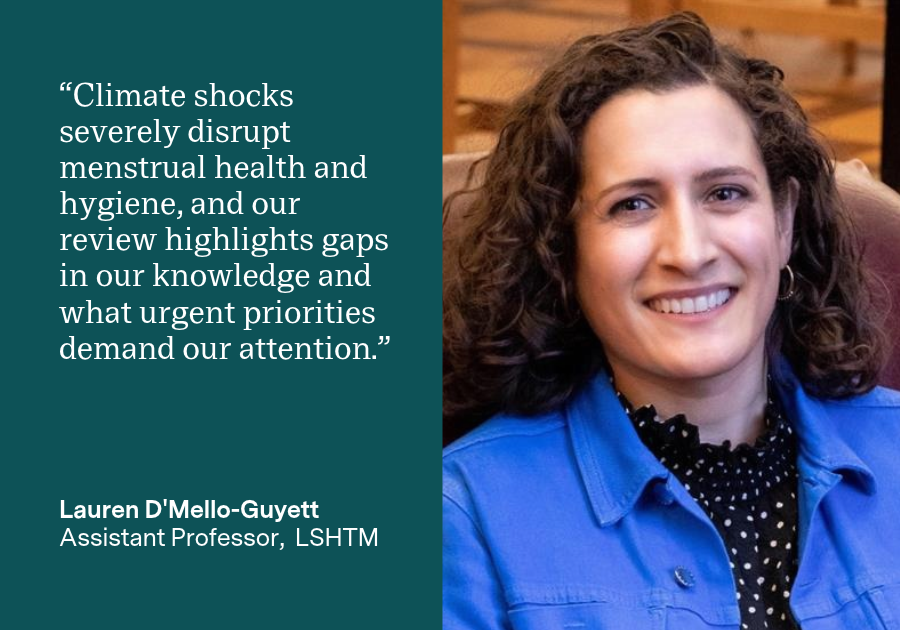
Dr Lauren D'Mello-Guyett, Assistant Professor at LSHTM, said: “Climate shocks and slow-onset environmental pressures severely disrupt menstrual health and hygiene, triggering cascading effects across sexual and reproductive health, education, livelihoods, safety, and civic participation. These profound vulnerabilities are distributed unequally along intersecting lines of identity, disproportionately harming marginalized populations.
“By systematically mapping the existing evidence base, this review highlights critical gaps in current literature to determine what is already established, what is actively being studied, and what urgent priorities demand our attention.”
The review also highlighted the specific issues that arose from different hazards. For example, the damage from floods and cyclones to core infrastructure meant less access to water, working sanitation, and menstrual products. Because of this, people had less access to medical care for menstrual issues or had to travel long distances to find care.
Studies into air pollution, an additional hazard considered in this review, highlighted how being exposed to pollutants were associated to irregular menstrual cycles and an earlier age for menarche (the age of a person’s first menstrual cycle). All of the studies that looked at the effects of air pollution were quantitative, and only assessed associations in high income countries (HICs).
This stood in contrast to studies collected on other hazards, like flooding, cyclones or droughts, which were qualitative investigations that focused on collecting accounts of people’s experiences of their MMH, and were mostly set in low- and middle- income countries (LMICs).
For the authors, this highlights a major issue in inconsistent research. Only studying the effect of air pollution on MHH in HICs will skew our understanding of the problems and solutions. And various climate scenarios were either underrepresented (e.g. cyclones and droughts) or not represented in any capacity like extreme heat. Plugging that gap is particularly important as extreme heat is a major stressor for the body that can affect people’s MMH and, over the long term, make water scarcer. Many areas of the world were also under researched as no studies were identified in Sub-Saharan Africa, Southeast Asia, or Latin America.
Publication
D’Mello-Guyett L, Jaggarwal N, Wilbur J et al. Effects of climate change on menstrual health and hygiene: A global mixed-methods systematic review. PLOS Climate, 2026. DOI: https://doi.org/10.1371/journal.pclm.0001083
If you enjoyed this article and would like to build a career in global health, we offer a range of MSc programmes covering health and data, infectious and tropical diseases, population health, and public health and policy.
Available on campus or online, including flexible study that works around your work and home life, be part of a global community at the UK's no.1 public health university.