
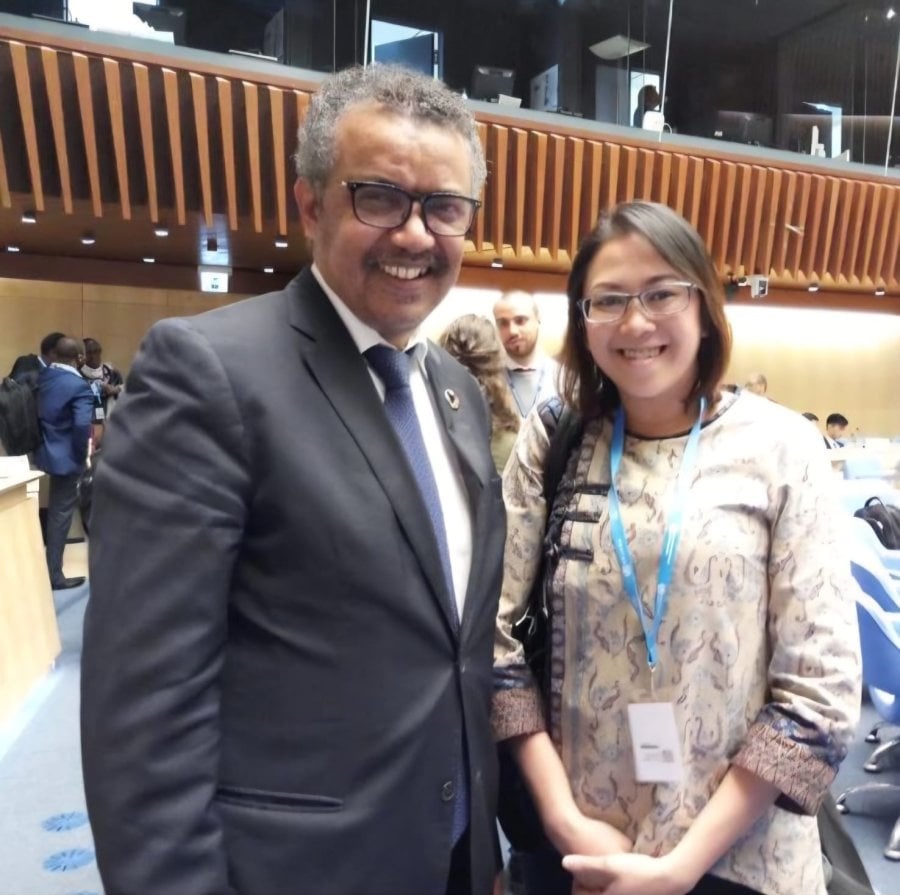
In 2017, Elizabeth Salmon, now a Doctor of Public Health student at the London School of Hygiene & Tropical Medicine (LSHTM), attended the World Health Organization (WHO) Director-General election at the Palais des Nations in Geneva.
As part of the Indonesian delegation, she watched member states cast three rounds of secret ballots before electing Dr Tedros Adhanom Ghebreyesus as WHO’s ninth Director-General.
At the time, antimicrobial resistance (AMR), which occurs when bacteria, viruses, fungi and parasites no longer respond to medicines, featured in the leadership debate, but largely at the margins.
Of the six candidates originally nominated, Sania Nishtar and Flavia Bustreo, explicitly raised AMR in a public commentary. Tedros included AMR in his candidacy document as part of the wider challenge of health security, alongside issues such as natural disasters and bioterrorism.
Five years later, Elizabeth returned to attend Tedros’s re-election. By then, the place of AMR on the global health agenda had changed considerably.
WHO had established a dedicated AMR Division and appointed its first Assistant Director-General for AMR. Tedros had also chaired the Global Leaders Group on AMR and increasingly highlighted drug-resistant infections as a major global health threat.
Having attended both elections, Elizabeth saw first-hand how AMR had moved from the margins of the leadership conversation to become a much more prominent global health priority.
Now, WHO member states are preparing to choose again.
Four candidates have so far been confirmed for the term beginning in August 2027: Dr Hanan Al-Kuwari of Qatar, Dr Hanan Balkhy of Saudi Arabia, Dr Hans Kluge of Belgium and Mr Budi Gunadi Sadikin of Indonesia.
This time, AMR is already visible in the experience and priorities of several candidates.
Dr Balkhy previously served as WHO’s Assistant Director-General for Antimicrobial Resistance before becoming Regional Director for the Eastern Mediterranean. Earlier in her career, she helped develop Saudi Arabia’s infection prevention programme.
Mr Sadikin, as Indonesia’s Health Minister, oversaw the country’s 2022 G20 Health Presidency, during which G20 health ministers adopted a dedicated Call to Action on Antimicrobial Resistance.
Dr Kluge has included AMR within the first priority of his campaign manifesto, pledging to strengthen action through a One Health approach. Dr Al-Kuwari’s public statements so far have focused more broadly on strengthening health systems.
But for Elizabeth, the importance of this election goes beyond whether AMR appears in candidates’ priorities.
The next Director-General will take office at an important time for global efforts to tackle drug-resistant infections.
The Sustainable Development Goals conclude in 2030, with AMR now tracked through one of their indicators. A year earlier, the next UN High-Level Meeting on AMR is expected to review progress following commitments made by world leaders in the 2024 political declaration on AMR.
The WHO Pandemic Agreement has also placed greater international focus on AMR surveillance and affordable and equitable access to antimicrobials.
Together, these commitments create an opportunity to turn growing political attention into measurable progress. But this comes at a time when resources for tackling AMR are under increasing pressure.
The UK’s Fleming Fund, which invested more than £250 million over a decade to strengthen AMR surveillance and support national action around the world, closed in 2025. Its closure has raised concerns about how countries, particularly those with fewer resources, can maintain and build on progress.
For Elizabeth, this highlights an important distinction between keeping AMR high on the international agenda and ensuring countries have the resources to act.
Elizabeth said: “The question I would put to every candidate is this: how will you secure new and sustained resources for AMR, rather than simply redirect existing funding?
“We have seen AMR gain significant political attention since 2017. The challenge for the next Director-General will be ensuring that this momentum translates into meaningful and measurable progress.”
Compared with the WHO leadership contest Elizabeth attended in 2017, AMR enters this election with much greater political visibility. Several of the candidates also bring direct experience of the issue.
But recognition alone will not strengthen surveillance, improve access to effective antimicrobials or deliver national plans to tackle AMR.
With the next UN High-Level Meeting on AMR expected in 2029 and the Sustainable Development Goals reaching their 2030 deadline, WHO’s next Director-General will take office at a significant moment for the global response.
Whoever is elected will inherit an AMR agenda that has gained considerable ground over the past decade. The challenge will be turning that momentum, and the commitments already made, into action backed by the resources needed to deliver it.
If you enjoyed this article and would like to build a career in global health, we offer a range of MSc programmes covering health and data, infectious and tropical diseases, population health, and public health and policy.
Available on campus or online, including flexible study that works around your work and home life, be part of a global community at the UK's no.1 public health university.