
New research from members of the London School of Hygiene & Tropical Medicine shows that the best way to stop antimicrobial resistance is to tackle its spread among different sectors. This includes spread between communities of people, farms and other places where animals live, and the natural environment. The researchers found that interventions to reduce transmission consistently had a greater impact than reducing antibiotic use alone but the levels of uncertainty were large.
Published in One Earth, the study used the same mathematical model to compare potential One Health interventions across England, Denmark and Senegal, helping researchers understand how different policies could work in countries with very different health systems, farming practices and levels of antimicrobial resistance. While identifying some of the most promising interventions, the authors note there are many uncertainties due to limited data on the spread of resistance between sectors, highlighting an urgent need for better monitoring of antimicrobial resistance.
Antimicrobial resistance (AMR) is a significant threat to global public health as it continues to spread and render antibiotics ineffective, causing millions of deaths per year. As the AMR crisis grows, public health bodies have become increasingly interested in tackling AMR as part of a ‘One Health’ systems approach.
This integrated approach views humans, animals and the environment as interconnected, bringing together multiple disciplines to address shared health challenges. The study found that because resistance moves between these sectors, interventions in one area can have benefits across all three, reinforcing the importance of coordinated One Health approaches.
Similar to previous modelling analyses, this model's results show that targeting the spread between different settings was the most effective way to reduce antimicrobial resistance. Interventions aimed at reducing transmission, particularly those involving the environment, were predicted to have a greater impact than interventions focused only on reducing antibiotic use. The findings also suggest that the environment plays a much larger role in the spread of resistance than is often recognised, highlighting it as an important source of antimicrobial resistance transmission.
By contrast, reducing antibiotic use in animals alone was predicted to have only a relatively small impact on resistance, suggesting that focusing on antibiotic stewardship in animals, whilst potentially reducing “black swan” events and remaining a vital intervention for reducing total AMR, reducing transmission alongside responsible antibiotic use may offer greater public health benefits for humans.
While the authors were able to identify this broad trend across these three countries, they emphasise there is a lot of uncertainty with their numbers due to either missing data, or concerns with its quality. Some types of data were difficult to source, such as how often antibiotics were used (antibiotic use parameters) and the duration of AMR survival or persistence in each setting i.e. the total length of time that resistance remained.
Even when data were available, there were issues with quality and minimising bias. For example, cases where environmental data were only collected at coastlines rather than all appropriate natural areas of a country, or broader issues of inconsistency due to the methods for collecting data changed over time. How much date were reliably available also varied among the countries, with Senegal in particular having sparse and unreliable data. Generally, antimicrobial data were more limited in animals and the natural environment than humans.
Because of these issues, the authors argue that policymakers and funders need to invest in better surveillance for antimicrobial resistance, particularly to improve understanding of the links between animals, humans and the environment. Without stronger One Health surveillance, it will remain difficult to identify which interventions should be prioritised and provide robust evidence to guide policy decisions.
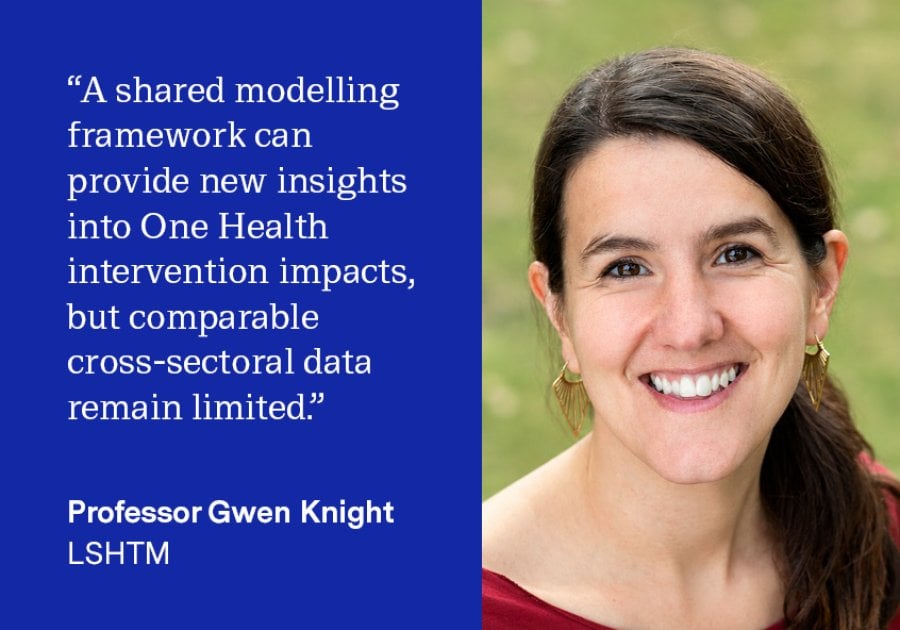
Gwen Knight, Professor at LSHTM and first author of this paper said: “Using a shared modelling framework fitted to data across multiple countries can provide new insights into One Health intervention impacts but this is approach is currently limited by cross-sectoral comparable data on antibiotic use, resistance prevalence and length of AMR persistence in different settings such as the environment”
The new mathematical model was developed to compare the health policies designed to tackle antimicrobial resistant E. coli of England, Denmark, and Senegal. To determine the impact of a set of policies, the model uses multiple types of data: levels of antimicrobial resistance recorded in a particular setting; the level of transmission among various groups of humans, animals and the natural environment; and how many antimicrobial drugs are used in each environment. These data were used to simulate the impact of various policies.
If you enjoyed this article and would like to build a career in global health, we offer a range of MSc programmes covering health and data, infectious and tropical diseases, population health, and public health and policy.
Available on campus or online, including flexible study that works around your work and home life, be part of a global community at the UK's no.1 public health university.