Maternal anaemia linked to increased risk of giving birth to small, vulnerable babies
21 August 2026 London School of Hygiene & Tropical Medicine London School of Hygiene & Tropical Medicine https://lshtm.ac.uk/themes/custom/lshtm/images/lshtm-logo-black.png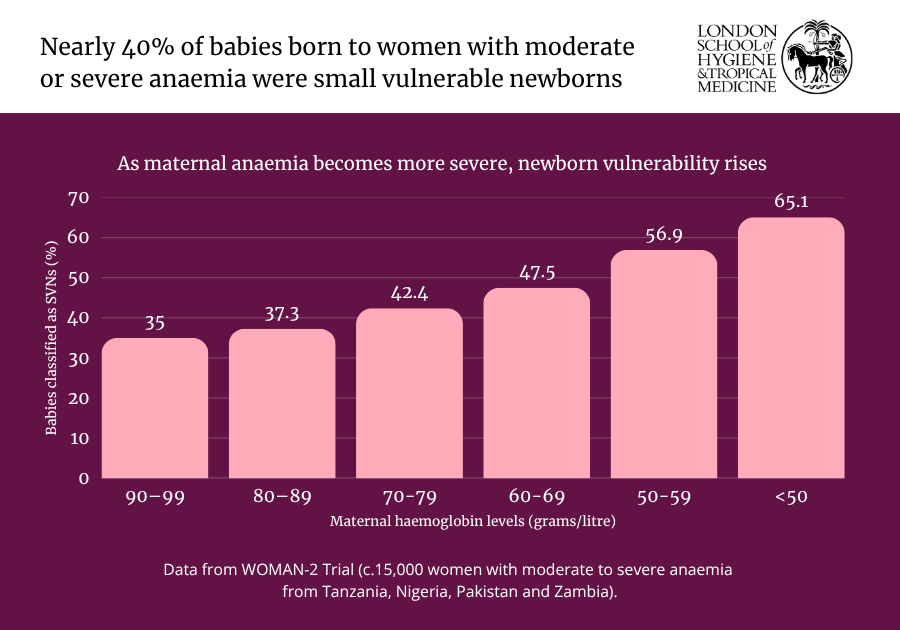
Almost 40% of mothers with moderate or severe anaemia gave birth to babies born prematurely, with low birth weight, or smaller than expected for their gestational age, according to new research from the London School of Hygiene & Tropical Medicine.
The study, published in the International Journal of Gynecology & Obstetrics, analysed data from 14,444 women* with moderate or severe anaemia in Nigeria, Pakistan, Tanzania and Zambia, who took part in the WOMAN-2 Trial coordinated by LSHTM’s Clinical Trials Unit. Of these women, 5,703 gave birth to a small vulnerable newborn, with those with more severe anaemia more likely to give birth to these babies.
Small vulnerable newborns are babies who are born prematurely, have low birth weight, or are smaller than expected for their gestational age. They are at increased risk of dying in their first weeks of life and can experience short- and long-term health complications, including infections, breathing difficulties and neurodevelopmental problems.
There are several possible explanations for the link between maternal anaemia and small vulnerable newborns. Moderate to severe anaemia can reduce the amount of oxygen that reaches the baby and placenta. Anaemia may also cause stress and inflammation in the mother and baby, which could increase the risk of early labour and restrict the baby’s growth.
Anaemia remains significantly overlooked as a contributor to poor maternal outcomes, as highlighted in the team’s Missing evidence report. Women with severe anaemia are seven times more likely to die or nearly die during childbirth and three times as likely to have a stillbirth, compared to women with moderate anaemia.
These findings are particularly important for countries with high levels of maternal anaemia, and maternal and newborn deaths. These include many countries in sub-Saharan Africa and South Asia, where small vulnerable newborns are disproportionately born and where 80% of global neonatal deaths occurred in 2022.
Co-author of the study, LSHTM Professor Joy Lawn previously led a 2023 Lancet Series on small vulnerable newborns which focused solely on babies born alive. It found 2.3 million liveborn babies died within their first 28 days of life.
Lead author Dr Henry Ochola, an Obstetrics and Gynaecology Resident at Mbarara University of Science and Technology/Mbarara Regional Referral Hospital, Uganda, and LSHTM MSc Epidemiology alumnus, said: “Small vulnerable newborns are at increased risk of growing up with health complications. Some are even likely to give birth to SVNs like themselves.
“We need to actively look for maternal anaemia, prevent it or treat it.
"Prevention should start at pre-conception. All women should know if they are anaemic before pregnancy, receive the necessary treatment for anaemia and any other underlying causes of infections, such as malaria and hookworm.”
Professor Ian Roberts, co-lead of the WOMAN Trials, said: “If we want to give every baby the best possible start in life, tackling anaemia in women cannot be an afterthought.
“Preventing and treating anaemia in women must start earlier. We need urgent action across the life course, from childhood and adolescence through to pregnancy, so anaemia is detected much earlier.”
The findings of the study add to the WOMAN Trials growing body of work, which is calling for anaemia to be prevented, detected and treated as early as possible, so as to improve outcomes for women and babies worldwide.
The WOMAN Trial team’s next trial – WOMAN-3 – is looking at reducing anaemia in women by giving them tranexamic acid tablets, alongside iron and lost vitamin replenishment.
*The WOMAN-2 Trial recruited over 15,000 women. Women delivering before 24 or after 42 weeks of gestation were excluded from this study’s analysis. Of the 14 444 women included in this analysis, the median haemoglobin level was 85 g/L.
Publication
Ochola et al. Severity of maternal anaemia and the risk of giving birth to a small vulnerable newborn: A cohort analysis of the WOMAN-2 trial in four countries. International Journal of Gynecology & Obstetrics. 2026 DOI: https://doi.org/10.1002/ijgo.71306
If you enjoyed this article and would like to build a career in global health, we offer a range of MSc programmes covering health and data, infectious and tropical diseases, population health, and public health and policy.
Available on campus or online, including flexible study that works around your work and home life, be part of a global community at the UK's no.1 public health university.