Keyhole surgery for colon cancer is not reaching those it would benefit most
2 February 2026 London School of Hygiene & Tropical Medicine London School of Hygiene & Tropical Medicine https://lshtm.ac.uk/themes/custom/lshtm/images/lshtm-logo-black.png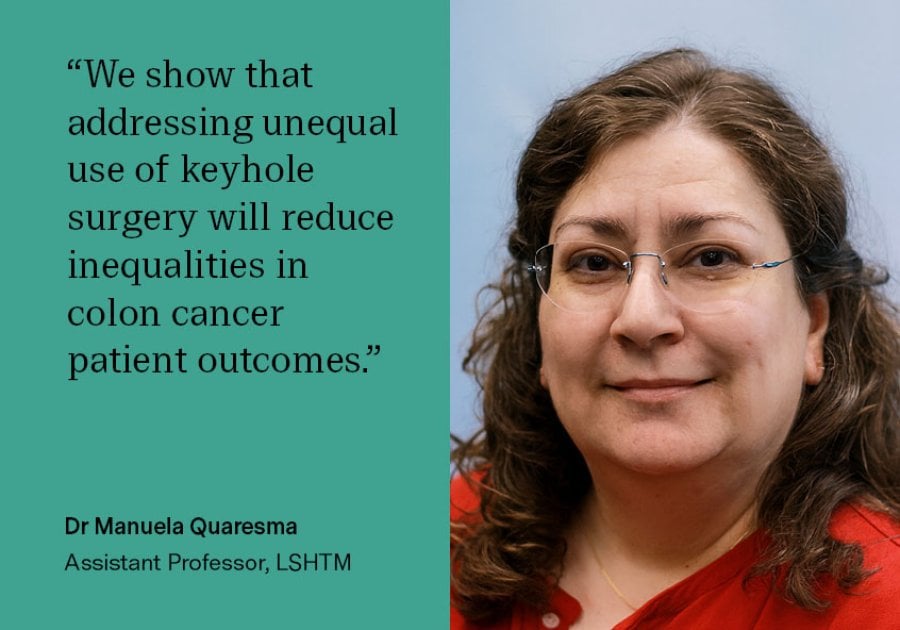
Minimally invasive surgery (keyhole) has become an established part of colon cancer care, offering faster recovery and fewer complications than traditional open surgery. In England, its use has increased steadily over the past decade. However, new research shows that use of keyhole surgery remains uneven, with older and patients with more complex needs less likely to receive it despite standing to benefit the most.
Two closely linked studies published by ICON researchers at LSHTM examined these inequalities from different angles. One article, published in eClinicalMedicine, examined which patients were more or less likely to receive keyhole surgery rather than open surgery, and assessed whether it was associated with lower mortality. The other article, published in The Lancet Oncology, built on these findings to estimate the impact of correcting the inequalities in use of keyhole surgery, observed in the eClinicalMedicine study.
The Lancet Oncology study analysed cancer registry data for 10,603 patients who underwent surgery for localised colon cancer in England in 2022. The researchers examined scenarios in which patients considered high risk were as likely to receive keyhole surgery as patients with higher uptake. The analyses showed that correcting these inequalities could lead to shorter hospital stays, less hospital readmissions and fewer deaths within one year of surgery, further reducing inequalities in patients’ outcomes. Hospital bed use was reduced by more than 1,500 days in a single year (from 5,100), 22 hospital readmissions (out of 56) were prevented and 14 deaths (out of 27) avoided, for high-risk patients assumed to receive keyhole surgery in the scenarios.
Results of the eClinicalMedicine study show that keyhole surgery was successfully completed in 74 percent. Nonetheless, uptake was consistently lower among older patients, those who are frail, with major illnesses and those from more socio-economically deprived areas. Using an emulated trial design, the researchers estimated the effect of surgical approach on one-year mortality. One-year mortality was 7.7 percent among patients who had open surgery, compared with 2.9 percent among those who had keyhole surgery. The largest absolute reductions in mortality were seen among patients aged 85 years and over, those who are frail and those with major other illnesses. These were also the groups least likely to receive keyhole surgery in routine practice.
Dr Camille Maringe, Associate Professor at lSHTM said: “Our data highlight the benefits to patients and to the NHS from increased use of keyhole surgery as the standard of care for localised colon cancer in higher as well as lower risk patients.”
Assistant Professor Dr Manuela Quaresma is a medical statistician at LSHTM who integrates advanced statistical methods with cancer epidemiology to analyse large-scale cancer datasets.
She said: “We show that addressing unequal use of keyhole surgery will reduce inequalities in colon cancer patient outcomes.”
Rather than reflecting clinical need alone, the findings of these two studies point to differences in how care is delivered across NHS Trusts. They underline a broader challenge for the NHS: as new surgical techniques become standard practice, unequal implementation can limit their potential to improve outcomes at a population level; a priority that should be addressed head on by the upcoming National Cancer Plan.
View the infographic (pdf).
If you enjoyed this article and would like to build a career in global health, we offer a range of MSc programmes covering health and data, infectious and tropical diseases, population health, and public health and policy.
Available on campus or online, including flexible study that works around your work and home life, be part of a global community at the UK's no.1 public health university.