Anticipatory action: a new paradigm for outbreak responses in crisis settings
26 August 2025 London School of Hygiene & Tropical Medicine London School of Hygiene & Tropical Medicine https://lshtm.ac.uk/themes/custom/lshtm/images/lshtm-logo-black.png
Tilly Alcayna, Senior Technical Advisor at the Red Cross Climate Centre and PhD Student at LSHTM
Bhargavi Rao, Clinical Associate Professor – Public Health, LSHTM
Rachel Lowe, Associate Professor, LSHTM
In the humanitarian sector, anticipatory action means acting ahead of predicted hazardous events to prevent or mitigate potential impacts and needs – including forecasting and securing funding for pre-agreed early actions.
This approach has traditionally been used for predicted extreme weather events, but our new study presents a framework for how it can be applied for disease outbreak preparedness and response.
Anticipatory action would allow humanitarian actors to rapidly scale up interventions, such as the release of emergency funding and promotion of safe hygiene practices, as risks emerge – shaped by climate, environmental, social and political factors.
This framework has been informed by practices from organisations such as the Red Cross Red Crescent, United Nations agencies and Médecins Sans Frontières.
Triggers for anticipatory action
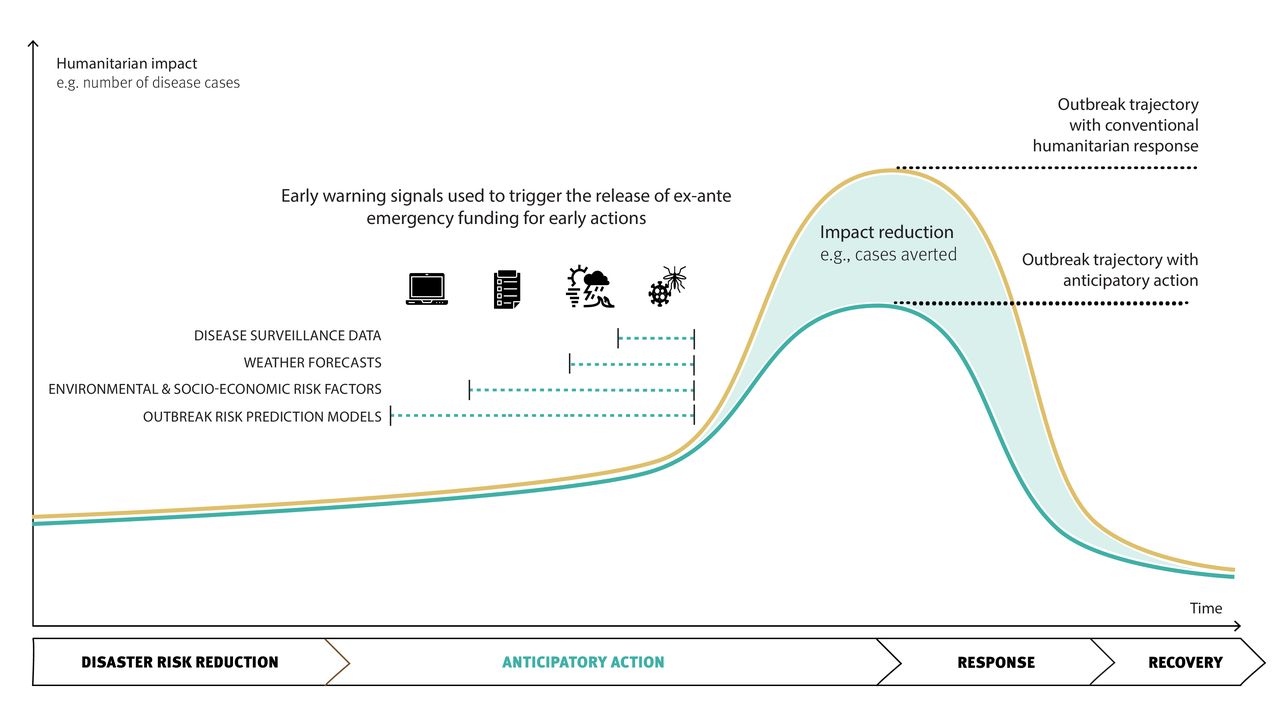
In this study, we highlighted four triggers for early action:
- Real-time disease surveillance data
- Forecasts of extreme climate or weather events
- Observing environmental and socioeconomic transmission risk factors
- Using data-driven approaches
Each approach has distinct advantages and trade-offs. The decision to identify the most suitable trigger depends on data availability and capacity.
For example, when there is pre-existing evidence of a link between extreme climate events and disease outbreak, and sufficient accurate weather forecasts are available in the location, extreme climate forecasting may be the most appropriate approach.
In the past, this was used by the Mozambican Red Cross to implement early actions in preparation for a cyclone. These actions included training volunteers to use water purification tablets and distribution of hygiene kits.
If a sufficient historical record of disease data exists, and there is capacity for the humanitarian agency to develop risk prediction models, data-driven outbreak forecasting may be more suitable.
Médecins Sans Frontières’ Malaria Anticipation Project, launched in 2021, has utilised data analysis and modelling to predict rises in malaria cases, aiming to identify when to carry out preventative action such as vector control and distribution of antimalarial drugs.
Challenges of anticipatory action
Implementation of anticipatory action still faces persistent challenges, such as the lack of prearranged funding and incompleteness of data in humanitarian settings.
Previous efforts and evidence have shown that interdisciplinary collaboration is necessary for the development of effective anticipatory action. This requires building effective partnerships between disaster risk managers, climate scientists, social scientists, social protection experts, public health professionals, epidemiologists and finance professionals.
Data sharing is a persistent issue affecting planning of anticipatory action. Currently, only 14% of WHO Member States have agreements in place for sharing data between health ministries and climate monitoring agencies.
Despite these challenges, a shift in mindset from traditional reactive responses to proactive use of existing information is imperative to reduce preventable suffering.
Unlike anticipatory action for extreme climatic events, which mitigate but do not prevent the event, anticipatory action for outbreaks has the potential to contain the spread of disease early, and even prevent the outbreak from occurring at all in exceptional cases.
Discover more of LSHTM's work in this area and consider signing up to join our Centres:
If you enjoyed this article and would like to build a career in global health, we offer a range of MSc programmes covering health and data, infectious and tropical diseases, population health, and public health and policy.
Available on campus or online, including flexible study that works around your work and home life, be part of a global community at the UK's no.1 public health university.