
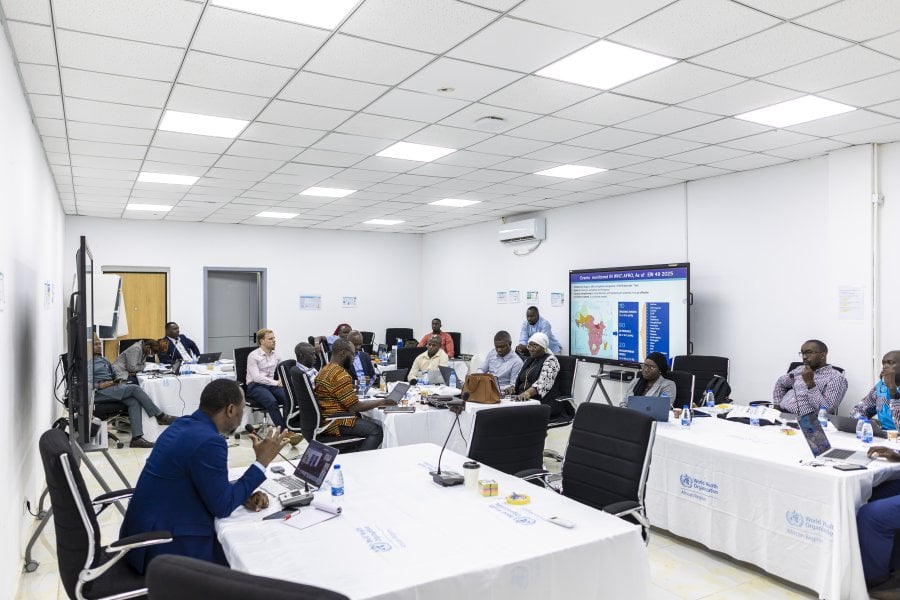
The workshop which brought together Fellows from Africa, including The Gambia, Côte d’Ivoire, Ghana, Kenya, Nigeria, Rwanda, Senegal, Sierra Leone, Tanzania, and Togo, and Epiverse-TRACE members from MRCG, LSHTM and University of Javariana,forms part of the second phase of the Epiverse-TRACE project. This phase focuses on the adoption of Epiverse tools in Africa to improve decision support during outbreaks. It also seeks to strengthen epidemiological and data science capacity following the completion of the epidemiological data science training, and a country needs assessments conducted by the fellows.
In his welcome remarks, Dr. Etien Luc Koua, Programme Area Manager for Health Information and Risk Assessment at the WHO African Region (AFRO) Emergency Hub, underscored the importance of the training stating “Your presence reflects our shared commitment to strengthening the use of data and evidence in public health. I am confident that the discussions over the next few days will generate valuable insights and results that can support stronger, more resilient health systems across Africa”.
Stakeholders expect that following the training and this workshop, a roadmap for the adoption of the tools in these 10 countries will be accelerated.
Dr. Bubacarr Bah, Head of Data Science, commended the fellows for their dedication, noting that this training marks a significant milestone in strengthening Africa’s technical expertise in data-driven public health. “The skills gained will help shape a stronger, more connected community of researchers working to improve epidemic preparedness and response”, he remarked.
Participants engaged in practical sessions designed to deepen their technical skills in outbreak analytics, data management, and collaborative problem-solving.
Mr. Dembo Kanteh, Head of Strategic Partnerships, emphasised the importance of advancing science through partnerships. “The MRCG model shows how collaborative research, shared platforms, and strong capacity building can transform our ability to generate impactful evidence for global health. By investing in systems, talent, and networks, we make better health outcomes possible across West Africa and beyond.”
The fellows also developed country-specific roadmaps for advancing the adoption of Epiverse tools within their respective countries.
Mercy Cheptoo, an Epidemiologist and Epiverse Fellow from Kenya, reflecting on the programmer’s impact highlighted this opportunity as critical to leverage open-source epidemiological tools and be part of a growing global community advancing modern epidemiology. “The knowledge and skills gained would significantly enhance my ability for more collaborative research and scientific leadership in epidemiology and public health analytics,” she added.
Kenneth Emeka Enwerem, a Physician and an Epiverse Fellow in Nigeria, highlighted the practical value of the programme. “The training has significantly strengthened my ability to use modern, open-source R tools for public health analysis. It has enhanced my analytics skills, expanded my professional network, and better positioned me for future leadership in data-driven public health,” he added.
The training builds on MRCG’s continued strategic commitment to foster research excellence, especially among young aspiring scientists in Africa. In partnership with WHO and technical support from DataDotOrg, the initiative underscores a shared vision for an empowered network of researchers equipped to address the region’s evolving public health challenges.
If you enjoyed this article and would like to build a career in global health, we offer a range of MSc programmes covering health and data, infectious and tropical diseases, population health, and public health and policy.
Available on campus or online, including flexible study that works around your work and home life, be part of a global community at the UK's no.1 public health university.