
New research published in The Lancet Infectious Diseases, has collected long-term data showing that using just two doses of pneumococcal conjugate vaccine (PCV10, Synflorix (GSK)) was comparable to the traditional three dose World Health Organization recommendation to protect against pneumococcal disease.
The new study, following up on a large clinical trial in Viet Nam two years after its primary endpoint, found that two doses of pneumococcal conjugate vaccine (PCV10, Synflorix (GSK) maintained control of the target pneumococcal bacteria in young children. In addition, the LSHTM, Nagasaki University and National Institute of Hygiene and Epidemiology Viet Nam team found that the reduced dose vaccine course also protects adults by interrupting community level transmission.
Pneumococcal disease remains a substantial health issue worldwide, especially among young children in low-income and middle-income countries (LMICs). In 2023, 674,000 people died from pneumococcal disease, including 211,000 children under five. Streptococcus pneumoniae is globally recognised as the number one leading bacterial cause of lower respiratory infections (LRIs) and pneumonia (25% of all LRI deaths). Pneumococcal conjugate vaccines (PCVs) have been incredibly successful in reducing pneumococcal diseases such as pneumonia, sepsis and meningitis but remain one of the most expensive vaccines in an LMIC’s infant immunisation programme.
The PCV funding gap
The findings are significant as they could help solve a problem faced by many countries that are trying to sustain PCV programmes – the significant difference in the market cost of vaccines and the amount of money countries can afford to pay for them (the vaccine funding gap).
To combat this, the Gavi Alliance launched its pneumococcal vaccine support initiative that helps Gavi funding-eligible countries, often LMICs, access the vaccine at a reduced cost. This initiative has had great success; by the end of 2019, Gavi support had helped countries immunise more than 215 million children across 60 lower-income countries against pneumococcal disease.
However, Gavi supported funding is only available to countries that have a gross national income below a particular threshold. Any countries that cross that threshold over time “graduate from Gavi support” and lose access to the reduced cost vaccines as they have to pay for them directly at normal market rates. This effective “funding gap” means many countries can no longer afford to continue running long-term PCV campaigns, especially at the required number of three doses, putting their populations at risk.
A simpler and lower cost vaccine regimen
By reducing the number of doses from three to two, countries establishing or with already established PCV programmes could effectively bridge this “funding gap” and continue to offer this life-saving vaccine while also freeing up funds to add other life-saving immunisations to their national programmes (such as maternal RSV).
The new findings have already shaped WHO recommendations for PCVs, which now states that countries that have a high coverage and established vaccination programmes can consider using a reduced vaccine dose schedule as a lower cost alternative.
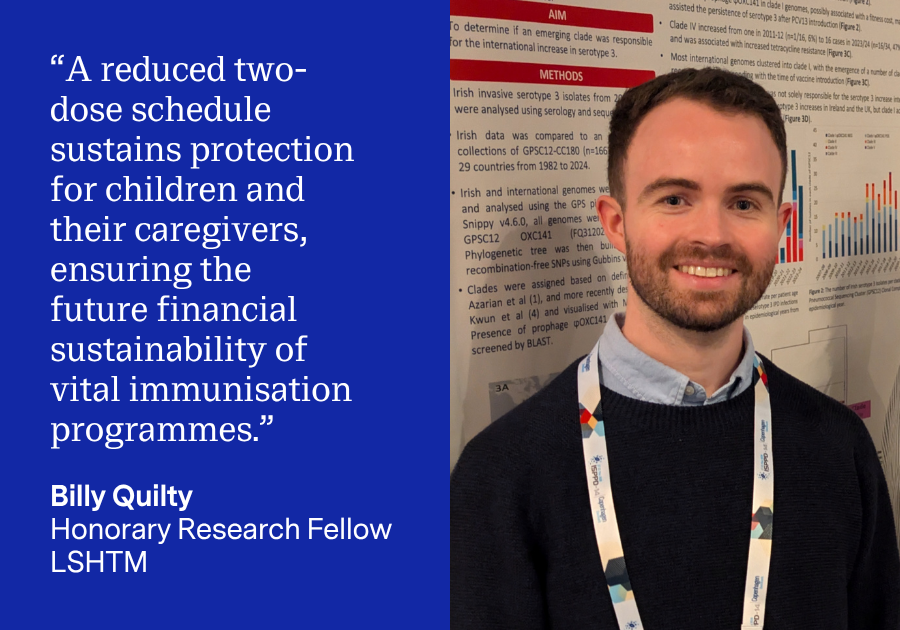
Lead author, Dr Billy Quilty, Honorary Research Fellow, LSHTM said: “Our work in Viet Nam adds to the evidence that a reduced two-dose schedule, as adopted in the UK, sustains protection for children and their caregivers, ensuring the future financial sustainability of vital immunisation programmes.”
Long-term research at LSHTM
Researchers from LSHTM have been involved in many clinical trials and modelling studies focused on PCVs. Teams based in The Gambia established their safety and effectiveness in the early 2000s, which led to the life-saving vaccines being introduced worldwide.
More recently, alongside this long-running trial in Viet Nam, researchers from the MRC Unit The Gambia at LSHTM and partners are also conducting similar work in a setting which experiences high community transmission of the bacteria.
Professor Grant Mackenzie at the MRC Unit The Gambia at LSHTM said: "Encouragingly, these findings in Viet Nam are similar to our findings in The Gambia, proving that, even in different national contexts, two-dose regimens are safe and effective. Together, the studies further strengthen the case for a two-dose PCV regimen to be used more widely across affected countries globally.”
Similarly, LSHTM researchers alongside partners in Somaliland explored the effectiveness of PCV vaccine interventions to protect internally displaced populations during humanitarian crises, where delivering multiple vaccine doses can be logistically challenging.
Dr Kevin van Zandvoort, Assistant Professor at LSHTM said: “This finding is promising as it implies that a schedule of two or even a single dose of PCV can still prevent pneumococcal disease. Such reduced dose schedules would be much more feasible to implement in crisis-affected populations, where the burden is high but PCVs remain underutilised.”
If you are interested in learning more about studying how clinical trials work, then consider watching LSHTM’s Clinical Trials Distance Learning Programme information session that was held on 23 June 2026 to hear directly from programme directors and get your questions answered.
If you are interested in learning more about healthcare in humanitarian crises, then consider watching LSHTM’s Health in Humanitarian Crises Distance Learning Programme information session which was held on 23 June 2026 to hear directly from programme directors and get your questions answered.
Publication
Quilty B, et al. Sustained and indirect effects of PCV10 reduced-dose schedules on pneumococcal carriage in Viet Nam: a long-term follow-up of a cluster-randomised controlled trial The Lancet Infectious Diseases, 2026. DOI: https://doi.org/10.1016/S1473-3099(26)00172-6
If you enjoyed this article and would like to build a career in global health, we offer a range of MSc programmes covering health and data, infectious and tropical diseases, population health, and public health and policy.
Available on campus or online, including flexible study that works around your work and home life, be part of a global community at the UK's no.1 public health university.