New research from the London School of Hygiene & Tropical Medicine and the World Health Organization (WHO) details where delays for vaccinations are currently being experienced for children in low- and middle-income countries (LMICs).
Published in the Lancet Global Health, the authors looked at household survey data for 91 countries around the world. This study updates a previous analysis of 45 countries published in the Lancet in 2009 by the same LSHTM authors.
While most children receive vaccines around the recommended target age, many children continue to receive vaccines several weeks late. The analysis included vaccines against tuberculosis, polio, hepatitis b, diphtheria, tetanus, whooping cough, haemophilus influenzae type b, rotavirus, pneumococcal, and measles.
Overall, the mean delay was about three weeks for BCG (for prevention of tuberculosis), increasing to about eight weeks for the third dose of DTP (diphtheria, tetanus, and pertussis) vaccine. Median coverage of BCG increased from 73% to 93% between 1 and 6 months of age. Measles vaccine coverage increased from 53% to 81% between 12 and 18 months of age. Vaccines co-recommended with BCG (hepatitis b and polio) and DTP1–3 (polio, pneumococcal, and rotavirus) had similar delays but lower coverage.
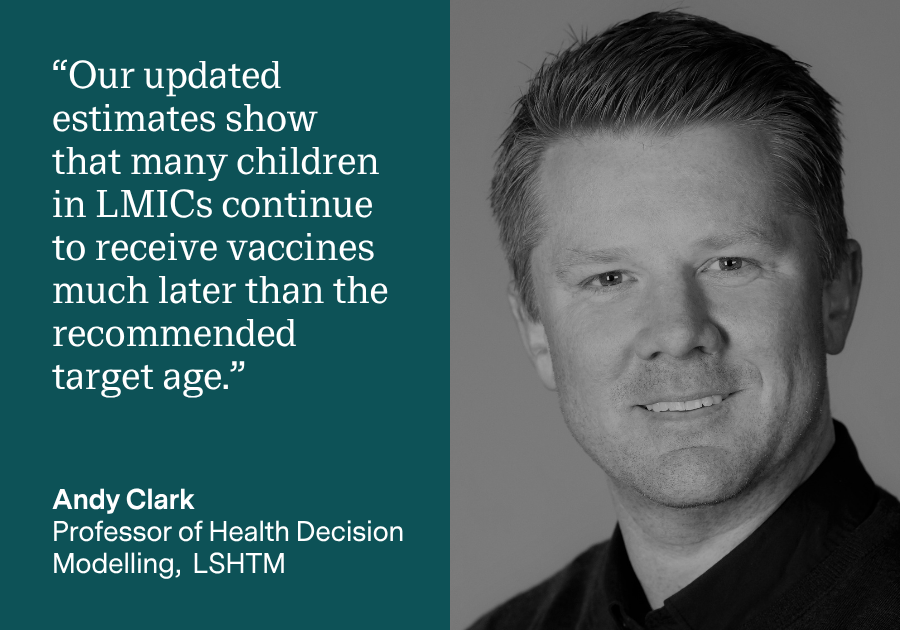
Andy Clark, Professor of Health Decision Modelling at LSHTM, said: “Our updated estimates show that many children in LMICs continue to receive vaccinations much later than the recommended target age.
“The result is extended periods with no direct protection from vaccine-preventable disease in many children at particularly vulnerable ages. Updated evidence on vaccine timeliness can help to inform strategies to boost the impact of child vaccination programmes.”
Although delayed vaccinations were the biggest problem, the authors also noted some cases of vaccines being given too early. Though the problem isn’t as severe as late vaccination, giving vaccines earlier than recommended can lead to lower protection.
Understanding the extent of vaccine delays is important for public health efforts. Most vaccine impact models assume that all vaccines are given on time, which can mean their impact is over or underestimated.
Colin Sanderson, Emeritus Professor of Operation Research in Health Care at LSHTM, said: “We hope that our findings with prove a useful resource for modellers who want to take vaccine timeliness into account when estimating programme impact, particularly at global and regional levels.”
By providing this information, the authors hope their estimates and methods can help with strategies to improve vaccine scheduling and coverage.
The study was conducted by a small team of researchers at LSHTM and the WHO’s Department of Immunizations, Vaccines, and Biologicals based in Geneva. This study was funded by WHO and the Gates Foundation.
Clark A et al. Timeliness of children's vaccinations in 91 low-income and middle-income countries: an analysis of survey data. The Lancet Global Health, 2026. DOI: https://doi.org/10.1016/S2214-109X(25)00554-6
If you enjoyed this article and would like to build a career in global health, we offer a range of MSc programmes covering health and data, infectious and tropical diseases, population health, and public health and policy.
Available on campus or online, including flexible study that works around your work and home life, be part of a global community at the UK's no.1 public health university.