
As a vaccine scientist, there is a lot that I worry about at the moment. I worry about the consistent year-on-year declines in childhood vaccination coverage across the UK, and the recent resurgence of diseases once kept at bay. I worry about widespread cuts to public health funding, and their impact on the research and delivery of vaccines globally. I worry about RFK Jr’s decision to cancel research funding for mRNA vaccines, critically undermining efforts to prepare for the next pandemic.
These worries reflect the many challenges facing vaccination programmes today. But vaccine success stories abound, and it is all too easy to overlook these amidst the daily bombardment of concerning headlines.
The UK’s introduction of a new vaccine targeting respiratory syncytial virus (RSV) provides a reminder of the power of vaccination to protect us from harm, and the programme’s anniversary is a fitting moment to reflect on this.
RSV sits alongside flu and COVID-19 as one of the major causes of severe respiratory infection. Prior to the vaccine roll-out, RSV caused more than 10,000 hospitalisations and 4,000 deaths annually among adults over the age of 75 in the UK. The virus also presents an acute risk in early life, causing over 30,000 hospitalisations and up to 30 deaths each year among children under 5. Babies are particularly vulnerable – their small airways leaving them prone to a condition called bronchiolitis in which the lungs become inflamed during the battle with infection.
The roll-out of RSV vaccination across most of the UK began on 1 September 2024 (12August in Scotland). For older adults, a single dose of vaccine has been offered to those aged 75 to 79. For babies, protection is achieved via maternal vaccination – the same approach used to protect newborns from whooping cough. Specifically, the RSV vaccine is offered to people who are at least 28 weeks pregnant with the aim of inducing protective antibodies that are transferred from mother to newborn via the placenta.
There is rarely room for poetry when it comes to public health, but I cannot help thinking of maternal vaccination in poetic terms – the passing on of a protective cloak of antibodies woven from all of a mother’s past infectious encounters. Vaccination during pregnancy serves to fortify this cloak, boosting the supply of antibodies against some of the most dangerous hazards that await a child in their first months of life.
RSV vaccine coverage has been rising steadily since the programme began. Among eligible older adults in England, coverage rose from 23% in September 2024 to 63% by the end of June 2025. Maternal vaccination has followed a similar trajectory – among mothers who gave birth in March 2025, 55% had been vaccinated. The challenge now is to maintain the upward trend in coverage.
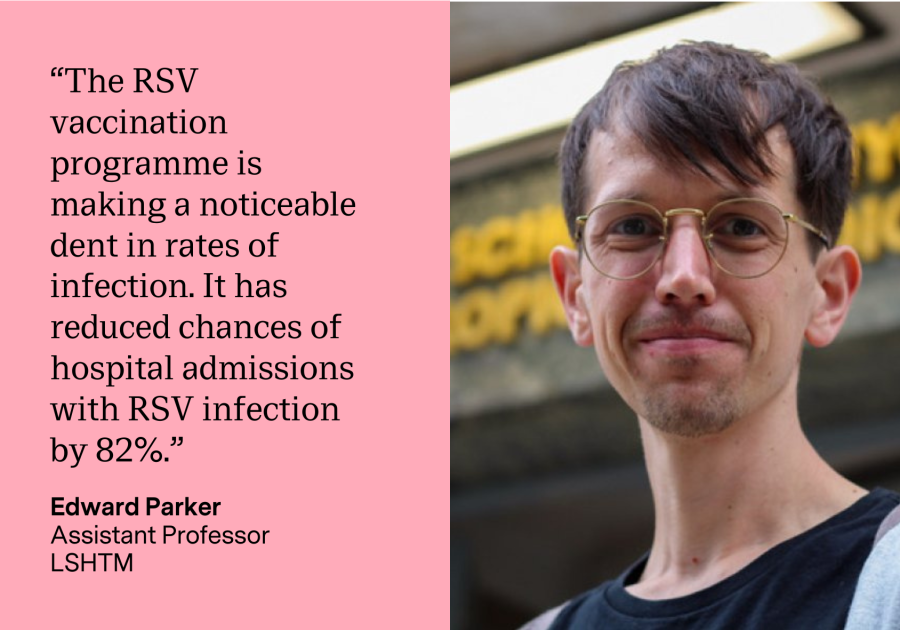
Crucially, the programme is beginning to make a noticeable dent in the burden of RSV. A recent study looking at data from 14 hospitals in England up to March 2025 found that vaccination reduced the chances of hospital admissions with RSV infection by 82%. Encouragingly, the strong protective effect was apparent in people with a chronic respiratory condition and those living with immunosuppression.
Findings for maternal RSV vaccination are also highly encouraging. A study combining data from 30 hospitals across Scotland and England showed a dramatic fall in severe RSV among infants born to vaccinated mothers. The estimated reduction in RSV risk was 58% for infants whose mothers were vaccinated any time before delivery. This effect rose to 72% if mothers received their vaccine more than 14 days before delivery (providing crucial time for the maternal immune response to develop).
These statistics tell a powerful tale. Many hundreds of people – our friends, our parents, our children – would have been hospitalised with RSV in the past year had it not been for vaccination.
The job for RSV vaccination is far from over. Further gains in vaccine coverage will be hard won, and we must take urgent action to address stark inequities in coverage, including significantly lower uptake in ethnic minority groups. We know that solutions come in the form of local, community-driven approaches to promote access to vaccines and trust in the institutes that offer them – no small feat within a fragmented, austerity-depleted immunisation service in which local care boards are being asked to cut operational costs by 50%.
Ultimately, to fully harness the benefits of RSV vaccination we need to achieve equitable access at a global level. More than 97% of paediatric deaths from RSV occur in low- and middle-income countries, yet vaccine roll-out is currently restricted to wealthier nations. This feels uncomfortably reminiscent of the vast inequities in vaccine access seen for COVID-19. The moment such inequity becomes ‘business as usual’ is a worrying one indeed.
While I do not underestimate the challenges facing vaccination programmes, their protective effects have never felt more tangible. In December last year, my wife received her RSV vaccine. A few months later our second child arrived, ready to turn our lives upside down.
If the list of things I worry about as a vaccine scientist is lengthy, rest assured that it is nothing compared to the list of things I worry about as a parent. So I feel immensely grateful that our little boy was born protected by his mother’s antibodies against RSV. In a worrying world, each dose of vaccine offers one reason to worry a little less.
If you enjoyed this article and would like to build a career in global health, we offer a range of MSc programmes covering health and data, infectious and tropical diseases, population health, and public health and policy.
Available on campus or online, including flexible study that works around your work and home life, be part of a global community at the UK's no.1 public health university.