
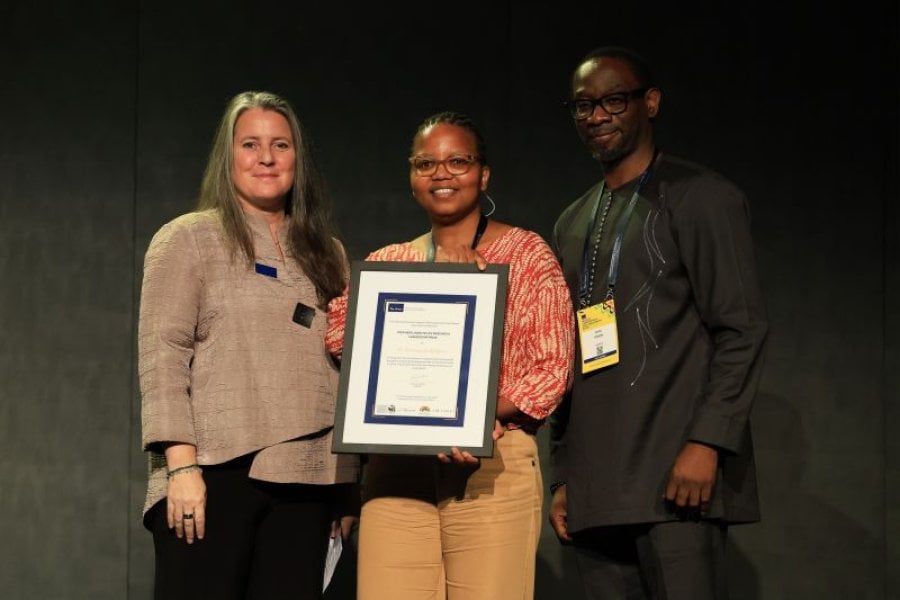
Dr Mmamapudi Kubjane, a South African epidemiologist and infectious disease modeller, has received the 2026 Stephen Lawn TB-HIV Research Leadership Prize at the Union World Conference on Lung Health in Rio de Janeiro, Brazil.
The prestigious award recognises promising early-career researchers whose work is advancing tuberculosis (TB) and HIV research in sub-Saharan Africa.
Dr Kubjane, based at the Health Economics and Epidemiology Research Office (HE²RO), Wits Health Consortium, was recognised for her contributions to mathematical modelling that supports evidence-based decisions on TB prevention, diagnosis and treatment.
During her PhD at the University of Cape Town, she developed Thembisa-TB, a mathematical model that is now used to estimate South Africa's TB burden and evaluate the potential impact of different interventions.
Her work has helped inform the interventions and budget outlined in South Africa's National Strategic Plan for HIV, TB and STIs (2023–2028), identifying cost-effective approaches, including TB preventive therapy for people living with HIV and GeneXpert testing for people with TB symptoms.
The modelling also demonstrated that even substantially expanding existing interventions would not be enough to meet the 2030 End TB targets, highlighting the need for investment in new diagnostics and vaccines.
Reflecting on receiving the award, Dr Kubjane said:
"It is a huge honour to receive this prize. I’ve never met Stephen Lawn personally, but I have read and used many of his studies on TB-HIV interactions to inform our modelling work, so receiving a prize in his name is very meaningful to me.
“Professionally, it recognises the value of locally led modelling that is embedded in national decision-making. It is also a recognition of the many mentors, colleagues and collaborators who have supported me throughout my career.”
Toyin Togun, Professor of Global Health at the London School of Hygiene & Tropical Medicine and Co-Director of the TB Centre, said: “On behalf of the LSHTM TB Centre, I warmly congratulate Dr Kubjane on this well-deserved recognition. Her work on Thembisa-TB shows what it looks like when rigorous science leads directly to policy: her modelling has shaped the interventions and budget in South Africa’s National Strategic Plan, and it gives a clear evidence base for investing in new diagnostics and vaccines.
“Stephen Lawn was deeply committed to building research capacity in Africa, and this prize carries that commitment forward. Supporting African scientists to lead the research that shapes their own countries’ responses to TB and HIV is essential if we are to reach the End TB targets.”
Looking ahead, Dr Kubjane is focusing on helping South Africa and other countries in the region prepare for the introduction of new TB vaccines. Her research aims to inform decisions about vaccination strategies, costs and implementation, while strengthening local modelling expertise.
She is also working to improve estimates of the long-term health consequences experienced by people after TB treatment, ensuring these are better reflected in national disease burden estimates and policy decisions.
The Stephen Lawn TB-HIV Research Leadership Prize honours the legacy of Professor Stephen Lawn, whose research made important contributions to understanding TB and HIV, particularly in sub-Saharan Africa. The prize recognises emerging research leaders whose work has the potential to improve TB/HIV prevention and care.
The Stephen Lawn Prize is a collaboration between the TB Centre at the London School of Hygiene and Tropical Medicine, U. of London, the Desmond Tutu Health Foundation and The Union, with support from The Lancet Group.
If you enjoyed this article and would like to build a career in global health, we offer a range of MSc programmes covering health and data, infectious and tropical diseases, population health, and public health and policy.
Available on campus or online, including flexible study that works around your work and home life, be part of a global community at the UK's no.1 public health university.