
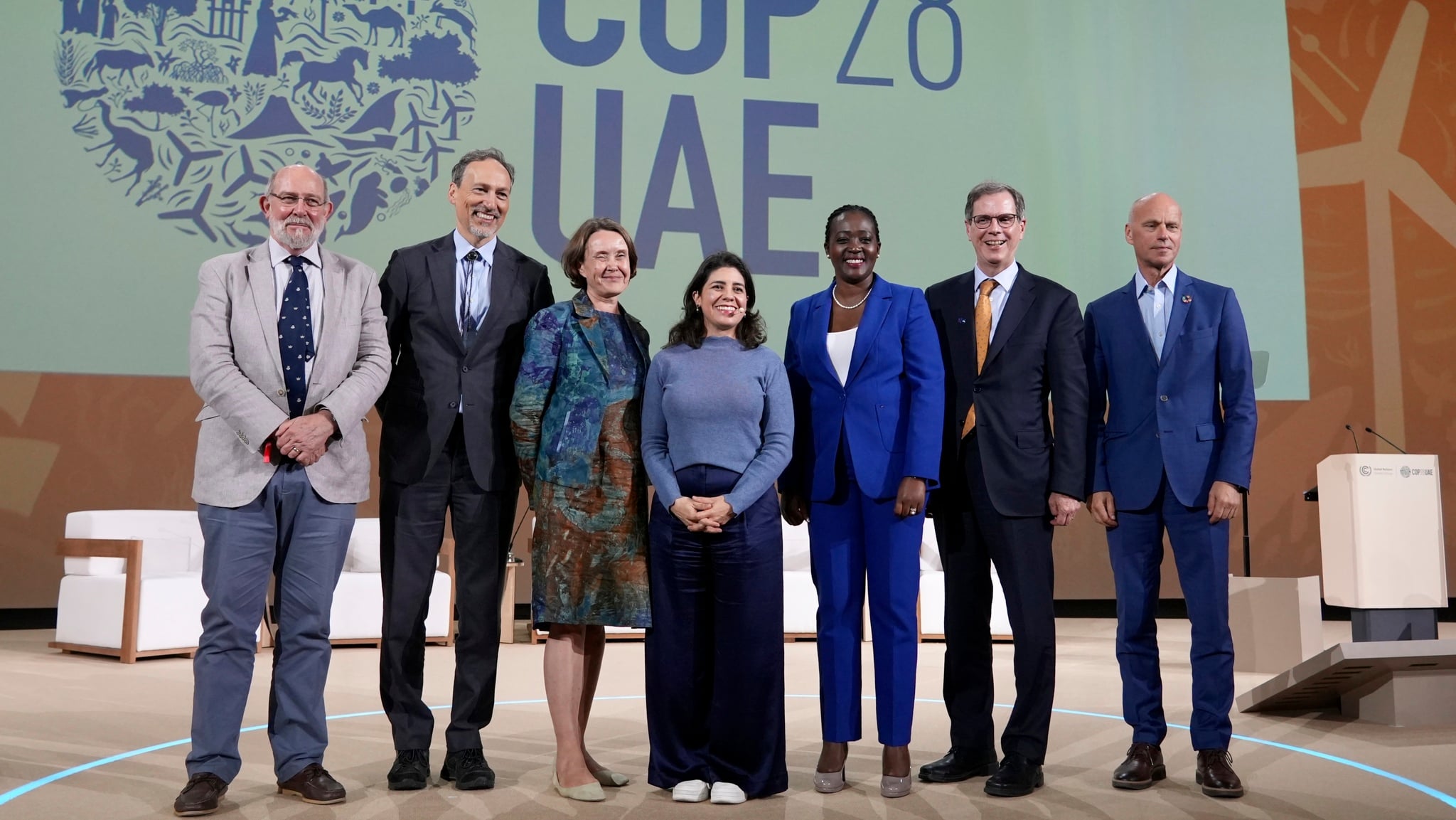
In December 2023, the Research Consortium for School Health and Nutrition attended the COP28 Climate Conference in Dubai, UAE, where it presented the key insights from its evidence-based white paper on School Meals and Food Systems: Rethinking the consequences for climate, environment, biodiversity, and food sovereignty.
Led by a research team based at the London School of Hygiene & Tropical Medicine, in collaboration with 167 experts from 84 organisations worldwide, the white paper uses original mathematical modelling analyses and more than 40 case studies to estimate the potential impact of school meals policy changes on both health and the environment across different income settings.
Currently, food systems are responsible for a third of all human-induced greenhouse gas (GHG) emissions: meaning the very food systems that keep us alive are also contributing to environmental catastrophe. School meals programmes, as one of the largest subsections of the global public food system, with more than 400 million children receiving a meal at school each day, could hold enormous potential to drive transformation towards healthier, more sustainable, and more equitable food systems globally. This is because, despite their vast global coverage, school meals programmes are overwhelmingly financed and managed at the national level, meaning the policy levers lie in the hands of governments – giving them a unique opportunity to effect significant change quickly and at scale.
The white paper brings together the existing evidence from around the world on how strategic policy changes to national school meals programmes could have significant positive consequences for both people and the planet, finding that the greatest effects come from changes in the following four priority areas: menu design, energy use, waste management, and food education. It also explores the potential of these short-term policy changes to drive longer-term shifts in agricultural and procurement practices towards more ecologically sustainable farming systems.
These policy insights were presented by members of the white paper’s coordination team for discussion at four events across the course of the COP28 climate conference in Dubai in December 2023. At the School Meals Coalition’s flagship session ‘Nourishing the Planet, Sustaining Futures’ – the first dedicated school meals session in COP history – Kenya became the first country to announce its intention to take the insights forward, declaring its commitment to provide nourishing, planet-friendly meals to 10 million children by 2030: an increase from the current 2.3 million children being reached. This was soon followed by commitments from Sierra Leone and Rwanda, who announced their own plans to implement planet-friendly policies when scaling up their national school meals programmes.
Catch up on all four of the Research Consortium’s COP28 sessions.
If you enjoyed this article and would like to build a career in global health, we offer a range of MSc programmes covering health and data, infectious and tropical diseases, population health, and public health and policy.
Available on campus or online, including flexible study that works around your work and home life, be part of a global community at the UK's no.1 public health university.