
What is your role at LSHTM?
I'm a PhD candidate in the Department of Infectious Disease Epidemiology at the London School of Hygiene & Tropical Medicine (LSHTM), and my research focuses on strengthening routine childhood immunisation in crisis-affected settings. My focus is northeastern Nigeria, and particularly Borno State.
Tell us about yourself and your background
I was born and raised in Borno State, Nigeria. Borno State was once called “Home of Peace” but sadly this is no longer, due to the protracted Boko Haram crises. These crises have affected people in every dimension of life, and most importantly for me, they have weakened our health systems.
I studied medicine and surgery at University of Maiduguri in Borno State. During my final year, the conflict became amplified, and it was very difficult to study because you never knew when the next attack would happen. Looking back, I see those years as a true test of courage and resilience.
After medical school, I joined the World Health Organization (WHO) as a local government area facilitator and I was working on routine immunisation and surveillance of vaccine-preventable diseases. I was also honoured with a WHO Afro-Regional Certificate for my contribution to the interruption of wild poliovirus in Nigeria.
When COVID-19 came to Nigeria, I started working with the National Pandemic Response Center as a consultant for eHealth Africa, supporting coordination and response efforts. After that, I joined the Nigeria Center for Disease Control and Prevention as a public health officer in the Department of Planning, Research, and Statistics. There, I travelled a lot across the country for outbreak responses and public health interventions.
After that, I recognised that I need to strengthen my skills in public health. I initially applied for a Master’s in Health Policy Planning and Financing at LSHTM but I couldn’t accept the offer because I was still working in Nigeria. I pursued my Master's in Global Health at the University of Aberdeen in Scotland, where I graduated with distinction. Then in May, I began my PhD at LSHTM.
Tell us about your research
Having worked in the conflict-affected settings in Borno State, my interest has always been in finding locally driven strategies to improve health outcomes where health systems are severely weakened. The health system there was greatly disrupted by Boko Haram attacks – when health clinics and public health centres are destroyed, the staff are driven out, the supply chain is disrupted and no longer functional, and drugs are destroyed. People in the region lose all access to healthcare.
What truly sparked my interest in strengthening routine childhood immunisation was when I read a report by Human Rights Watch titled “Those Who Returned Are Suffering”, which described how internally displaced persons in camps in Borno State were told to go back to their communities, only to find that essential services, including healthcare, were disrupted. That raised a serious question in my mind: what happens to the most vulnerable when the structures that supported them in the camps are no longer there? Is there a strategy in place to sustain these gains and vaccine coverage?
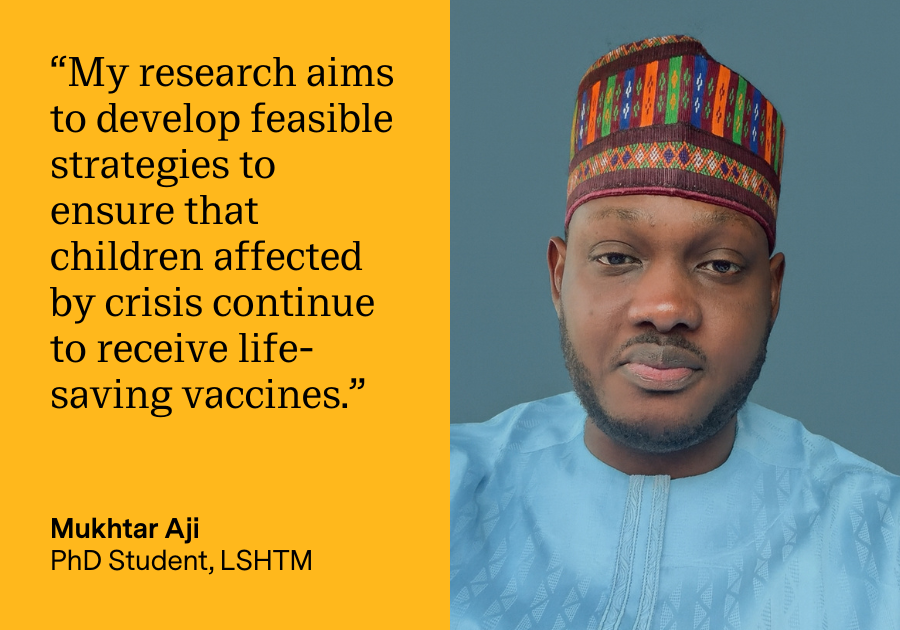
My research aims to address exactly that, developing context-specific, feasible and scalable strategies to ensure that children affected by crisis continue to receive life-saving vaccines.
What impact do you hope your research will have?
Hopefully, I see my research influencing both local realities and global policy directions.
Locally, I want to strengthen routine immunisation delivery for children in Borno State, whether they are displaced, have returned home, or are in stable communities during conflict. The conflict is still ongoing and we need to ensure that no child is left unprotected in the long run.
Globally, I hope my findings contribute to WHO recommendations and the work of partners like Gavi, who have a strategy to embed immunisation into humanitarian health responses.
In the long term, I would like to work at the intersection of research, leadership and policymaking, potentially ending up with the UN or WHO or in national health leadership to make sure that vulnerable populations are a priority in health planning and delivery.
What would people be surprised to learn about you?
I like to say that I don't like studying, but I find myself going back to it all the time. After my master's, I said I was done. I said the same after going through medical school, but here I am doing a PhD, and recently I was thinking of doing an MBA! So, I suppose I portray an image that I don't like studying, but I think people would be surprised to know that I actually do.
What advice do you have for prospective PhD students?
Go with what you are passionate about. You should be genuinely passionate about your topic because passion is what will keep you going when the challenges inevitably come. Undertaking a PhD is not just about academic expertise. I've now realised it's a test of patience, resilience and problem solving.
I think everyone's research journey is unique, so a prospective PhD candidate shouldn't compare their own research to others and should focus on making steady progresses on their own.
Celebrate small wins as well. They add up to the big achievements over time.
What do you like to do in your free time?
Outside of my PhD, I'm passionate about making the most out of my surroundings.
I love coffee, not just drinking it, but exploring new cafes, each with its own atmosphere and story. I like taking long walks, it gives me the space to think while I'm discovering new places. I often find myself taking photos of hidden gems and striking city views. In fact, people often ask me if I have gone to photography school.
I like traveling as well. For me, travel is not just ticking off destinations, but it's about meeting people, learning from their perspective and their culture, and finding inspiration in unexpected places. Whether I'm exploring a new city, or taking a quiet weekend trip, I see each experience as a chance to recharge, reflect and return to my work with a fresh mind.
Where do you take inspiration from?
I'm deeply grateful to my mentors, my colleagues and the resilient communities of Borno State whose courage inspires me daily, having experienced the same thing in the past. This research is as much theirs as it is mine.
I also want to thank the MARCH Centre, the Health in Humanitarian Crises Centre and the Vaccine Centre for providing this platform to amplify voices and ideas that can change the way we approach health in crisis settings.
If you enjoyed this article and would like to build a career in global health, we offer a range of MSc programmes covering health and data, infectious and tropical diseases, population health, and public health and policy.
Available on campus or online, including flexible study that works around your work and home life, be part of a global community at the UK's no.1 public health university.