
Next-generation mosquito nets reduced malaria cases among children by up to 43% compared with conventional nets in an area of Côte d’Ivoire where mosquitoes are highly resistant to pyrethroid insecticides, according to new research involving the London School of Hygiene & Tropical Medicine (LSHTM).
Published in NEJM Evidence, the study found that mosquito nets combining two insecticides provided greater protection against malaria than conventional nets, offering important evidence for malaria prevention in West Africa, where research on the effectiveness of PBO-pyrethroid nets in particular has been limited.
The study was conducted by researchers from LSHTM, Institut Pierre Richet in Côte d’Ivoire and international partners in 41 villages in central Côte d’Ivoire, an area with intense malaria transmission and high levels of resistance to pyrethroids, the insecticides traditionally used in mosquito nets.
Researchers distributed 25,660 insecticide-treated nets across 11,283 households and followed 1,649 children aged six months to nine years over 12 months to compare the effectiveness of three types of mosquito nets.
Children in communities receiving nets combining chlorfenapyr and pyrethroids experienced 43% fewer malaria episodes than those receiving conventional pyrethroid-only nets. Nets combining pyrethroids with piperonyl butoxide (PBO), a chemical that helps improve insecticide effectiveness, reduced malaria incidence by 28%.
On average, children in communities receiving conventional nets experienced 1.11 malaria episodes per child per year, compared with 0.65 among those receiving chlorfenapyr-pyrethroid nets and 0.84 among those receiving PBO-pyrethroid nets.
The researchers also examined malaria infection rates among people of all ages. After 12 months, 37.3% of participants in communities receiving chlorfenapyr-pyrethroid nets tested positive for malaria, compared with 44.8% in communities receiving conventional nets.
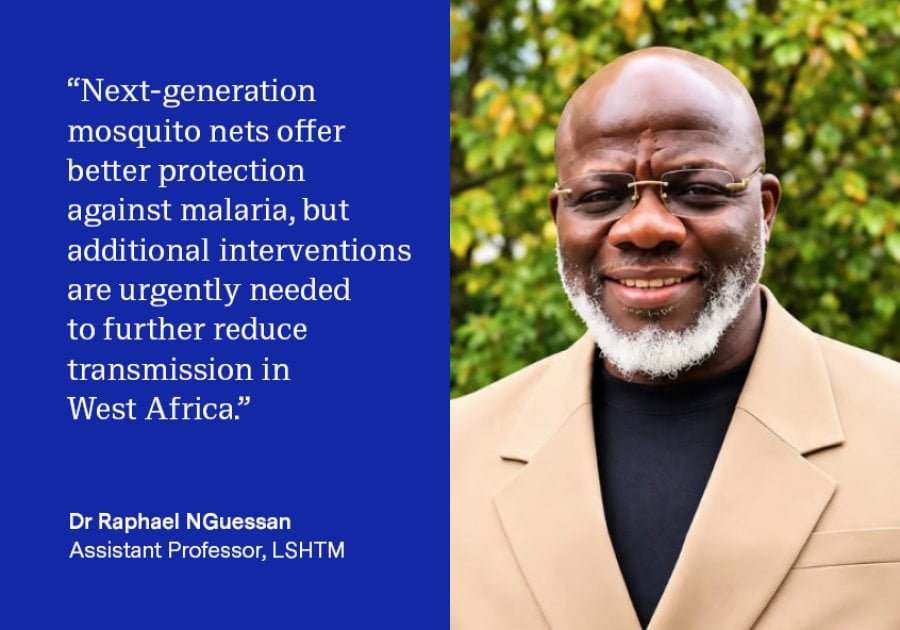
Dr Raphael N’Guessan, Assistant Professor at LSHTM, said: “These findings provide compelling evidence that next-generation mosquito nets offer substantially better protection against malaria than conventional nets in areas where insecticide resistance has escalated and threatens the effectiveness of traditional pyrethroid-only nets.
"This is particularly important for West Africa, where evidence from large-scale clinical trials is scarce. Our study demonstrates that chlorfenapyr-based nets provide the greatest protection, while PBO nets also offer significant benefits. However, the continued high burden of malaria highlights the urgent need to complement these improved nets with additional interventions to further reduce transmission”
Insecticide-treated mosquito nets have been instrumental in reducing malaria transmission across sub-Saharan Africa. However, the spread of mosquitoes resistant to pyrethroids threatens their effectiveness, increasing the need for nets that use additional insecticides to provide better protection.
Although previous trials in Tanzania, Uganda and Benin have demonstrated the benefits of next-generation nets, evidence for PBO nets in particular has remained limited in West African settings with particularly intense malaria transmission and insecticide resistance.
The new study helps address this gap, showing that both types of next-generation nets can significantly reduce malaria incidence among children even under these challenging conditions.
However, the reductions were smaller than those observed in previous trials in Benin and Tanzania, where chlorfenapyr-pyrethroid nets reduced malaria incidence by 54% after one year. Researchers suggest that the particularly high levels of malaria transmission and insecticide resistance in the Côte d’Ivoire study area may help explain the difference.
Despite high levels of mosquito net use, malaria transmission remained substantial across all three study groups. The findings suggest that while next-generation nets offer improved protection, they are unlikely to be sufficient on their own to control malaria in areas with intense transmission.
Jackie Cook, Professor of Infectious Disease Epidemiology at LSHTM, said: "It is great to have evidence that PBO-pyrethroid nets do provide protection in West African settings- giving malaria control programmes options for types of next-generation nets to select for distribution. Importantly, there may be differences in durability between the different net types- which has impacts on their cost-effectiveness- we are currently evaluating this in an extension to this trial."
The findings provide further evidence to inform mosquito net selection and distribution in malaria-endemic countries, while highlighting the continued need for complementary approaches to malaria prevention in areas where insecticide resistance and transmission remain high.
The researchers received additional funding from Coefficient Giving to extend the follow up to examine durability of the nets over time- and to answer additional questions about the effectiveness of school-based net top ups for further reducing malaria. This study, known as NETSTRA, will be finishing in February 2027.
The study was funded by the Global Fund to Fight AIDS, Tuberculosis and Malaria.
Publication
Sih C et al. Next-Generation Bed Nets to Control Malaria in Côte d’Ivoire. NEJM Evidence, 2026. DOI: 10.1056/EVIDoa2600153
If you enjoyed this article and would like to build a career in global health, we offer a range of MSc programmes covering health and data, infectious and tropical diseases, population health, and public health and policy.
Available on campus or online, including flexible study that works around your work and home life, be part of a global community at the UK's no.1 public health university.