
Researchers from the London School of Hygiene & Tropical Medicine (LSHTM) and Imperial College London have discovered that vitamin B6 plays an important role in helping malaria parasites grow inside mosquitoes, revealing a potential new approach to reducing transmission.
The study, published in PLOS Pathogens, provides the first snapshot of the proteins that mature Plasmodium falciparum malaria parasites are actively producing as they prepare to move from humans into mosquitoes.
Malaria parasites have a complex life cycle that depends on both humans and mosquitoes. In humans, some parasites develop into a form called gametocytes, which can remain in the bloodstream until they are picked up by a mosquito. Once inside the mosquito, the parasites continue their development before eventually reaching the salivary glands, ready to infect another person.
Until now, relatively little has been known about which proteins mature gametocytes continue to produce while waiting for this transition. The study revealed that the parasites actively produce proteins that help them survive in the human bloodstream and prepare for life inside the mosquito, providing a more focused list of processes that could potentially be targeted to stop transmission.
The parasites were particularly active in producing proteins that allow them to make B vitamins. Researchers tested the importance of vitamin B6 by removing the parasite's ability to produce it.
Without its own supply of vitamin B6, the parasite was still able to reach the stage needed for transmission from humans, but struggled to grow once inside mosquitoes. The number of oocysts, structures where malaria parasites multiply inside the mosquito, fell by around 54% and those that were present were around 40% smaller.
By the final stages of development, 61% to 90% fewer parasites reached the mosquito's salivary glands, substantially reducing the number in the position needed for onward transmission to humans.
Providing additional vitamin B6 restored parasite development, confirming its importance for successful growth inside mosquitoes.
The discovery could have implications beyond the malaria parasite itself. Mosquitoes also depend on vitamin B6 to survive, but cannot produce it themselves. Instead, they obtain the vitamin from microorganisms living naturally in their gut.
This shared dependence raises the possibility of disrupting vitamin B6 production in both the malaria parasite and the microorganisms mosquitoes rely on, potentially targeting parasite transmission and mosquito survival at the same time. Researchers suggest this could eventually be explored through approaches including baited sugar traps or insecticides.
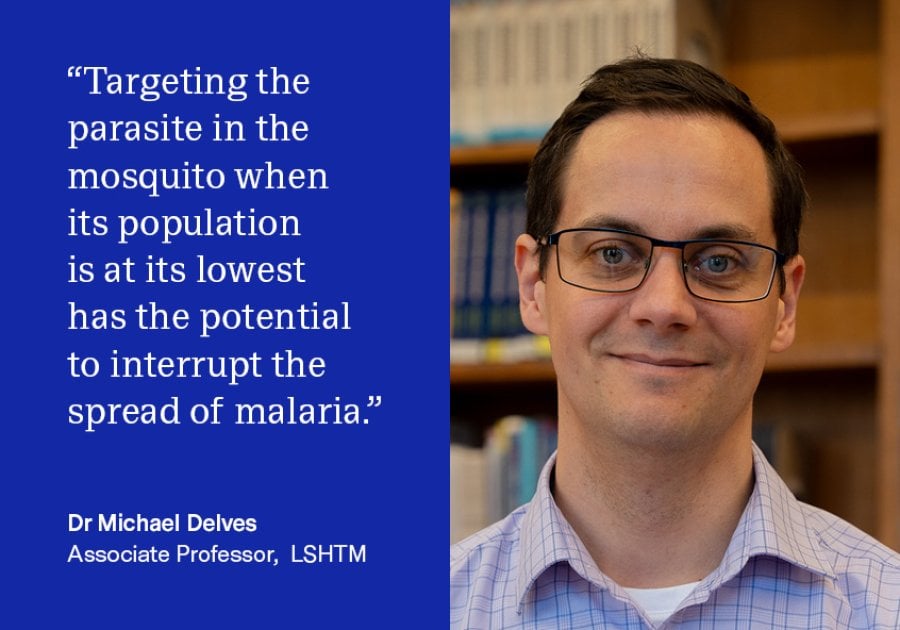
Dr Michael Delves, Associate Professor of Malaria Transmission Biology at LSHTM and senior author of the study, said: “Targeting the parasite in the mosquito when the parasite population is at its lowest has the potential to interrupt malaria transmission. Our data provides a new piece of the puzzle to understand this process and suggests new ways to design antimalarial interventions.”
The study also provides researchers with the first detailed picture of the proteins mature malaria gametocytes are actively producing before transmission. The researchers hope this could help prioritise promising targets for future drugs designed to stop malaria parasites completing their life cycle between humans and mosquitoes.
If you enjoyed this article and would like to build a career in global health, we offer a range of MSc programmes covering health and data, infectious and tropical diseases, population health, and public health and policy.
Available on campus or online, including flexible study that works around your work and home life, be part of a global community at the UK's no.1 public health university.