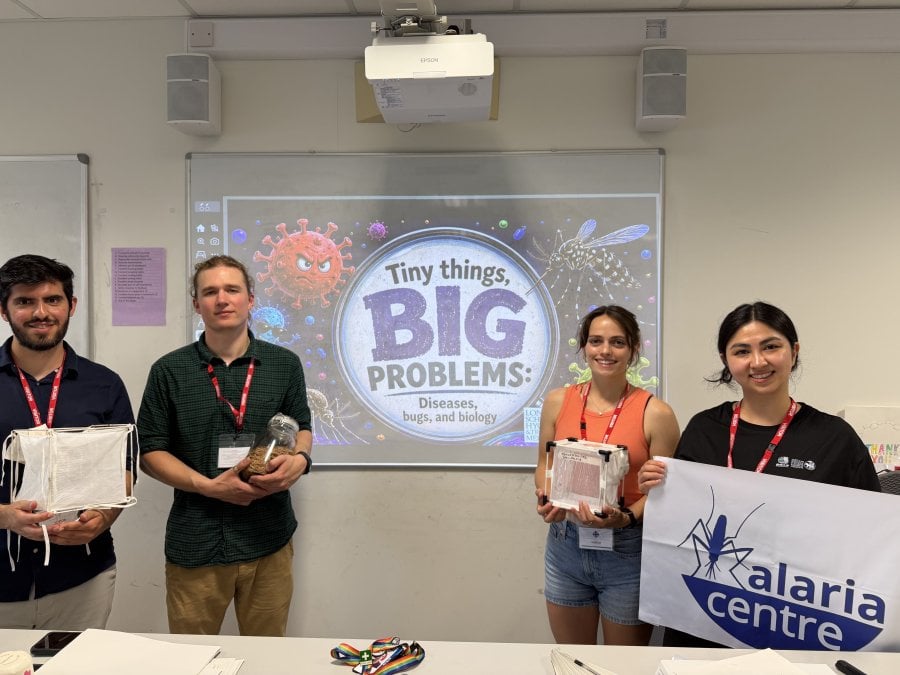
Supported by the Malaria Centre, Roz Taylor, Mika Malouf, Keir Hughes and Yassar Kadoom delivered an interactive session titled Tiny Things, Big Problems: Diseases, Bugs and Biology at William Perkin CofE High School's annual Founders' Day on Friday 10 July. The event brought together students from Years 7–10 for a day of science-focused talks, workshops and hands-on activities.
Students had the opportunity to observe live mosquitoes and sand flies, examine malaria and Leishmania parasites under the microscope, and learn about disease vectors through interactive displays, with Yassar Kadoom, a second-year PhD student with MRC Laboratory of Infectious Diseases (LID), helping students explore the science behind these organisms. Keir Hughes, a Scientific Officer at the Malaria Reference Laboratory, demonstrated Trypanosoma cruzi parasites in blood samples and introduced students to live Triatomine bugs and house dust mites from the LSHTM insectaries.
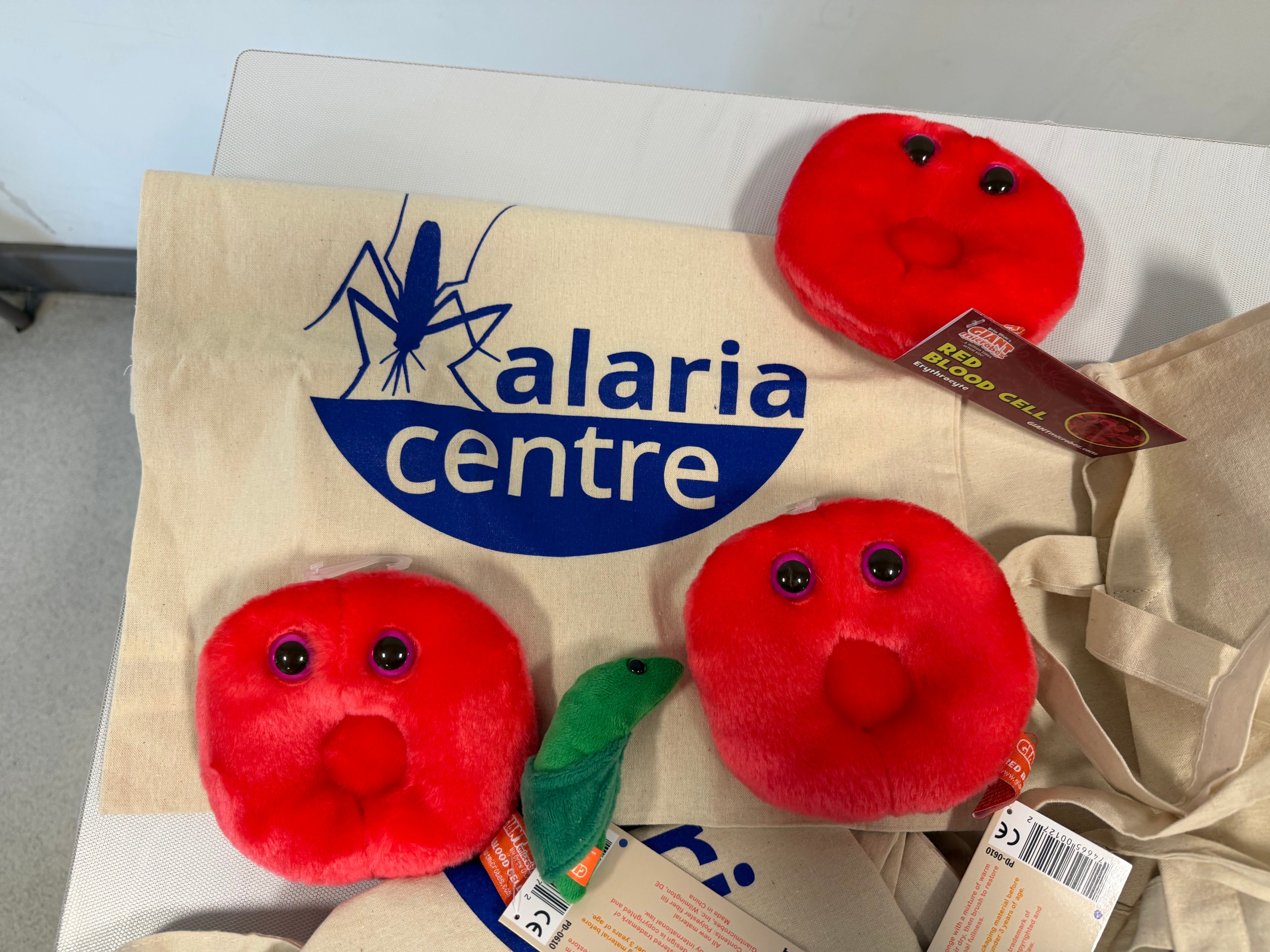
The activities encouraged students to think like scientists while demonstrating how research helps tackle infectious diseases and improve global health. LSHTM and Malaria Centre tote bags and badges proved popular prizes, while Giant Microbes donated malaria parasite and red blood cell plushies, which were an instant hit with students.
Roz Taylor, a PhD candidate with the UKRI-funded OneZoo CDT, whose research focuses on invasive mosquito vectors and the links between vector-borne diseases and human-driven environmental change, said: “We were hugely impressed by the students' enthusiasm and curiosity. Their thoughtful questions about infectious diseases, global health and careers in research highlighted the value of public engagement in making science accessible and demonstrating the real-world impact of global health research.
“By connecting researchers directly with schools and communities, these activities help raise awareness of challenges such as malaria while inspiring the next generation of scientists, healthcare professionals and public health leaders.”
Mika Malouf, a PhD student on the joint LSHTM and Nagasaki University programme, said: “We hope this visit marks the beginning of a growing partnership between the LSHTM, Malaria Centre, and schools across London. A huge thank you to William Perkin CofE High School for welcoming us so warmly. We look forward to many more opportunities to share the fascinating world of global health research with students in the years ahead.”
The event highlighted the Malaria Centre's commitment to public engagement, one of the most powerful tools in the fight against malaria. Founded in 1998, the Malaria Centre is a global network of researchers spanning LSHTM, MRC Unit The Gambia and Imperial College London, working together to advance malaria research and control. Alongside world-leading research and teaching, the Centre is committed to engaging communities and inspiring the next generation of scientists and global health professionals.
If you enjoyed this article and would like to build a career in global health, we offer a range of MSc programmes covering health and data, infectious and tropical diseases, population health, and public health and policy.
Available on campus or online, including flexible study that works around your work and home life, be part of a global community at the UK's no.1 public health university.