A new study in the Lancet Global Health has found that nearly a quarter of all adult episodes of tuberculosis (TB) throughout the world could be eliminated by establishing programmes to end undernutrition.
Researchers at the London School of Hygiene & Tropical Medicine have contributed to new modelling of the potentially massive impact of food programmes on reducing the burden of TB, alongside their other health and socioeconomic benefits.
TB is the leading cause of death from an infectious disease, principally affecting poorer populations in low- and middle-income countries (LMICs). With current progress in reducing TB worldwide being slow and heterogeneous, public health researchers have been analysing the broader social factors that contribute to TB, such as undernutrition.
The authors modelled the potential impact of tackling undernutrition on the number of TB episodes in people aged 15 and over. This included looking at two scenarios related to changes in body mass index globally: one where ‘moderate/severe undernutrition’ was eliminated, and a second where ‘all undernutrition’ was eliminated.
Published in the Lancet Global Health, results found that ~24% of adult TB episodes could be prevented if all undernutrition was completely eliminated - an estimated ~2.3 million episodes worldwide. When tackling moderate/severe undernutrition, which affects around 5% of the global population, the authors estimated 1.4 million episodes (~15% throughout the world) would be prevented.
Such programmes to improve nutrition would have the greatest proportional impacts in LMICs within Africa, South-East Asia and the Eastern Mediterranean.
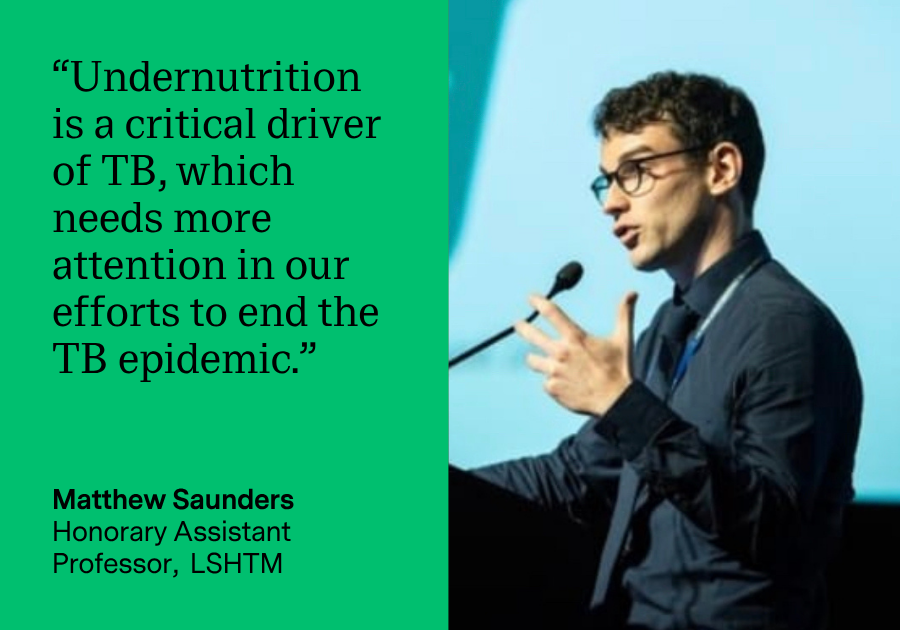
Matthew Saunders, Honorary Assistant Professor at LSHTM, said: “Our study demonstrates the critical importance that undernutrition has in driving the TB epidemic, and how addressing this determinant could represent a significant course change in our efforts to end TB.”
These results show the importance of factors beyond immediate diagnosis and treatment for TB and strengthen the case for supporting nutrition programmes at national levels. Importantly, these programmes would tackle both TB and provide broader health and socioeconomic benefits through addressing a fundamental human right and need.
Further research is needed to understand the best strategies for each nation to tackle undernutrition, considering their specific contexts. Examples of potential programmes range from providing people with direct food assistance, to broader programmes including cash to buy food, government subsidies for healthier food, and universal health coverage initiatives supporting nutritious diets.
These insights come at an important time in public health. Funding cuts to food programmes and other global crises, including inflation of food prices and climate change, threaten to increase both undernutrition and the burden of TB globally.
This study was conducted by researchers based at the London School of Hygiene & Tropical Medicine, City St George's University of London, the University of Sheffield, Imperial College London, and Boston University.
Read the full paper: Saunders M, McQuaid F, Sinha P et al. Global, regional, and national estimates of tuberculosis incidence averted by eliminating undernutrition in adults: a modelling study. Lancet Global Health, 2026. DOI: https://doi.org/10.1016/S2214-109X(26)00065-3
If you enjoyed this article and would like to build a career in global health, we offer a range of MSc programmes covering health and data, infectious and tropical diseases, population health, and public health and policy.
Available on campus or online, including flexible study that works around your work and home life, be part of a global community at the UK's no.1 public health university.