New models developed by researchers at London School of Hygiene & Tropical Medicine, Boston University School of Public Health, and Harvard University estimate US$ 7.5 billion cost from increased levels of tuberculosis (TB) solely due to already implemented cuts from USAID.
In the worst-case scenario of future funding cuts to TB public health initiatives, they estimate the damage reaching nearly $80 billion by 2050. In this scenario, 40.5 million households would become burdened by ‘catastrophic costs’.
Such figures, published in PLOS Medicine, represent the cost that would be borne by the individuals and families who no longer receive treatment and care for TB cases, as cuts would threaten essential health services. Over 50% of this estimated cost would be absorbed by the poorest 20% of households within the 79 low- and middle-income countries (LMICs) modelled. This highlights the importance of programmes supporting the poorest households and the significant inequities that funding cuts could create.
TB programmes in LMICs have been partly supported by international funding for global health programmes, which help prevent infections and give people easier access to TB treatment. These programmes currently face threats from funding cuts to global health projects, including existing losses from the de facto dissolution of USAID as well as further potential cuts to organisations like the Global Fund.
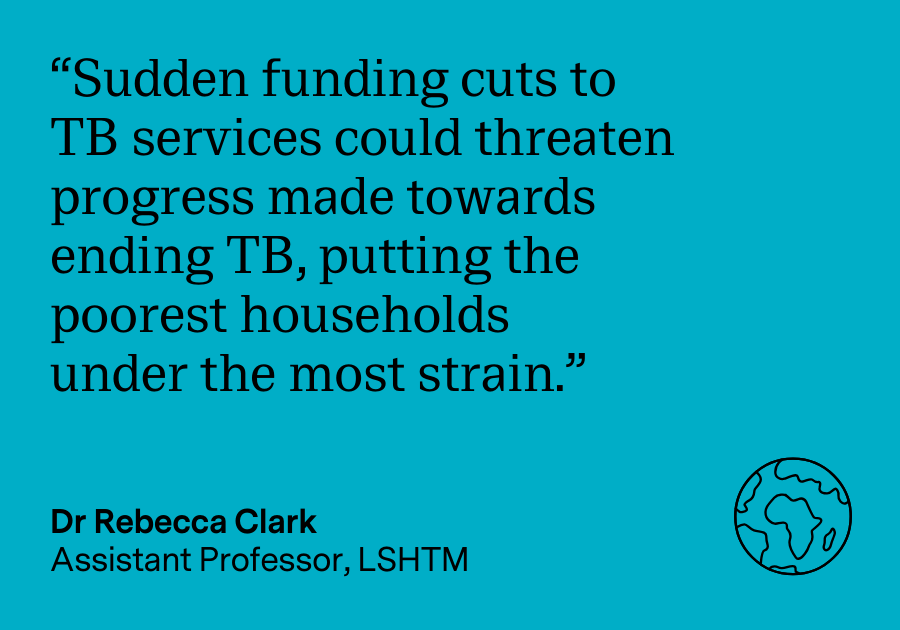
Rebecca Clark, Assistant Professor at LSHTM, said: “Our findings show the damage that could be caused by sudden cuts to funding for TB programmes from international donors. This could reverse much of the progress made by public health efforts against TB, with the increased hardships of costs and health disproportionately affecting the poorest households.
“We hope that our work can play a small part in guiding policy debates about the future of these programmes. Donors should support a phased transition while low- and middle-income countries decide how TB programmes can best suit their needs.”
The authors used models of disease pattern and economies from 79 LMICs to create several future scenarios of funding cuts from international donors. Scenarios ranged from maintaining funding at 2024 levels i.e. before USAID termination, to various levels of funding cuts from key organisations, and finally a complete loss of funding from international sources.
From these scenarios, models predicted their impact on each country’s TB services, and the costs this would create for individuals with TB. Costs included the direct expenses incurred to pay for healthcare, additional non-medical costs such as transportation to health facilities, and potential losses in jobs and income from illness.
Limitations
The authors note that there are questions and uncertainties around how to estimate costs. This includes calculating the cost from not treating TB patients, and modelling potential changes to patient costs and the price of TB treatments over time.
Read the full paper: Portnoy A, Clark R, Jit M, et al. The potential impact of reduced international donor funding on the household economic burden of tuberculosis in low- and middle-income countries: A modeling study. PLOS Medicine, 2026. DOI: https://doi.org/10.1371/journal.pmed.1004946
If you enjoyed this article and would like to build a career in global health, we offer a range of MSc programmes covering health and data, infectious and tropical diseases, population health, and public health and policy.
Available on campus or online, including flexible study that works around your work and home life, be part of a global community at the UK's no.1 public health university.