
An international collaboration involving researchers from the London School of Hygiene & Tropical Medicine (LSHTM), China and India is advancing new approaches to combat Campylobacter jejuni—one of the leading bacterial causes of gastroenteritis worldwide and a growing contributor to antimicrobial resistance (AMR).
The collaboration is led by the Enterics Research Team, an international network of scientists working across microbiology, immunology, microbiome science and vaccine development to tackle enteric infections. By combining fundamental discovery research with practical interventions, the team is helping to generate new approaches that can improve public health. As Campylobacter circulates between animals, food production systems and humans, the research also supports a One Health approach to tackling infectious diseases.
Recent studies from the collaboration span bacterial pathogenesis, vaccine development, microbiome research and food-system interventions.
In a study published in Science Advances, researchers uncovered a previously unknown mechanism that allows C. jejuni to evade LL-37, an antimicrobial peptide that forms part of the body's first line of immune defence. The team found that the bacterium produces a protease called HtrA, which degrades LL-37 and helps the pathogen survive in the intestinal environment. They also identified a modified version of LL-37 that resists bacterial degradation, offering a promising foundation for future antimicrobial therapies. LSHTM researchers contributed molecular microbiology expertise and phenotypic analyses that helped reveal how the bacterium responds to immune pressure.
Alongside these fundamental discoveries, complementary studies published in Vaccine and Microbiome explored practical ways to reduce Campylobacter colonisation in poultry, a major source of human infection. The studies showed that novel mucosal vaccine platforms can reduce bacterial colonisation in chickens while promoting beneficial immune and microbiome responses in the gut. LSHTM researchers contributed microbiome and omics-based analyses to understand how these interventions affect the wider gut ecosystem. Reducing Campylobacter in poultry could help lower foodborne transmission to humans while supporting wider One Health strategies and efforts to reduce AMR.
The programme has been supported by funding from the Royal Society and the Biotechnology and Biological Sciences Research Council (BBSRC), highlighting the importance of sustained investment in both discovery science and translational research.
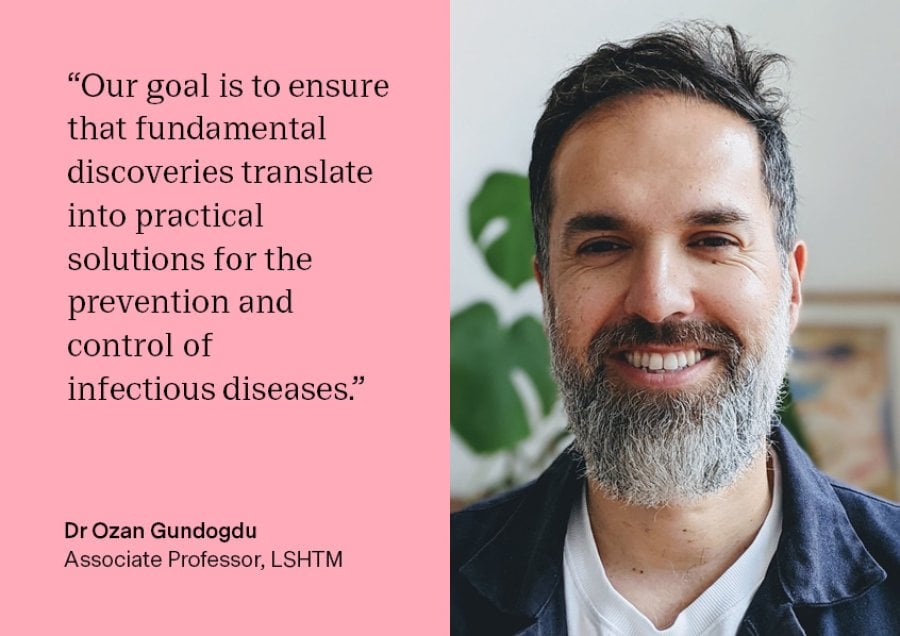
Associate Professor at LSHTM Dr Ozan Gundogdu said: “Addressing enteric diseases requires us to connect fundamental biology with real-world interventions. By understanding how pathogens survive and persist, we can develop targeted strategies that reduce transmission through food systems and ultimately improve public health. Our goal is to ensure that fundamental discoveries translate into practical solutions for the prevention and control of infectious diseases.”
As these collaborations continue to grow, the next phase of research will focus on translating mechanistic insights into implementable intervention strategies, helping to reduce the global burden of enteric infections and AMR across both human and animal health settings.
Publications
Li et al. Serine protease HtrA promotes Campylobacter jejuni intestinal colonization through degrading antimicrobial peptide LL-37. Science Advance (2026). DOI: 10.1126/sciadv.aee1996
Khan A et al. Polymyxin B-treated outer membrane vesicles of Campylobacter jejuni as prospective mucosal vaccine candidates in chickens. Vaccine (2026). DOI: https://doi.org/10.1016/j.vaccine.2026.128458
Biswas P et al. Recombinant LAB vector-based multicomponent vaccine against Campylobacter jejuni potentially promoting a healthier microbial balance in the poultry gut. Microbiome (2026). DOI: https://doi.org/10.1186/s40168-026-02421-w
If you enjoyed this article and would like to build a career in global health, we offer a range of MSc programmes covering health and data, infectious and tropical diseases, population health, and public health and policy.
Available on campus or online, including flexible study that works around your work and home life, be part of a global community at the UK's no.1 public health university.