
The new WHO Global AMR and Use Surveillance System (GLASS) 2025 report marks a major step forward in both scale and sophistication. By the end of 2024, 127 countries and three territories will have joined GLASS-AMR, with 104 providing AMR data in 2023, and 110 providing over 23 million laboratory-confirmed infections between 2016 and 2023. This is a fourfold increase in countries reporting from 2016 and shows the growing momentum behind this WHO initiative. This expansion enables the WHO to produce more representative and comparable global, regional and country-level estimates of AMR prevalence, using Bayesian statistical models that account for country-level demographic structure and somewhat capture surveillance-related biases arising from differences in testing practices and surveillance coverage. Excitingly, the models now take into account that resistance prevalence is likely to vary by both age and sex (linked to my own work in this area [1]).
Dr Esther Van Kleef, a researcher at the University of Oxford who worked extensively on the report as a consultant to WHO, notes that in her view, the “now featured country-level insights, in addition to regional analyses, represent an important step toward improving the usability of GLASS data for national and subnational decision-making. By applying advanced analytical approaches, the resulting estimates are also more comparable across countries and regions, strengthening the interpretability and policy relevance of the findings.”
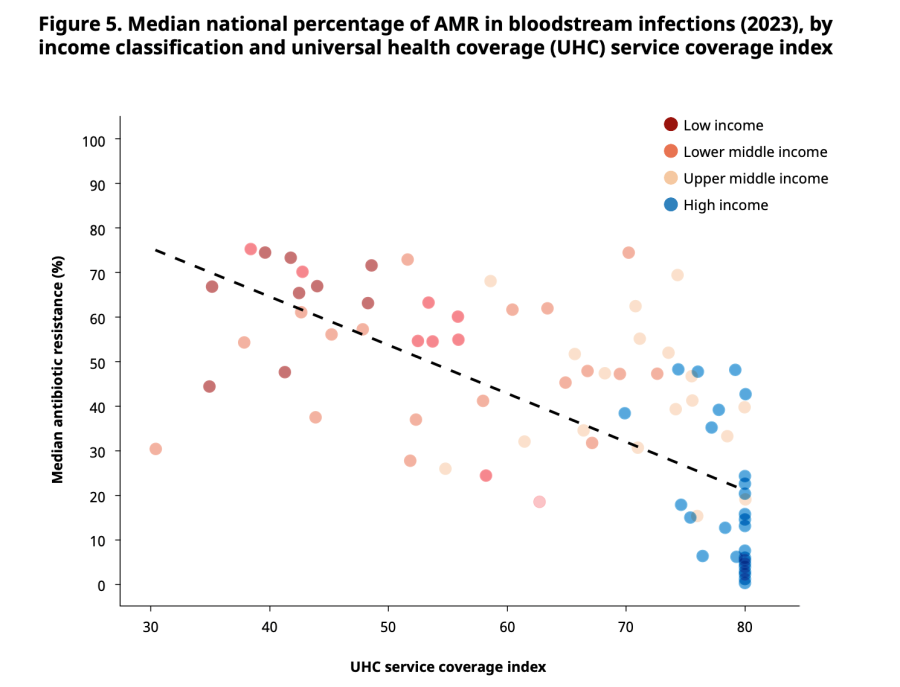
Despite these gains, the report highlights the continuing variation in AMR data, and as stated by van Kleef, “equally important, the analyses draw attention to critical surveillance data gaps, underscoring where further investment is needed to strengthen global AMR monitoring, including improved infection origin data to help distinguish trends between community and healthcare settings”. The overall global score for national data completeness – which includes, among other indicators, completeness of epidemiological, demographic and clinical information, in addition to completeness of GLASS infection types reported on, was only 53.8%, with large areas of sub-Saharan Africa, Central Asia and Latin America still contributing little or no data. Countries with the weakest surveillance and lowest universal health coverage often report the highest apparent levels of resistance (See Figure 5 and Figure A1.1 from the report below). This points directly at the elephant in the AMR data room – can we trust these patterns when we know that routine surveillance of infection is highly biased towards those that are failing empiric treatment?
If this reflects a true biological pattern or a data artefact really matters, the measured burden appears to fall heaviest on low- and middle-income countries, with a message in the report that in these settings resistance is “critically high”. But when, for example, as the report references, fewer than 0.3% of clinical laboratories across sub-Saharan Africa are set up to perform both bacteriological testing with automated antimicrobial susceptibility testing [2], do we really know the burden? Supporting this with a systematic review, the report finds some additional data from these settings, but with even higher resistance levels and the same data biases. What is great to see in this report is that the models have attempted to account for this bias by including surveillance coverage (the number of isolates reported relative to the national population) as a model covariate. Using the estimated association between surveillance coverage and AMR prevalence, the models predict how resistance levels might change under a higher surveillance coverage scenario. We just have to be careful as an AMR community to ensure that we interpret these numbers given what we know about surveillance. Throughout, the report is careful to discuss this and to push for a focus on improving access and use of Access, first-line antibiotics.
Beyond data completeness, it’s the trends in the modelled analysis that are most revealing. If resistance is still rising over time, this is particularly concerning, because improvements in surveillance and broader testing should have expanded the denominator and reduced bias toward severe or resistant cases. An upward trend despite those improvements therefore suggests a potentially genuine increase in resistance, not just better detection, unless there is a particular bias and concern over a resistance clone. Here is where the resistance trends in gram-negative pathogens stand out [3]. Klebsiella pneumoniae resistant to imipenem increased globally by bout 15% per year between 2018 and 2023 – rising fastest in the African Region. Such trajectories signal shrinking treatment options for bloodstream infections, even when accounting for demographic and surveillance biases.
Looking ahead, WHO identifies four priorities: expanding GLASS participation and data completeness, strengthening national lab and surveillance capacity, targeting Gram-negative resistance while promoting use of Access-category antibiotics and tailoring interventions rather than applying one-size-fits-all policies. The next steps are for the publication of a scientific report which will hopefully include releasing some of the underlying model results and providing greater transparency on the biases influencing resistance estimates—particularly those related to age, sex, and surveillance coverage. While some of this is addressed through age-standardisation, much remains to be explored about how AMR truly varies across demographic groups as well as across infection origin, and it is encouraging to see this growing demographic focus in WHO’s analysis. The 2025 report therefore offers the most rigorous global picture of AMR to date—and a timely reminder that better, fairer data remain our most potent weapon against resistance.
References
[1] Waterlow NR, Cooper BS, Robotham JV, Knight GM. Antimicrobial resistance prevalence in bloodstream infection in 29 European countries by age and sex: An observational study. PLoS Med. 2024
[2] Ondoa P, Kapoor G, Alimi Y, Shumba E, Osena G, Maina M et al. Bacteriology testing and antimicrobial resistance detection capacity of national tiered laboratory networks in sub-Saharan Africa: an analysis from 14 countries. Lancet Microbe. 2025
[3]Expert comment: WHO report shows rising antibiotic resistance in common bacteria
If you enjoyed this article and would like to build a career in global health, we offer a range of MSc programmes covering health and data, infectious and tropical diseases, population health, and public health and policy.
Available on campus or online, including flexible study that works around your work and home life, be part of a global community at the UK's no.1 public health university.